RSS Feed
 Facebook
 Twitter
THE BLOG AT THE CROSSROADS
Article: Joe Sacco - From Witness To Historian
Posted: December 18, 2011

Sixteen years separate the initial publication in comic book form of Palestine, started in 1993 at Fantagraphics Books, and the new graphic novel published in 2009, Footnotes In Gaza, the two graphic novels by Joe Sacco about Palestine. With the first book, Sacco, a young journalism student, combined for the first time in comics his own subjectivity with autobiographical ‘gonzo’ journalism, in the style of Hunter S. Thompson. For his return to the Gaza Strip, we see a more sobre, accurate and rigorous Sacco, driven by a real historian’s approach to investigate two massacres committed by the Israeli army in 1956 and consigned to oblivion. Based on this observation, I propose to compare these two important works by insisting on the one hand on examining the narrative techniques and stylistic choices, and above all, on the other hand, the personal motivations that led Sacco to carry out these changes from one work to another. Read the full article here…

Kevin O’Neill in Brussels & Paris
Posted: December 17, 2011

I am just back in London Saturday night after joining Kevin O’Neill for the private views of his first major selling exhibitions of his original artworks from League of Extraordinary Gentlemen, first in Brussels on Thursday 15th at Galerie Champaka, and last night, Friday 16th, at Galerie 9eme Art in Paris. Click here for some photos of Kevin, the centre of attention of course at the opening in Brussels, and here is one I took in Paris, a highlight when Kevin finally met the brilliant Argentinian-born comic artist José Munoz. The two of them got on really well, laughing about how José, initially an assistant at the Solano Lopez Studio in Buenos Aires, would try to sneak in forbidden artist credits into the thirty pages of comic art which were being supplied each week to IPC by Lopez’s studio - by hiding them in shrubbery or stonework - and how Kevin, who started at IPC aged 16, was given his first job of scouring these pages and white-ing out these offending hidden signatures! Both selling exhibitions continue till the end of this year and will carry on after on line via both galleries’ websites. Response was extremely positive, as proved by the estimate of about 60,000 euros of artwork already sold on the two first nights alone.
Michel Faber reviews 1001 Comics in The Guardian
Posted: December 13, 2011
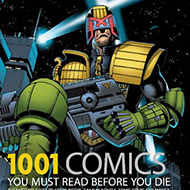
Last Saturday I was thrilled to find this intelligent, well-considered and overall positive review of 1001 Comics You Must Read Before You Die in The Guardian by Michel Faber. It’s stimulated plenty of debate, as intended. And for the record, the Judge Dredd cover, which unfortunately went uncredited, is not drawn by Brian Bolland but by Dylan Teague. Here’s what Faber wrote:
Paul Gravett’s 2005 compendium Graphic Novels: Stories To Change Your Life set a standard not just for excellence but also for immodest titles. At first glance, 1001 Comics You Must Read Before You Die seems to crank up the cockiness even further. However, this book is just part of Cassell’s trademarked series of guides to paintings, movies, buildings, historic sites and other cultural highlights you must sample before your demise. Gravett’s role is that of editor, collating articles written by 65 contributors from all over the world. The medium’s ongoing struggle for respect is underlined by the fact that, despite this international community of lecturers, museum curators and historians, the cover blurb still feels the need to tell you that “comics are emphatically no longer just for kids”.
Terry Gilliam, accorded equal billing with Gravett, seems to have been roped in mainly for his celebrity value, as his two-page foreword amounts to nothing more than a few amiable anecdotes. One of these, about the illicit ‘Adventures of Flesh Garden’ [in the early comic-book version of MAD] that alerted his parents to “the sex-mad beast that was being spawned in their son’s rapidly changing body”, bolsters the clichéd view of comics as the fantasy fuel of adolescent boys and undermines what the next 953 pages seek to prove: that comics address a marvellously broad range of experience and can appeal to anyone. The choice of cover illustration - Judge Dredd toting a massive gun - typecasts the demographic still further.
A pity, because this book is more inclusive, more useful and less culturally blinkered than other 1001 Before You Die efforts. It belongs in the home of anyone who is serious about investigating this boundlessly fertile art form. And there are many readers who have yet to begin that investigation, despite comics’ long history. (One of the earliest items in this chronological exploration was produced by Gustave Doré in 1854.)
The word “comics” in the title has a necessarily elastic scope. Sometimes it means standalone graphic novels, sometimes individual issues of a comic series, sometimes notable storylines within a series, and sometimes entire runs, such as the 102 issues of Fantastic Four produced by Stan Lee and Jack Kirby. All titles are given in English, although not all are available as such (Tomaz Lavric’s Bosanske Basni is listed as Bosnian Fables, but the nearest Lavric’s book has got to our island is the French edition). Indeed, the imperviousness of British and American tastes to some continental institutions is remarkable: Gaston, the Belgian slacker whose exploits have charmed Europe for half a century, was once trialled for a few pages in a 1990s American anthology as “Gomer Goof” and then abandoned. In the world of comics, as in literature generally, there is no assumption that what interests a million Europeans should automatically be offered in English.
Manga and bandes dessinées are heavily represented but there are welcome contributions from Sweden, Germany, Norway, China and a host of exotic elsewheres. I enjoyed the unintentional humour in Hemant Sareen’s dispatch from New Delhi: “India’s first graphic novel, Orijit Sen’s The River of Stories, has remained a hallowed presence on the Indian comics scene despite being out of print since it was published.” Gabriella Giandelli’s eerie meditation on the life of a building, Interiorae, and Gipi’s chronicle of moral erosion, Notes For a War Story, were unknown to me a week ago, but are now on my wish-list. A longtime favourite of mine, the Spanish satirist Miguelanxo Prado, gets his due, and what a delight to see Australia’s Michael Leunig finally receiving some recognition in this country.
While each selection is deemed a classic of its kind, no attempt is made to filter out the kids’ stuff from the erotica, the meditative memoir from the superhero slugfest, Palestine from Peanuts, Maus from Mickey Mouse. Sensible as this policy might be, it does mean that terms such as “powerful”, “complex”, “hilarious”, “profound”, etc, are even more relative than usual. It’s doubtful whether a reader who admired the disturbing ambiguities of Phoebe Gloeckner’s A Child’s Life would find the simplistic melodrama of a 1970s Iron Man storyline “challenging and provocative”, or whether a reader gobsmacked by The Arrival, Shaun Tan’s sepia evocation of immigrant experience, would find Spider-Man: Clone Saga “astounding”.
If this book is to function as a guide to essential purchases, each reader will need to ponder each entry with a dash of scepticism to avoid being disappointed. In this respect, Gravett’s Graphic Novels: Stories To Change Your Life was superior, in that it reproduced many entire pages of the comics, allowing you to evaluate the artwork and script for yourself. Most of the illustrations here are reproductions of covers, accompanied by précis that can occasionally be opaque (“the mushi are described as something close to the core of life”, observes a contributor from Japan).
Any encyclopaedic survey provokes criticism for what it omits, and 1001 Comics, despite its wrist-straining bulk, is no exception. Before you die, you’re urged to read no fewer than five Tintin books but none by Dave Geiser, Roberta Gregory or Dick Matena. There are several pornographic artists covered (by female scholar-enthusiasts) but Ignacio Noé, the best practitioner still alive, is overlooked. It’s regrettable, too, that Melinda Gebbie, whose 1980s undergrounds were more distinctive and better-drawn than many featured here, is noted only for her recent collaboration with her husband, Alan Moore. And so on. Each fan will have his or her gripes, but we should celebrate what’s included: the overwhelming majority of the art form’s greatest achievements, and plenty of its underappreciated gems.
Ah, but I know what you’re thinking, those of you who’d like to get to grips with this medium but are dutifully consuming Julian Barnes’ Booker-winning chef-d’oeuvre instead. How can you be seen reading a tome with Judge Dredd on the cover and Hellboy punching demons inside? Well, look at it this way: studying 1001 Comics You Must Read Before You Die is like visiting the world’s most fabulously well-stocked comics shop. This virtual emporium may be far superior to Forbidden Planet, but it can’t afford to ignore its regular customers. If superheroes, homicidal maniacs and feisty animals are not your thing, you’ll just have to tolerate them as you discover a wealth of other delights. Eventually, the realisation may even sneak up on you that a good superhero comic is better than a bad literary novel. Jack Kirby’s New Gods or Martin Amis’s The Pregnant Widow? Pow! No contest.
Interview: Shaun Tan
Posted: December 11, 2011

Fasten your wingnuts, you’re in for a bumpy ride. When you enter the weird and wondrous worlds of half-Chinese Australian artist Shaun Tan, there’s no telling where he will take you. From his background in picture books, not always solely for children, he has diversified into animation and graphic novels. In his first solo story, The Lost Thing, a man tries to help a bizarre creature he befriends on the beach to find his own kind. Tan won an Oscar for its sublime animated adaptation last year. The Arrival, his poetic, dream-like fable without words about an immigrant’s experience of his baffling new homeland, brought him to the attention of comics readers and has been showered with awards, from Australia’s best children’s book to 2008’s Essential prize at the Angoulême International Comics Festival in France. Tan was in London for an exhibition at the Illustration Cupboard and the launch of Templar Books’ beautiful new sketchbook, The Bird King, at Waterstone’s Piccadilly, where we met for this conversation. Read the full interview here…
Mattotti’s First London Exhibition at Trichrome
Posted: December 8, 2011
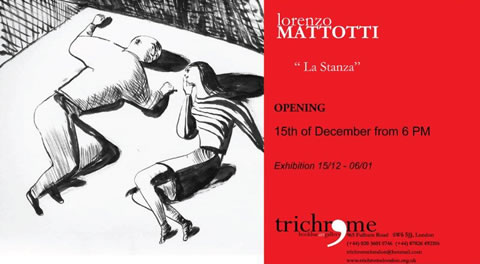
For me, the Italian artist Lorenzo Mattotti, a guest earlier this year at a Comica Conversation with Dave McKean, is simply one of the most mesmerising visionaries both in and beyond comics today, so I am thrilled that the new London branch of the Trichrome Art Gallery is staging his first selling exhibition in London next week. La Stanza centres around a man, a woman and a room and a story of love purely illustrated in all its moods. Not only can you see and buy Mattotti’s small but intense original ink works, but there are also copies available of the little volume of La Stanza published by Tricromia Rome.
Trichrome’s press release explains further: “In these images apparently there is no story. No prologue, no epilogue. There are though intimate fragments and part of those sensations that only a couple can experience. There are waiting moments, the approach, the touch, the thought, the reflection, the doubt, the excitement. The love, the kiss. Lorenzo Mattotti expresses in an unconventional way those feelings in which every lover, “someone who loves”, can recognize him/her self. Tenderness, anger, sympathy, passion and suffering to find yourself in those shy and slow bodies, where the two lovers look at each other, touch each other, grazing and then hugging, in a perpetual minuet.”
La Stanza is opening on December 15th from 6pm and all are welcome to the private view but please rsvp by emailing: trichromelondon[at]gmail.com The show and it runs till January 6th 2012 at their premises at 965 Fulham Road, London SW6, not far from Putney Bridge station. Be sure to pay it a visit and luxuriate in Mattott’s sensuous illustrations.
Britain is Guest Country at Strip Turnhout, Belgium
Posted: December 7, 2011

This weekend December 10th and 11th, the biggest and best biannual comics festival in Flanders, Strip Turnhout, celebrates the best of Flemish and international comics. And with generous support from The British Council, Tunhout has invited Great Britain to be their guest country this. As their liaison, I’ve been helping them reach creators and bring them over for events and exhibitions. The festival’s special British poster is of course illustrated from Tamara Drewe by Posy Simmonds, who will be taking part in the Sunday morning radio discussion show called ‘Overlezen’ or ‘About Reading. Other UK guests include Kevin O’Neill, Woodrow Phoenix and Paul Grist, joined by such international superstars as Edmond Baudoin and Charles Burns.
There will also be a live workshop over the whole weekend, in which Karrie Fransman, Daniel Merlin Goodbrey, Douglas Noble and Rachel Emily will be experimenting with making different forms of comics, from digital to sculptural, joined by the five latest London Print Studio comics interns. On the Saturday afternoon, 3-3.45pm, I’ll be hosting a panel discussion on international co-operation between comics festivals, with participants Rachid Alik from the Algiers festival FIBDA, the Flemish cartoonist Nix, best known for his Kinky & Cosy comedies translated now by NBM, the sublime Finnish comic artist Amanda Vähämäki, and former British Council liaison, now based in Istanbul, Canan Marasligil. With all this and a packed programme with sketch battles, live drawing on stage to music, an awards ceremony, exhibitions from Marc Sleen to Judith Vanistendael around the city, a lovely new comics mural by Ulf K., and much more, you can expect a massive turnout for Turnhout (sorry!).
Article: Previews for January 2012
Posted: December 4, 2011
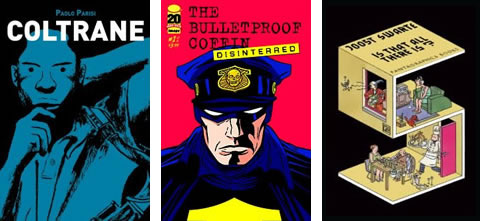
You know, I am extraordinarily lucky. Sometimes, I have to pinch myself. In many cases, I can get to read amazing comics months before their eventual publication. While scrolling on screen through an advance reader’s pdf may not be quite the same as those inky, tactile, papery, page-turning pleasures of the printed object, this does mean I can delight in treats that are still in store for you in the months ahead. I’ve found yet another embarrassment of riches for you here, all due out in January. 2012 already looks like being another banner year! Read the full article here…
ACME Conference: States of Independence
Posted: December 1, 2011
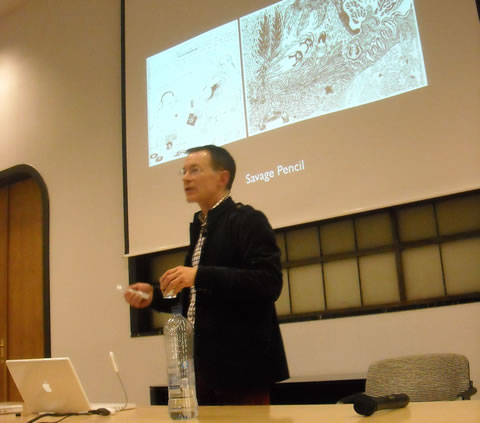
This photo of me by Charles Hatfield from the ACME Conference on Independent Comics Worldwide in Liège, Belgium. Here’s the cool poster:
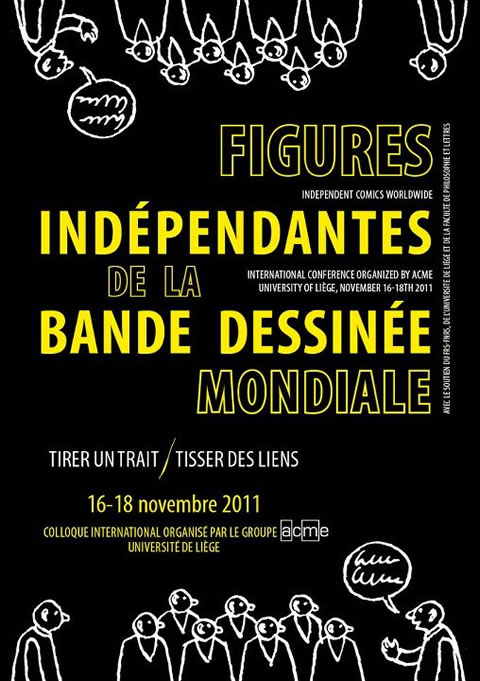
Others attending and presenting included Jimmy Beaulieu, Erwin Dejasse, Thierry Groensteen, Gert Meesters, Jean-Christophe Menu and Harry Morgan.
My paper on Thursday Nov 17th was called ‘States of Independence: The Shifting Landscape of British Independent Comics’:
The blurry term ‘independent’ covers a spectrum of business models, financing solutions and creative visions. How have they shaped the variant forms, formats and formulae of so-called ‘independent’ comics in Great Britain? What if anything constitutes an ‘independent’ comic, and when does one become no longer truly independent? This paper charts Britain’s ever-shifting publishing landscape, from photocopied zines to hardback graphic novels, by drawing on interviews and insights from participants and my personal participation. It will examine contrasting examples, from ArZak, Brainstorm, Near Myths and Viz in the 1970’s underground scene, through the Fast Fiction self-publishing explosion, pssst!, Escape, Warrior and Deadline, to Sturgeon White Moss, Nobrow, Blank Slate, Solipsistic Pop and Self-Made Hero and other 21st century innovators. As media have become more transnational, what aesthetic and commercial choices are being made and how much do these comics need to be specifically rooted in “Britishness”?
Kevin O’Neill’s Extraordinary Art Exhibitions
Posted: November 30, 2011
Kevin O’Neill is making nearly ninety pages of his stunning original artwork from the three most recently published books of The League of Extraordinary Gentlemen, which he co-creates with writer Alan Moore, available for the first time to comic art connoisseurs worldwide. On Thursday December 15th, he will be in Brussels at the elegant Galerie Champaka for the grand opening and private view of the first part of this very special selling exhibition.
Then the next day, on Friday December 16th, O’Neill will be appearing at Galerie 9eme Art in Paris where a smaller but equally stunning selection of pages will also be on offer. As exhibition consultant and media liaison, I am lucky enough to be traveling with Kevin on this mini-Euro-tour and doing a guided press ‘tour’ of Champaka’s two floors, so I’ll be posting some photos and updates.

The selection on sale includes choice pages from League of Extraordinary Gentlemen: The Black Dossier: the slipcased edition cover and front and back endpapers; the 16-page complete Fanny Hill portfolio; and two spreads from the 3D sequence.

From the first volume of the trilogy, League of Extraordinary Gentlemen: Century 1910: the front cover and thirty choice pages, several in sequence, plus the magnificent Nautilus spread.

And from the most recent second volume, League of Extraordinary Gentlemen: Century 1969: there is again the iconic front cover and thirty choice interior pages, including the climactic acid-trip double-page spread.
If you can’t make it over in person, you’ll be pleased to know that the whole range can also be viewed in scan form and purchased on the Champaka website, even after the exhibits themselves close on December 31st. And if you were wondering, the entirety of the first two League volumes were sold complete several years ago. There has never been an opportunity like this to acquire so many key pages from these Moore & O’Neill masterpieces.
Article: MetaMaus by Art Spiegelman
Posted: November 27, 2011

Twenty-five years after its first publication in book form, Art has compiled MetaMaus, the print equivalent of a movie’s most copious DVD extras, encompassing scripts, first drafts, deleted scenes, a ‘director’s commentary’, making-of and more behind-the-scenes materials. In fact, this 300-page hardback, as long as Maus itself, comes with its own hyperlinked DVD of voluminous “supplementary supplements”. The field of ‘Maus-ology’ studies is already considerable; apart from Hergé‘s finite Tintin albums, there may be no specific corpus in the medium other than the two volumes of Maus which has been so intensely investigated. Nevertheless, Art felt a need to reply definitively to three persistent questions: “Why the Holocaust?”, “Why Mice?”, and “Why Comics?” Read the full article here…