RSS Feed
 Facebook
 Twitter
Richard Corben:
Getting Over The Underground
The surprise comeback of Richard Corben over the past few years, drawing for DC and Marvel comic books of all places, has introduced his inimitable comic art to a whole new readership, many of whom were not even born when he started out on his career over thirty years ago. Now partnered with hot writer Brian Azzarello, Corben is enjoying some overdue reappraisal as one of America’s most individualistic sequential artists.
He’s always been a bit of a loner and a maverick, self-contained and deliberately keeping himself isolated from both the mainstream comics industry of New York and the hippy underground scene in San Francicso. A Missouri farmboy, he spent his middle-American childhood in Sunflower, population 800. Hooked on comic books, his tastes developed through a superhero stage to an addiction to the classy EC comics line, especially their horror short stories, brimming with macabre comedy. When the cleansing Comics Code wiped those out, Corben all but abandoned comics, apart from sketching a few of his own purely for fun.
Shy with girls, bookish and introverted, Corben was encouraged to pursue art by his parents and moved to Kansas City to study film-making. His talents for illustration and animation were soon recognised and after graduation and a stint in the army, he worked for some nine years for Calvin Studios as an animator on uninspiring industrial films.
And there he might have languished, twenty-something and unfulfilled, had he not rediscovered his enthusiasm for comics, rekindled by Jim Warren’s black and white magazines Creepy in 1964 and Eerie the following year. He bombarded them with submissions but got no response.
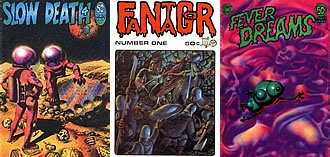
Undeterred, he tried other routes, discovering fandom and contributing strips and illos to well-produced fanzines. These and the then emerging underground comix, uncensored by the Code, prompted him to shell out for his own black and white comic as a portfolio of his greytone and airbrush effects. Fantagor in 1970 presented three of his darkly ironic science fiction tales, inspired by EC but with more explicit sex and violence and with a grasp of purely visual storytelling from his years of storyboarding. Reprinted and properly distributed by underground publishers Last Gasp, Fantagor put Corben on the comix map.
Paying appearances in the EC-style comix Skull, Slow Death, Fever Dreams and others swiftly followed and, overoptimistic, Corben quit his day job to cartoon fulltime. The underground boom of the early Seventies was soon heading for a bust. Luckily from 1971 Corben had started receiving scripts for Creepy and Eerie, where he would craft some of his strongest work in colour.
In these days of Alex Ross and company, everyone is used to fully painted colour in comics, but it was virtually unknown at that time in America (apart perhaps from Harvey Kurtzman’s Little Annie Fanny in Playboy). Unable to afford mechanical colour separations, Corben devised a unique but labour-intensive method to simulate full colour artwork by building up the colours himself on four acetate overlays, resulting in an uncanny, almost photographic immediacy. He would also sculpt clay models of his characters to help visualise lighting effects or even to photograph for ‘fumetti’ experiments. In the new colour inserts in Warren’s magazines, illuminating twisted twist-enders and recurring series like Child, The Butcher and Mutant World, his electric spectrum grabbed you by the eyeballs.
Corben took some five years, on and off, to write and draw his landmark 98-page graphic novel, Neverwhere in 1978, serialised in France’s Metal Hurlant and later its American offshoot Heavy Metal. It sprung from a half-hour 16mm movie, part hand-drawn animation, part live action, which he had made with help and finance from his former employers at Calvin. The lead in both the film and the comic sequel is a mild-mannered electrical engineer, zapped by a circuit he has mysteriously constructed to the untamed dimension of Neverwhere. Here he is transformed into its pumped-up champion Den, absurdly muscled and endowed, hairless and naked, the unlikely hero sent to rescue tempting but devious buxom beauties from savage beasts and scheming rulers. Corben’s plotting may be erratic and prone to charges of sexism and cliché, but his total conviction and self-absorption in imagining this sensual dreamscape captivate and transport us there.

To his fantasy, science fiction and horror comics from the Eighties and Nineties, illustrating the stories of Edgar Allan Poe, Harlan Ellison, Bruce Jones, Jan Strnad and others, Corben brings an unsettling mixture of caricatured, often satirical grotesquerie and intense, convincing realism. Never before had such wildly cartoonish worlds proved so tangibly convincing.
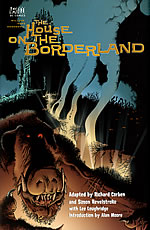
Corben’s resurgence began in 2000 at DC with a Batman one-off, and Vertigo genre shorts scripted by long-time collaborator Simon Revelstroke. These led to their riveting 85-page adaptation of The House On The Borderland, the chilling 1908 classic by William Hope Hodgson. Next came the five-part Hellblazer arc Hard Time, in which writer Azzarello, new to the character, put the cynical Constantine through the wringer in what must be the bleakest and funniest prison sentence on record. These DC projects heralded a shift in Corben’s technique back to pen-and-ink black line, heightened with precision stippling and cross-hatching, which could then be finished by skilled computer colourists.
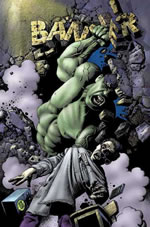
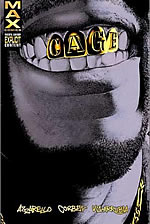
Which brings us to Corben’s mini-series for Marvel, both by Azzarello, now in book form. If any artist was born to draw green muscleman The Hulk, it is surely Corben and Banner is a minor but enjoyable variation on the monster-hero. Cage, on the other hand, is the business, a fearsome modernisation of Seventies blaxploitation star Luke Cage, still a ‘hero-for-hire’, but now a moody brother on the streets, looking cool in his red reflective shades, as he gets caught in the crossfire of a three-way turf war. José Villarubia provides the richest textured colouring yet to Corben’s linework, a perfect combo. Mr Corben, it’s good to have you back.

The original version of this article appeared in 2003 in the pages of Comics International, the UK’s leading magazine about comics.