RSS Feed
 Facebook
 Twitter
Mike Mignola:
To Hellboy & Back Again
Maybe his obsession with all things monstrous really started with the book Pilgrim’s Progress. It’s a fantastical vision of the perils and rewards of the religious life told through a man called Christian and his allegorical journey through humanity and hell to reach heaven. The fervent English preacher John Bunyan wrote his tract during six months’ imprisonment for his religious views in 1673. It became the most widely published and read book after the Bible.
Centuries later, it was still in print. A copy waited in an Oakland, California elementary school for a young American boy to discover in the mid-Sixties. He found the antiquated text too difficult to read, but the richly detailed illustrations burned themselves into his impressionable brain.
Instead of inspiring a religious conversion, however, what transfixed this youngster about the book’s plates were the vivid glimpses they gave him into other unimagined worlds, especially one showing a knight in armour embroiled with a giant serpent. From that first childhood taste, Mike Mignola acquired an appetite for myths and monsters.
When he was only seven, his mother died. This real-life horror could have been traumatic for him, but instead it seems to have brought him even closer to his two younger brothers. Quiet, creative kids, they helped take care of each other and escaped by sharing their Marvel comic books and horror and fantasy fiction.
A passionate student of illustration, Mignola (a Swiss-Italian name pronounced Min-YO-la) broke into Marvel Comics from fanzines at the age of 19 initially as an inker. Never interested in superheroes but fitting into their house style, he bounced from pencilling one series to the next until 1987, when First Comics offered him Michael Moorcock’s Chronicles Of Corum. Mignola leapt at the chance to illustrate one of his favourite author’s heroes. Sword-and-sorcery was a genre he returned to later to adapt Fritz Leiber’s Fafhrd & The Gray Mouser for Epic and DC.
The first of two liberating growth spurts came on DC’s Cosmic Odyssey in 1988. For this Mignola immersed himself in Jack Kirby’s artwork, which helped him understand Kirby’s exaggerated, unrealistic anatomy and the almost carved solidity beneath the surface details and apply them to his drawing. The second change was the advice that he add more shadows to strengthen his figures’ presence and enhance the mood. The sheer quantity of luscious, thick black ink inundating his pages was a revelation, especially on 1989 Batman Elseworlds story Gotham By Gaslight set in the London streets of Jack the Ripper.
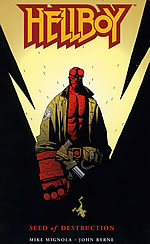
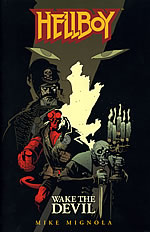
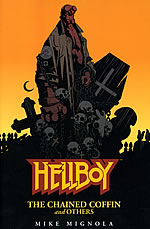
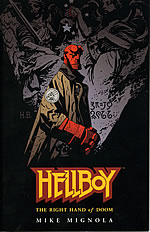
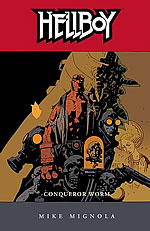
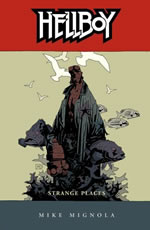
Mignola was increasingly hankering to create a character that suited him and to put him into stories of his own. He had a wacky name scribbled in a sketchbook. That name, and Mignola’s reputation, were enough for Dark Horse to give him carte blanche to unleash his own comic in 1994. Relatively new to writing, Mignola kept his hero’s origins unknown, always handy when you’re not totally sure yourself. All we learnt is that he first appeared on Earth on December 23rd, 1944, appropriately the Eve of Christmas Eve, in a huge fireball in an old church in East Bromwich. A bright red child with cloven hooves, sawn-off horns, forked tail and a huge right hand made of stone, he could only be called Hellboy.

Mignola’s learning curve as a writer and artist took off from his very first book, Seed of Destruction. Here he had some scripting help from veteran John Byrne, but he was soon editing and re-writing his texts to make them less slick, more deliberately terse, even awkward. He was finding his voice. All the old tales he loved from world folklore swept into his plots, as he sourced them back to their roots, before rules and familiarity wrapped themselves around those ancient legends like tentacles choking a helpless victim.
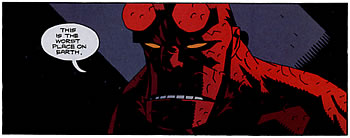
Mignola’s choreography of colour and blacks in varied panel groupings creates an almost stained-glass effect out of his pages. In his shades of red, Hellboy grabs the eye like a car crash or autopsy, the only other red on the pages being blood. Kirby is the enduring influence, of course: Hellboy has The Thing’s right hand, he looks related to Kirby’s Demon and his Atlas monsters, with the horns of Surtur out of Thor. But visually, Mignola also looks beyond comics, to a Goya engraving, a Dürer woodcut, letting the art of the past seep into comics.

At first, Hellboy was in denial about his past - after all he knew ‘It’s not going to be good’. Mignola too wanted to keep the concept simple and accessible - a big, cool-looking red demon guy battling monsters. Raised on an army base in New Mexico and granted honorary human status by the United Nations in 1952, Hellboy joined the Bureau for Paranormal Research and Defense to defend us from evil. In subsequent stories Mignola has revealed more of the awful truth, and added a dimension and sympathy through Hellboy‘s rejection of his mission to wipe out mankind, a rebellion symbolised by his breaking off his horns.
Determined above all not to take himself too seriously, Mignola injected a dry sense of humour that has kept the series fresh and surprising. The very fact that this hulking, stubbled creature is still called Hellboy as an adult is quite deliberate. The gruff, seemingly cynical Hellboy punctures any pretension and acts as a mechanism to stop Mignola getting too grim or pompous. Mignola can lighten the tone brilliantly, for example, in a two-page flashback which shows that Hell lost its grip on Hellboy from the very moment he had his first taste, at the age of two, of pancakes.
Hellboy has been spun off into prose novels, the comedy satire Hellboy Junior, a Weird Tales anthology for other creators to try their and, a B.P.R.D. series, merchandise galore and now a Hollywood movie. In some ways, from being his playground, Hellboy seems to have become something of a burden to Mignola as he elaborated his history. So as a complete break, in 2002 he fabricated the deliriously loopy Amazing Screw-On Head. This clunky robot secret agent screws his head onto all manner of metal bodies. Teamed with the equally warped Mr Groin, he is in the service of none other than President Lincoln. These bizarre unsung heroes prove that perhaps Mignola’s greatest flair is actually for all-out absurd humour - funny ha-ha as much as funny peculiar.
Mignola enjoys the freedom to let his story wander off down unexpected corridors, so he can surprise himself as much as his readers. Shadows have never seemed so inviting.
The original version of this article appeared in 2004 in the pages of Comics International, the UK’s leading magazine about comics.