RSS Feed
 Facebook
 Twitter

Jayme Cortez 100: Brazil’s Horror Comics Maestro:
A Centenary Commentary

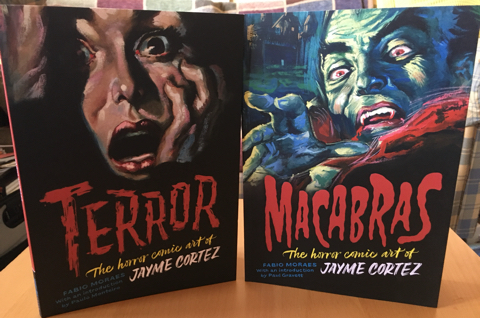
Today, September 8th 2026, is the Centenary of Jayme Cortez and to mark this I’m sharing the Foreword I wrote about the exceptional horror comics covers he created in Brazil. I helped instigate and fulfil the project to gather all of these graphic gems, with huge help from Cortez’s expert biographer, blogger and friend of the artist, Fabio Moraes. British publisher extraordinaire Korero Press published this in two handsome full-colour volumes, Terror and Macabras: The Horror Comic Art of Jayme Cortez. They are available here and I cannot recommend them to you highly enough.
JAYME CORTEZ: HORROR COMICS MAESTRO
The horror comic cover relies on grabbing your eye, tingling your spine and racing your heart, both to terrify and entice you into picking it up, daring you to open it, promising you still more shivers and shocks inside, and leaving you with no choice but to buy it. And when it comes to devising such seductive visuals, I am convinced that Jayme Cortez must be one of the horror comic book’s most outstanding cover artists in the world. And yet he’s quite possibly one you have never heard of before. Born in Portugal, Cortez pursued his career in Brazil, where he became much in demand, notably for his numerous covers for almost every genre going, from comedies to cowboys. And now that all of his extensive body of illustration in the horror field is compiled here at last, we can begin to grasp the sheer skill and scale of his achievement.
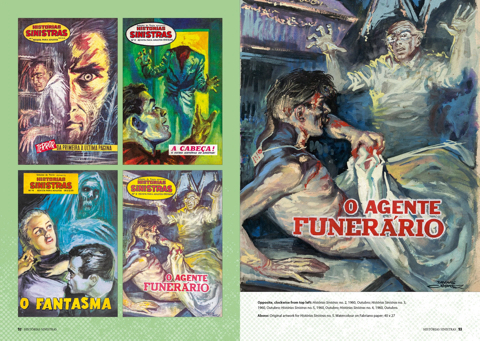
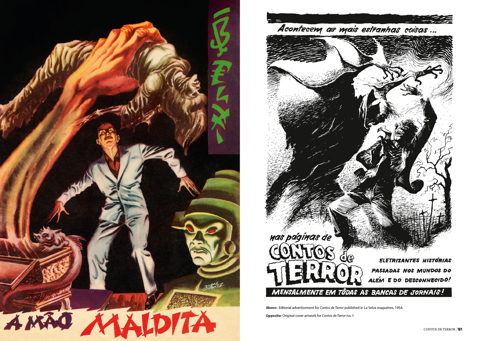
The genre of horror in comics has attracted some of the medium’s very greatest illustrators, from E.C.’s Johnny Craig, Jack Davis, and especially the ‘Ghastly’ Graham Ingels on Tales from the Crypt and others, to the painted covers by Frank Frazetta, Ken Kelly and a host of Spanish maestros on Warren’s Creepy, Eerie and Vampirella magazines, for example. Without a doubt, Jayme Cortez ranks alongside them in terms of quality but also quantity, because somehow he would produce one arresting cover after another, month after month, and in several styles and different media.
My personal epiphany to the brilliance of Cortez began when I was invited to the first Comics Bienal held in Rio de Janeiro in 1991. Among the superstar guests was Will Eisner and I was lucky enough to be present, up on a rooftop in a setting straight out of Eisner’s The Spirit, when he reminisced fondly with the multi-talented Alvaro di Moya. They both recalled how Cortez had helped produce a landmark exhibition of original comics art in São Paulo in 1951, and of course, the works by Cortez were put on display alongside those by such great American masters as Milton Caniff, Alex Raymond and Al Capp - and more than lived up to them. So how could I learn more about Cortez?
Luckily, at the Bienal I also met one of the most knowledgable and enthusiastic specialists in comics history, notably Brazilian, Carlos Baptista, known to everyone as ‘Patati’. He became my guide and my friend, and gave me a crash course in how Brazil sidestepped the moral panic and neutering self-censorship that drove American horror comic books almost out of existence, surviving only as pale shadows. Instead, their dark genius refused to be buried and amazingly lived on in Brazil, where this locally produced phenomenon blossomed and boomed. There were just a few older Brazilian comics on sale at the Biennale and the sight of my very first Cortez cover, for Historias Macabras No. 2, seared his image into my imagination permanently. I was struck by how his painterly skills conjure up not only the monstrous, utterly convincing physicality of the creature carrying off his victims, but also the fetid, mist-enshrouded setting, disappearing into the tangled vines and sickly yellow sky. These were comics ‘para adultos’, not infantilised by any restrictive code of content. With Patati’s help and his wisdom, I sought out more examples, and more information. In 2015, I also had the good fortune of talking further with Alvaro di Moya in Sao Paulo over dinner, reminiscing to me about his great friend and fellow comics professional.
Another generous expert is Skye Ott, whose family’s massive, multi-generational Komikazi collection of exceptional printed and original gems is worthy of a museum of its own. Skye shared images and information, which revealed to me even more of the full range and excellence of Cortez’s output, and importantly my first sight of his rare surviving artworks, all of which convinced me that an art-book compiling them was long overdue and essential. Sadly, we lost Patati and apparently his research into Brazilian comics history as well, but thankfully we found Cortez’s biographer and curator Fabio Moraes, who brings to this endeavour his deep knowledge and insights about the artist’s life, art and creative processes.
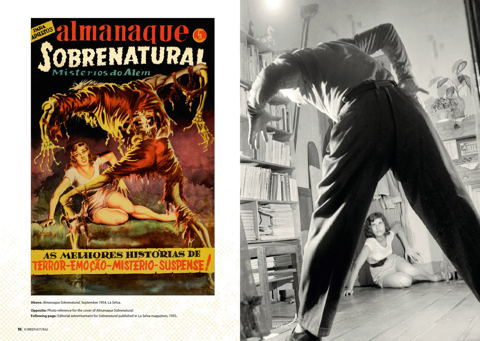
Striving for impact and believability, Cortez often posed and photographed live models for reference, to enact the scenes and strike the precise prescribed poses he wanted to capture - the incredulous, terrified facial expressions, the extenuated, tense hand gestures, their fingers seized, the body language of arched and twisted physiques. If you compare, you will notice that his staged shots were usually only a step in his composing and you can see how he injected so much more than what his actors gave him. He made many adjustments, major and minor, to accentuate the expressiveness and drama he was after. Always conscious of the sources of light in his images, he was a master of chiaroscuro, brilliantly handling the tenebrism of deepest black shadows and dazzling highlights. Frequently, he heightens the physicality of twisted, strained faces and anatomies, wracked by paroxysms of anguished trauma, which threaten to burst the bounds of the printed paper.
Rather than making a clean break between his several techniques, Cortez would retain and vary them, choosing whichever best suited his subject and intentions. So on certain covers, notably of terrified victims, he often opted for a luscious realism and exacting facial and physical precision, all the more to heighten the reader’s identification with these all-too-human victims, often staring at us wide-eyed with fear. Then he could also combine two painterly registers in the same illustration to create an extreme contrast between the vivid human frailty and the ethereal supernatural realm, sometimes approaching abstraction in their loose, expressive vigour. In some, diaphanous, gossamer fabrics barely conceal the bodies they encircle. Sometimes he even coloured and collaged his actual photographs into his painted locations and scenes of monsters. To my mind, covers such as O Terror Negro No. 61 and 62 and Sobrenatural No. 13 and 22 stand as amongst his most daring experiments. Cortez brings a similar Dalí-esque exactitude and credibility to plunge us into his own versions of psychological mindscapes, shimmering with symbolism.
So it’s time to enter and experience the nightmarish oeuvre of Jayme Cortez and give him the long-overdue acclaim he deserves as a truly versatile and visionary virtuoso of comics art.
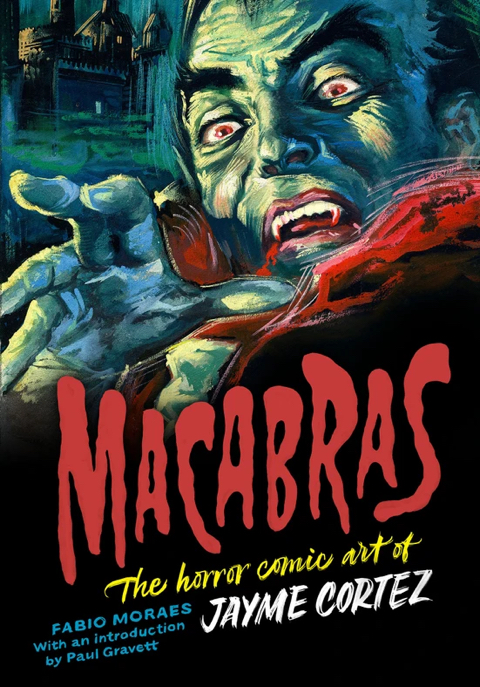
This was originally published as the Foreword to Macabras: The Horror Comic Art of Jayme Cortez by Fabio Moraes (Korero Press, UK, 2024)