RSS Feed
 Facebook
 Twitter
Hermann:
A Man of Characters
Hermann is the first name and pen-name of Hermann Huppen, one of Belgium’s greatest contemporary creators of realistic adventure comics across a wide range of genres. In the Sixties, his gutsy illustration helped to re-energise the weekly Tintin magazine, where he drew Michel Greg’s new serials about the seafaring action-man Bernard Prince and the feisty heiress to Ranch 666, known only as Comanche. Hermann then went solo and has not looked back, writing his own stories, most famously the post-apocalyptic epic Jeremiah and the medieval epic The Towers of Bois-Maury.
Now 78, Hermann is still in his prime and his career of over fifty years shows no signs of slowing down. As well as continuing to write and draw Jeremiah, he has taken to working in dazzling watercolours and creating a string of hugely diverse one-shot albums and short series, many written by Yves H., pen-name of his son. Hermann never flinches from portraying the ugliness of so-called humanity, but if he was a complete pessimist, he wouldn’t continue making his compelling comics.
In 2016, Hermann won the Grand Prix or Lifetime Achievement Award at the Angoulême International Comics Festival in France, and at the 2017 Festival he is being honoured with a major retrospective. Prizes and acclaim don’t mean as much to this vigorous veteran as working on more stories, his next being the trilogy Duke, a return to hard-hitting Westerns, again written by his son.
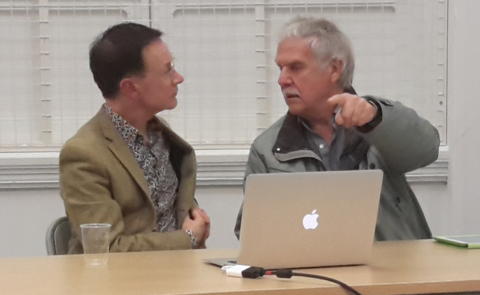
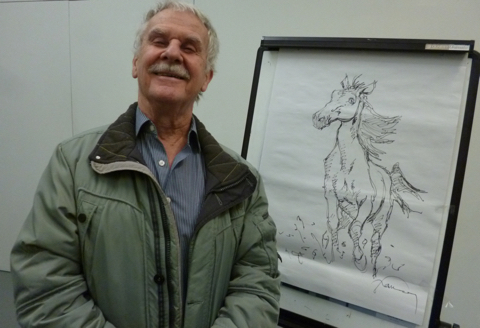
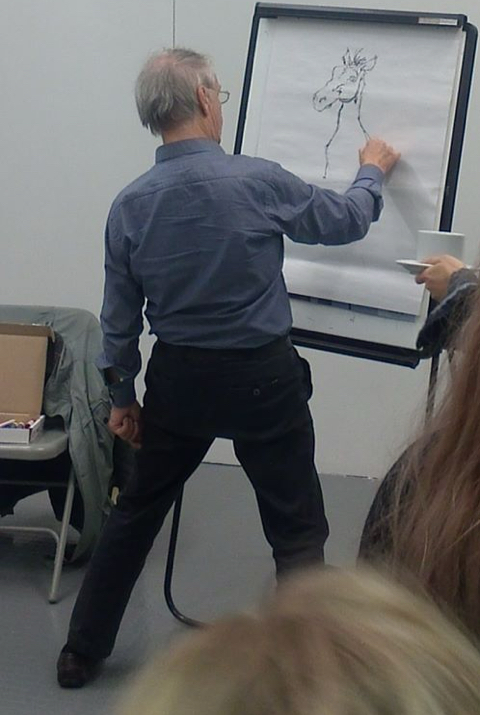
Outspoken and passionate about his medium and his messages, Hermann was interviewed by me as the special guest of the Comics Forum Conference on Genre, part of 2016’s Thought Bubble Sequential Art Festival in Leeds. On a flipchart during the break before, he drew a beautiful lightning sketch of a galloping horse (see above), which poured onto the page, his pen barely lifting off the paper.
Paul Gravett: What brought you into the comics field?
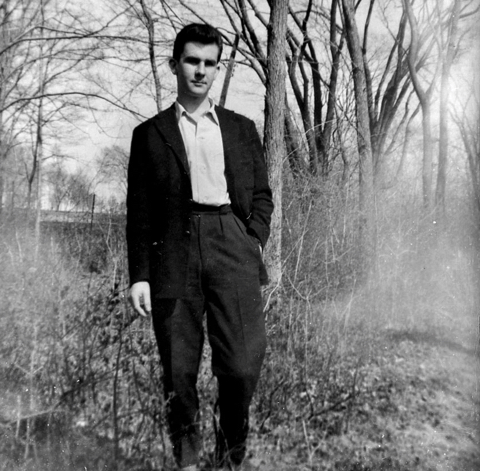
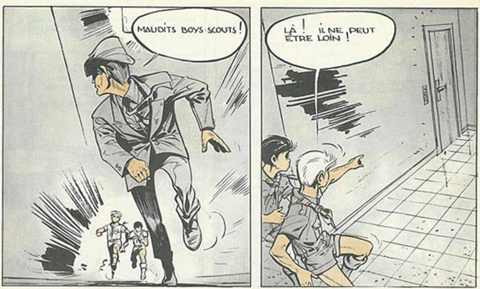
Hermann Huppen: I started by studying interior design. I worked for Expo 58 in Brussels, and I was employed as a cabinet maker for two weeks. Then I worked as an interior designer, until I met Philip Vandooren, the man who would become my brother-in-law and editor-in-chief of the Belgian weekly comic Spirou. Vandooren saw a little scribble of mine and he said ‘You’ve got a good hand, why don’t you try making comics?’ He got me my first commission in 1964, a short comic for Plein-Feu, a scouting magazine he was editing.
PG: Had you been in the scouts, like Hergé?
HH: I was a boy scout for only one year, because I got into a fight with them!
PG: Was Jijé (pseudonym of Joseph Gillain) one of your early influences?
HH: Yes, Jijé was crazy but a very nice guy. I was very impressed by his drawing, though he suffered from poor motivation. He didn’t like comics very much, he preferred to be a painter. But he had to make money, he had a big family and his paintings weren’t selling, so he kept drawing comics. Jijé had high moments sometimes but also very low. The beginning of his Western, Jerry Spring, was a highpoint with his powerful chiaroscuro brushwork.
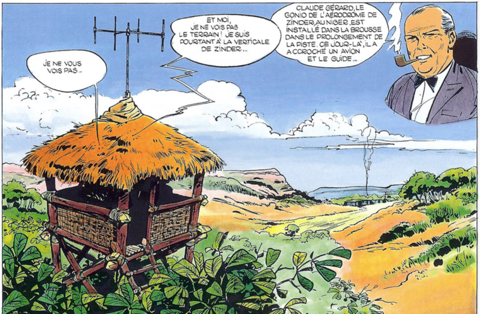
PG: You broke into Spirou with occasional short educational comics hosted by ‘Oncle Paul’.
HH: Yes, but they were only six pages at most to keep me busy. This wasn’t my goal. I wanted to work full-time in that field. So mornings I worked in the architect’s firm and in the afternoon I tried to make comics to show to publishers. My future scriptwriter Michel Greg saw these pieces and called me to join his studio, at least for a trial period. Greg was working as chief manager of a studio with different draughtsmen. I quit the architect’s office as soon as he asked me to join the club. Greg was a writer and cartoonist as well, so he understood the whole process. But he was a very bad teacher, he was humiliating. Whenever there was something wrong, he would tear up your artwork. I was all set to leave or punch him on the nose! Finally he cooled down and we worked together for eighteen years.
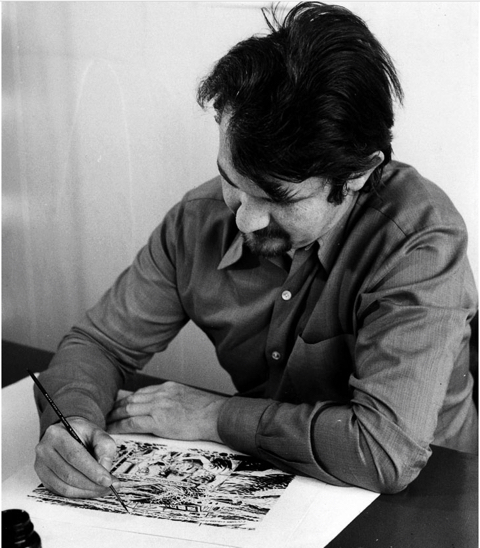
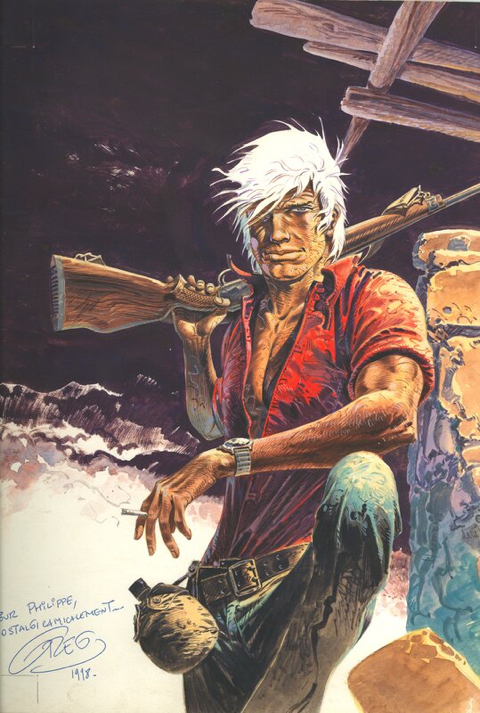
PG: Your partnership began in Spirou’s rival, Tintin in 1966 with Bernard Prince. Initially an Interpol agent appearing in complete episodes, he became an adventurer, after he inherited a boat and set sail around the globe with his two companions.
HH: Bernard Prince started as a clean-cut guy, brushing his teeth every day. That was what the period demanded, but Tintin needed to change, because starting in 1959 the French magazine Pilote had changed a lot in bande dessinée. They brought in some non-respect for the rules, like in the Western Lieutenant Blueberry by Charlier and Giraud. Bernard Prince became very popular as a serial, because Greg had a sense of humour, bringing in Prince’s rough-and-ready companion Barney Gordon. Like Tintin and Captain Haddock, if you have a very clean leading man, you need a wilder partner. In 2010, I made a new Bernard Prince album with my son, even better than Greg’s, but it’s not selling. It’s of its time.
PG: You also drew Tintin’s first serial of Jugurtha, based on the Ancient Libyan King’s uprising against the Roman Empire.
HH: I did Jugurtha because Greg didn’t have time to provide sufficient scripts to feed me. Jean-Luc Vernal’s script was really bad, he twisted history and made some very Leftist changes, turning these North Africans fighting against the Romans into some kind of Vietnamese fighting the Americans. Vernal described Jugurtha as if he was killing people by accident—there were a lot of accidents in his life!
PG: Whatever the setting or period, you always put a lot of the natural world into your comics.
HH: Yes, I grew up in the countryside in a small village, fifteen houses at most, surrounded by woods. To me, the woods are very important. I live in nature now. When I walk in the woods, I look at the trees, at the way they are made, that’s why some people say I am the closest to nature among Belgian comics draughtsmen. I live in Brussels but I’m not a real city guy. I like nature. And I have a house in the south of France, I spend two months every summer there, surrounded by sheep and cows. I have a swimming pool there, which a cow fell into recently. Fortunately, she was very sporty and managed to jump out!
PG: Greg became editor of Tintin in 1966 and Bernard Prince was part of his modernisation plans. How did Hergé react?
HH: Hergé was mostly in control but he was no dictator, he accepted these changes very fast, because he’s intelligent, he knew everything evolves. Some people complained that my type of drawing was bringing violence into the magazine and some of the staff felt the same way. But under Greg, sales went up again and when money comes in, the boss, Raymond Leblanc, didn’t care about the rest!
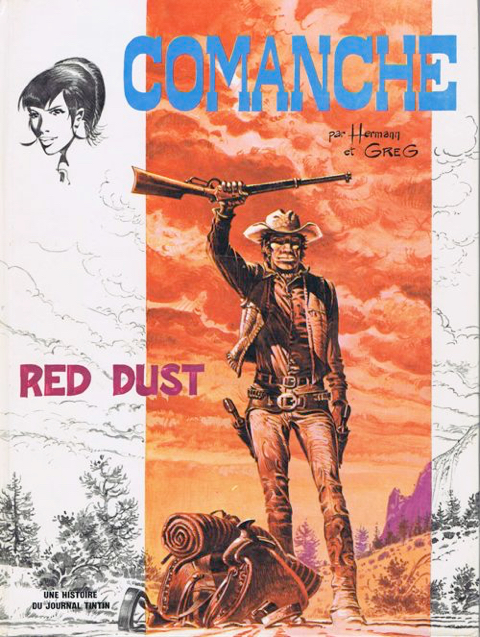
PG: In 1972, you and Greg switched genres to start the Western drama Comanche, adding a grittier edge to the weekly.
HH: Yes, especially in the climax of the fourth story, where the cowboy Red Dust was not supposed to shoot the killer, only arrest him. But I said to Greg that he is such a horrible man, I insisted that Red Dust kill him, on garbage cans in the back streets. So he did. It was a sign that times were changing. But in the next episode, Greg decided we must show Red Dust coming out of jail. I didn’t like the idea that he was punished. It’s hypocrisy, it wasn’t like that in the Wild West. People were killing for much less than that. I like to stick to reality, no illusions, not trying to show mankind as something fantastic. I don’t want to be dishonest, but if I’m rough, I’m rough.
PG: How did your artwork develop during this period?
HH: I moved away from the brush to the finer lines of the Rotring pen. I did my own colouring at first but later I was looking for a colourist for Bernard Prince and Comanche, because I needed time for my new solo project, Jeremiah. So my artist-friend Dany introduced me to his colourist, Fraymond, alias Raymond Fernandez. A sort of osmosis soon formed between us, so when I drew, I kept in mind how he would colour and eliminated all unnecessary effects.
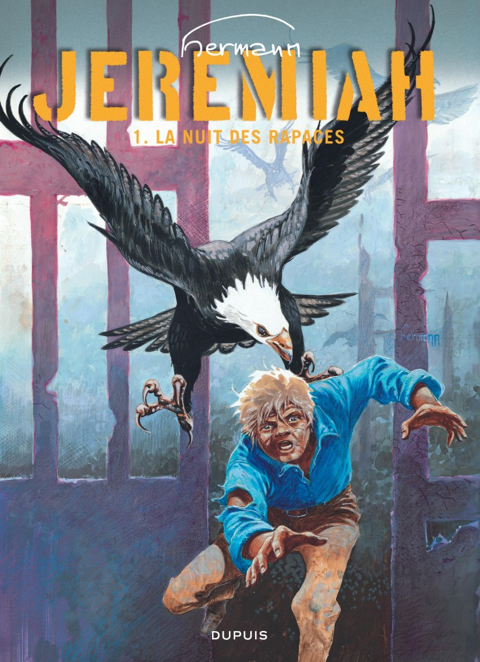
PG: Jeremiah in 1979 marked your daring departure from two hit series in Belgium to pursue writing and drawing your own, a transition from draughtsman to complete auteur.
HH: Yes, it was total freedom! I left Greg, I fell out of love with him! Because he once told me, when I was writing some short comics for myself, ‘For a draughtsman they’re very good, but you’ll never be a scriptwriter.’ It’s up to me to discover what I can do! So I took up a good deal with a German magazine to create my own series. And some years later, I heard that Greg told someone, ‘I think he became a scriptwriter too!’
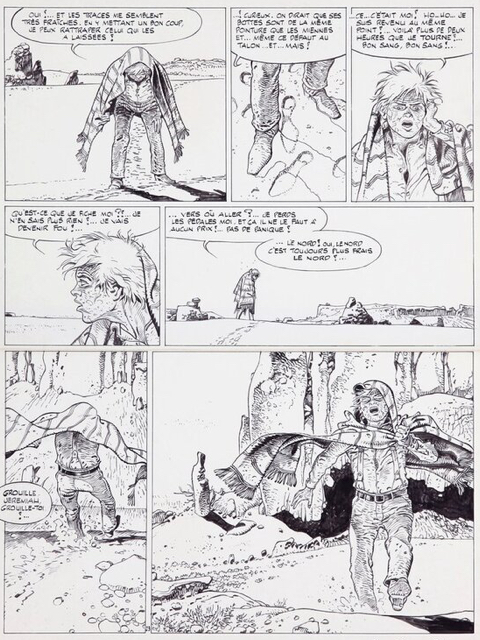
What put me on the track towards Jeremiah was reading a science fiction novel called Ravage written in 1943 by René Barjavel, about a dystopian near-future after a nuclear war. Jeremiah has touches of the Western, as it’s set in an America torn apart after racial wars. I didn’t want to stick to one location, so Jeremiah and his friend Kurdy are always on the move, it’s a sort of post-apocalyptic road movie. Their quest is eternal and never completed. It’s the same for you and me. But the journey can be good. My next Jeremiah, the 34th, will be a flashback to Kurdy a few years before he met Jeremiah. As for the 2002-4 American TV adaptation, I had no approval, they just paid me some money. They made it politically correct, about two guys saving the world with the American flag. Forget it - just flush the toilet!
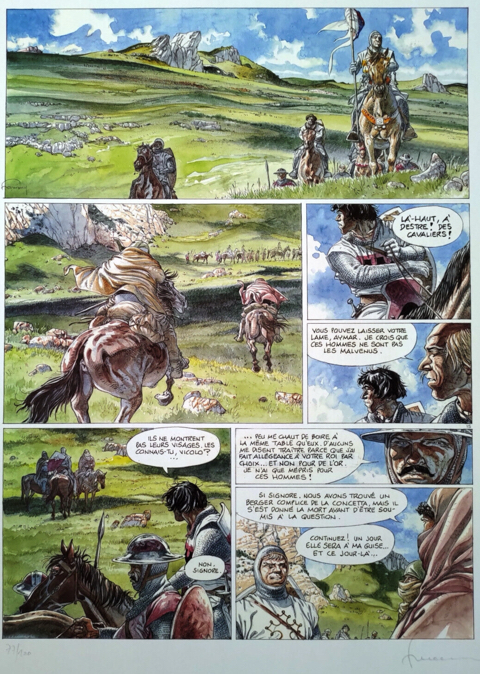
PG: How did your ten-volume medieval series, Towers of Bois-Maury, come about?
HH: By pure chance. I made one 23-page story but had no publisher. My friend Ervin Rustemagić in Sarajevo told me to make another story to have enough for an album. He became my agent for it and sold it to Glénat who specialise in historical comics. Hal Foster’s Prince Valiant never influenced me, his figures were too stiff, like statues. I don’t show the life of somebody important, it’s about a more ordinary person. Some medieval specialists told me my comic came closest to their understanding of the harshness, the absence of comfort, of the Middle Ages.
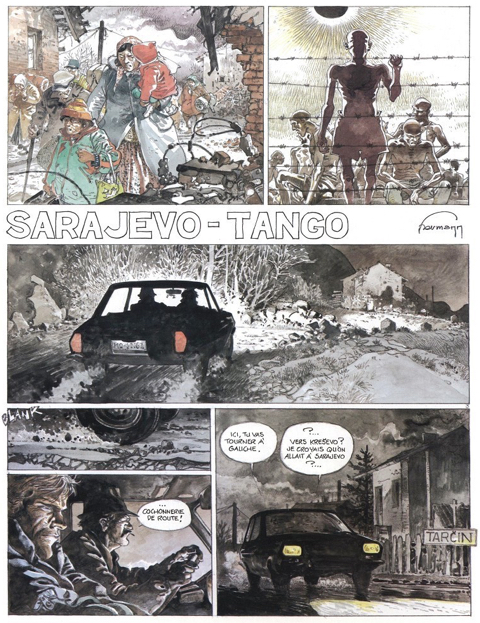
PG: Ervin sent you faxes with real news about the Bosnian War, which inspired the first of many one-shot albums in 1995, Sarajevo Tango, and your first in watercolours.
HH: Yes, English Daler-Rowney and Winsor & Newton colours are the best, you know. I’d been to Sarajevo several times and knew the city. I was deeply touched by the bombing of Markale market. I had to do make a book about it. I accused the United Nations and President Mitterand of not doing enough. Some critics complained I am not a journalist. So do I have no right to express my anger? There are no lies in my book, I just show what happened.
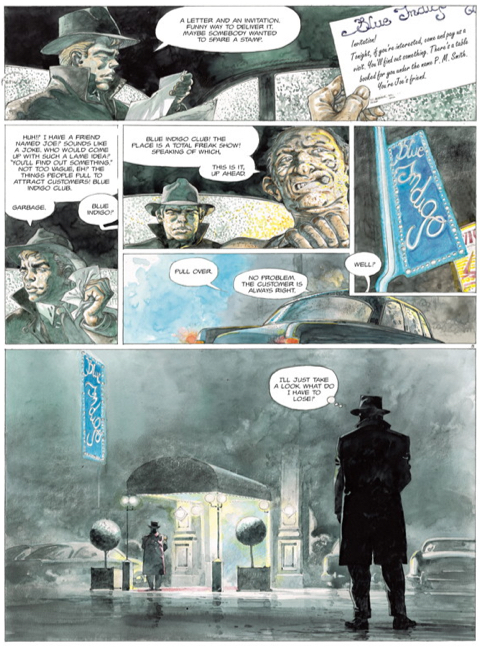
PG: What’s it like having your son Yves as your scriptwriter on many of your one-shots, like Blood Ties and Trilogy USA, translated by Dark Horse?
HH: The relationship is really good. We talk and when there is a problem, we fix it together. I’m lucky, because my series never sold 100,000 copies, I was never trapped having to produce only a hit series. My public follows whatever I do, and I never cheat, I always pull out the best in me. I am my own boss and I follow my own feelings. I try to remain natural. Storytelling, that’s my life.
Posted in tribute on the day after his passing on March 22nd 2026 at the age of 87. This interview originally appeared in Comic Heroes magazine in 2017. Photos courtesy of Cameron Fletcher & Matteo Polone.