RSS Feed
 Facebook
 Twitter
Comics & Film:
Lights! Camera! Comics!
Whether adapting them into special effects blockbusters or arthouse indies, today the film industry virtually worldwide seems to love comics. Looking back, however, this is clearly nothing new; the funnies and the movies have long been closely connected. What’s different now, though, are the ways comics and comics creators are inspiring and interacting with films and film-directors.
The young Orson Welles’ first feature film, Citizen Kane, comes top, or close to it, on many people’s list of all-time greatest films. On its release in 1941, its progressive compositions, camera angles and experimental effects created quite a sensation among apprentice American cartoonists, often with little or no training, struggling to draw the latest publishing novelty, the comic book. Before videos and DVDs, some of these tyros went back again and again to the cinema to learn from Welles’ masterpiece. Films were great teachers, helping novices select each "shot" and think visually and sequentially. For many, composing their pages was like making movies on paper. Jack Kirby, for one, recalled, "I was a movie person. I think it was one of the reasons I drew comics." Hergé billed his scouting hero Totor in 1926, three years before Tintin, with "United Rovers present an extrasuperfilm" by "Hergé, director."
The tides of influences flow in both directions. Certain directors like Alain Resnais and Quentin Tarantino have acknowledged the impact of comics, while others, such as Federico Fellini and the Wachowski Brothers, came to film having previously worked in the comics industry. In the case of Orson Welles, one comic artist we know he admired was Milton Caniff, whose newspaper strip Terry And The Pirates had begun in 1934. Among Caniff’s papers at the Ohio State University Cartoon Research Library is a letter sent to him on Mercury Theatre stationery from Welles. It’s a thank you note for Caniff’s gift of an original drawing of his sultry Oriental villainess:
"The Dragon Lady is everything a mortal could ask for. She occupies an honored wall in a frame which is everything she could ask for. For a lovely and a glamourous portrait of the loveliest and most glamourous personage in present-day fiction, my undying thanks. I wonder, though, what you can have, one half so precious as the stuff you draw. Gratefully and with sincerest admiration."
In a 1978 interview reprinted in R.C. Harvey’s Milton Caniff Conversations (Univeristy Press Of Mississippi), Caniff mentioned, "After Citizen Kane, for instance, I got letters from Orson Welles." So his admiration continued, but significantly his above letter is dated 1939, two years before Citizen Kane was made. Welles might well have been appreciating Terry And The Pirates prior to 1939, and so would have observed Caniff develop his signature illustration approach, encouraged and assisted by his brilliant studio colleague, Noel Sickles. Drawing in black and white for crude newsprint reproduction, Caniff broke away from conventional outlined cartoons and gave form to faces, figures, objects, settings out of his vibrant swathes and delicate delineations of black ink onto blank board. Their play of highlights and shadows or "chiaroscuro" often resembled the artificial lighting and high contrast in black-and-white films.
Even more striking to Welles might have been the dynamics of Caniff’s visual storytelling and composition which exploded through the 1930s. As Austin Stevens wrote in Conversations, by 1939 "Caniff’s panels were so subtly planned that they looked like a storyboard for a movie to be produced ten years in the future. His use of extreme ‘camera angles’, dramatic contrasts, the push and pull of a pictorial sequence, was paralleled only once during that period, and then in the very advanced movie Citizen Kane." Such "subtle planning" was crucial to Welles too, who had his whole film drawn beforehand as a precise storyboard, their sequences closely akin to comics.
One sophisticated property of Caniff’s strips that Welles might have noted was their density and clarity of narrative information. At times, in one cleverly composed panel, characters would be interacting and events unfolding on more than one plane at once, between the foreground, middle-ground or background, everything shown to the reader in crystal detail. This may be how our eyes see and how comics looked, but then it was not how the camera saw. Welles wanted the same readability and richness of story and perception on screen and successfully overcame the technical challenges in Citizen Kane through Gregg Toland’s deep-focus innovations.
Travelling further back in time, it’s clear that comics and film have cross-pollinated each other back and forth. Caniff was unmistakeably conscious of Hollywood films and their stars, for example basing Pat Ryan on Fred MacMurray (later the model for Captain Marvel) and the Dragon Lady on Anna May Wong and Joan Crawford. But if you’re looking for a start to this chicken-and-egg trail, go back to the birth of cinema and watch the very first short silent film projected for an audience in Paris in 1895. What the Lumiére Brothers chose for their story was the simple visual sketch of a gardener whose watering hose is blocked by a prankster stepping on it. Curious, the gardener looks closely at the nozzle and then, when the prankster releases his foot, he gets a drenching. The source of this gag was a one-page comic strip, L’Arroseur Arrosé, of which there were several versions, famously one by Christophe. It made a perfect storyboard from which to stage their first film.
It also offers proof that comics not only pre-date but predict cinema. A recent BFI documentary on the early British silent cinema hailed one director for "inventing" the cutaway shot in the 1890s, taking the viewer from one setting to another and then back again. But this claim ignores the fact that crosscutting and so many others techniques in movies were already familiar to the creators and readers of comics. And to film directors. Decades before the technology of film came along, cartoonists had been working out how to break down a story into a sequence of images, the "cutting" from one frame to the next, their only technology pen and paper. Cinephiles rarely acknowledge the roots of cinema in comics. Rather than calling comics cinematic, though, shouldn’t we be calling movies "comicamatic"?
Currently, the links between comics and films and their creators are becoming more intriguing. To adapt the very British teen action movie Stormbreaker (Walker Books) the publisher took the inspired leap of teaming homegrown writer Antony Johnston with a Japanese duo, sisters Kanako and Yuzuru. They craft a fresh, highly effective hybrid of colour graphic novel and manga, using the style and storytelling tricks youngsters want.
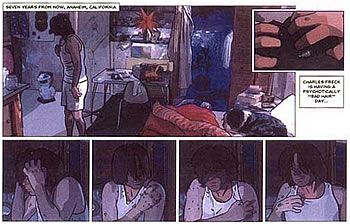
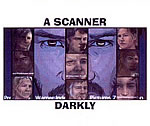
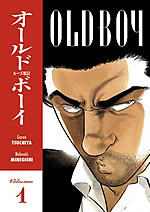
A different result comes from the ‘"Rotoshop" software used by Richard Linklater on his animated adaptation of Philip K. Dick’s novel A Scanner Darkly (Gollancz). When their shots are digitised into drawings, Keanu Reeves and the other actors morph into Roy Lichtenstein-like hard contours around swirling highlights like multi-hued plasticene, a look which fits the unstable, paranoid, trippy mood. To create a graphic novel from these, artists Laura and Gary Dumm compiled stills into page layouts. Though some scenes work perfectly without a narrator in the movie, somehow they are thought to require extra captions, by Harvey Pekar, to read clearly as comics. Perhaps allowing more panels and pages would have made this sometimes intrusive voice less necessary. It’s not a weakness of comics. As proof, the original manga of Old Boy (Dark Horse) by Garon Tsuchiya and Nobuaki Minegishi conveys every nuance, and more, of what’s on the screen of Chan-wook Park’s film version.
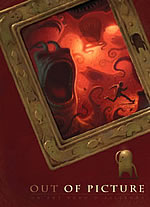
John Woo, Kevin Smith, Joss Whedon and other film-makers drawn to the graphic novel are generating their own, and so are animators. However rewarding the team effort on big animated films like Ice Age and Robots can be, the eleven members of the studio Blue Sky each nurtured personal comics projects. The sheer freedom and control that comics permit come across powerfully in these sumptuous solo flights in Out Of Picture (Paquet), a large yet well-priced 128-page colour hardcover.

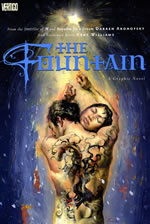
Director Darron Aronofsky’s new movie The Fountain (DC/Vertigo) with Keanu Reeves, to open in January 2007, is another case entirely. Ages ago, Aronofsky entrusted Kent Williams to visualise the screenplay in his own way for Vertigo. Rather than drawing actors’ lookalikes or from daily rushes, this is a director’s rare trust in a comics creator to run with it and make it his way. How will one visionary artist’s comic compare to the mega-budget, yet studio-controlled and often compromised movie? Which will the director feel realised his aims? Similarly, one wonders how freely Eddie Campbell has been allowed to interpret, even improve, the screenplay for The Black Diamond Agency, (First Second Books). This way the period Chicago detective thriller due next year could be hyped as being based on a graphic novel by From Hell‘s co-creator.
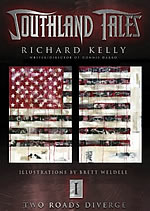
For his next movie Southland Tales (Graphitti Designs), Richard Kelly of Donnie Darko fame has scripted three 96-page graphic novels drawn by Brett Weldele to establish the history and characters integral to the story that concludes as the movie. This "Prequel Saga" is one way to stoke anticipation, except that the film has been delayed for re-editing after poor previews. Would it have made any more sense if the critics had read the comics?
Another screenplay that never got filmed and was presumed lost was Playback (Arcade Publishing) from 1948 by crime-fiction’s master, Raymond Chandler. Who would have thought that nearly 60 years later it would be rediscovered and made into a hard-boiled, hardback comic by France’s Ted Benoit and François Ayroles? Their act is a classy mix of Hergé clarity and Caniff shadows. Chandler’s dialogue, like "Don’t I even get my face slapped?", still sparks, lean, cynical and stiletto-sharp, not a superfluous caption in sight. It’s the best graphic novel Chandler never wrote. So when is the film coming out?
Posted: September 8, 2007The original version of this article appeared in Comics International, the UK’s leading magazine about comics, graphic novels and manga, in 2006.