RSS Feed
 Facebook
 Twitter
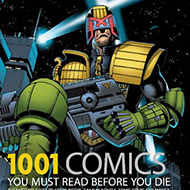
1001 COMICS
A Review By: Ian Williams, Amazon.co.uk
Ian Williams posted this review on Amazon.co.uk on 8 October 2011.
This book arrived in the same package from Amazon with another of similar size that had been ordered separately. There’s a reason I mention this this but it will have to wait to the end of the review.
But first let’s dispose of that stupid title. Unlike companion volumes in this series -movies, albums, songs- it is completely impossible for anyone to read all the comics listed unless: you have a lot of free time; a large amount of disposable funds; and are versed in numerous foreign languages. Many of the works are out of print and unobtainable except from national libraries; many have never been translated out of their original language. So forget the title, that isn’t what this book is really about.
Essentially it’s an historical survey of what the various writers and editor believe to be the best or most significant (the two are not necessarily synonymous) comics ever published. I’d argue that it’s also polemical in that it’s an argument for comics (by which the compiler includes newspaper strips, comics, graphic novels, manga or whatever form a narrative consisting of words and images appears in) as an art form. Comics are a medium just like films and novels.
It’s also a reference book which is arranged chronologically. However, before the entries begin, there is an alphabetical list of titles and at the end an alphabetical index of author and illustrator which lists their included works. (You might not be too surprised to learn that Alan Moore has the most entries.) Include useful introduction and a brief guide to contributors and as a reference work it works very well. What you want to know is easily accessed.
It’s enormously wide ranging which means people who read only superhero titles will find it quite disappointing, though the superhero genre is represented along with all the other genres from humour to social realism and all stops in between. It’s international in scope which is sometimes frustrating as when a work looks extremely interesting but hasn’t been translated into English. And it’s also enlightening particularly when you come across something you’ve raved over but didn’t believe anyone else had ever heard of. In my case it was The Chimpanzee Complex (UK, Cinebooks, 3 slim volumes), an amazing work of Science Fiction which I’d read earlier this year. Inevitably you won’t agree with all the inclusions and will wonder why some of your particular favourites have been left out but that is all part of the fun of books like this.
The amount of text per entry is just enough to cover the basics of what you need to know about each work and it’s up to you and me to decide if we want to dig deeper. There is often a cover or full page illustration to convey the flavour of a work but often there isn’t. But then space is limited and the book is heavy enough and price is just enough too.
I do have one criticism to make though, admittedly, it is quite minor. A few more works could have been included by excluding multiple entries of a single title by the same creator (Asterix, Corto Maltese, Blake & Mortimer). This doesn’t apply to series which have different creators (Batman).
Of course with books like this, because of the publishing lead-in time, they tend to be out date as soon as they appear. The book which arrived in the same package is Craig Thompson’s new masterpiece Habibi, a truly remarkable graphic novel like nothing you’ve ever read and one that certainly ought to have been included but for its almost simultaneous publication date. And then I looked at the last entry…
1001 COMICS
A Review By: Tim Bishop, Amazon.co.uk
Tim Bishop posted the following review on Amazon.co.uk on 6 October 2011.
Beautiful, phonebook-sized publication. A reference book for the best and most important comics of the last century.
Even though it’s a heavy, dip-in-and-out-of, coffee-table book I still find it a bit of a page turner - every review is written very well and gives the relevant info you’d want on each comic, re style, genre, target audience etc.
It also serves as a history book, detailing the books in chronological order of publishing date which makes for very interesting reading.
The reviewers provide a bit of cultural context for some the older or more obscure international books too, valuable info when assessing further interest.
1001 COMICS
A Review By: Comic Heroes Magazine
The following review by Jes Bickman appeared in the October 2011 issue of Comic Heroes.

Think you know 1001 comics you reckon everyone should read? Think again. We all think we know the classics, but odds are you’ll never have read,much less heard of, the bulk of the masterpieces in this book - which is brilliant. The world of comics is impossibly vast, and 1001 Comics You Must Read Before You Die is a fascinating attempt to sketch its boundaries.
Of course, all the comics you actually do know to be classics - Maus, The Dark Knight Returns, Watchmen and the rest - are all present and correct, but what 1001 Comics does is make you appreciate how much more there is to the medium than superheroes. They have their place, of course, but so does everything else - and there’s a lot of the latter.
Gravett - a man who’s probably forgotten more about comics than the rest of us will ever learn - notes in his excellent introduction to this shelf-busting colossus of a celebration that “There can never be one history or one experience of comics,” but he does a damn good job of attempting to provide some kind of definitive statement of the ninth art, dividing his and his 67-strong team’s picks by period.
There are entire universes turning inside the covers of this book, and it’s a delight to just flick through them or get lost in their joyous mysteries for hours at a time.
1001 COMICS
A Review By: Bleeding Cool
The following review by Greg Baldino appeared on Bleeding Cool on 9 November 2011.
Trying to compile any sort of top ten list is just asking for trouble. It’s just begging for disagreements to emerge. The less you imply posterity the safer you are; it’s much easier to write up, say, the top ten comics of this week than this month or - god help you - this year. Trying to write up a list of a hundred of anything noteworthy will at least buy you enough time to run for cover while it’s still being read.
But a thousand comics? A thousand and one comic books, strip, and graphic novels deserving standout attention? That’s serious business.
From Universe, the publisher who brought you 1001 Golf Courses You Must Play Before You Die and next year bring out 1001 Whiskeys You Must Drink Before You Die, comes 1001 Comics You Must Read Before You Die edited by Paul Gravett, acclaimed comics scholar, dubbed ‘The Man at the Crossroads’ by Eddie Campbell.
It’s an idea that could have been very boring. If 1001 was just a shopping guide, a Consumer Report on where to spend your hard-earned comic-dollars, the result would be at worst an overpriced compilation of advertorials, and at best severely limited in its scope (Could legitimately include free webcomics and out-of-print material in a buyer’s guide?)
Gravett does something very different, though, something downright clever. 1001 is a secret history of comics in disguise.
To start with, Gravett and his writers (some sixty-odd of them) take a wide definition of comics, both in terms of where they come from and what constitutes ‘comics’. There are newspaper strips, manga, bande dessinée, underground comics, and more, published everywhere from New York City to the Czech Republic. Structured as a chronological catalog of sorts, the first entry listed is The Adventures of Mr. Obadiah Oldbuck, by Rodolphe Töpffer in 1837. From there the book moves forward, chronicling as best it can the landmark books that shaped the medium worldwide.
The international approach keeps the book balanced. American comics were more limited in their scope for the longest time, and it’s not until the latter half of the book that more American comics and graphic novels begin to make the cut. In the interim years, Nakho Kim writes about South Korean superhero RyePhie, while Matteo Stefanelli covers the parodic detective stories of German creator Manfred Schmidt.
Not that American comics are completely left out. 1001 still includes American comics through the first three quarters of the 20th century listings, and in fact brings out some gems that might have gone forgotten or unnoticed otherwise. (Amazing Fantasy #15 is a no-brainer to include in such a listing, but it’s a joy to find things like Gladys Parker’s flapper girl Mopsy getting a moment in the sun.
Volumes of collected works are listed by when their content first saw print, and so for example Alan Moore and Melinda Gebbie’s Lost Girls is listed in the early ‘90s despite seeing its full release almost fifteen years later. Reading through it front-to-back is to walk through the growth of an emerging art form: inspiration leads to invention, to refinement, to reimagining. It’s a view of comics that has no trouble at all putting Charles Schultz’s Peanuts in the same continuum as Barron Storey’s Marat/Sade Journals.
Is it perfect? No; in a compendium this size there’s bound to be a few minor errors (Craig Thompson’s year of birth magically changes between his listings for Blankets and Habibi). But the errors and inconsistencies are minor, and do not detract from the merits of the work. Is it complete? No, nor could it be (though the presence of webcomics in the book is somewhat wanting.) But these are not issues that make 1001 a failure; but rather makes it, hopefully, a starting point for discussion. What else could have been included? Should the definition of comics been stretched to include illustrated books or is that taking the definition of comics to far? Is a chronological ordering more or less valid than a cultural categorization? Is it just cruel to write about out-of-print Scandanavian comics that sound amazing but I couldn’t read even if I could get my hands on a copy?
Read up, and let’s discuss.
UNMASKS CORRUPTION
A Review By: Art Sleuth
Art Sleuth attended the opening night of the Unmasks Corruption exhibition on 6 November 2009.
Art Sleuth made it to two excellent openings last night. The first being Control.Alt.Shift’s Unmasked Corruption. Original artwork for Political comic strips have been amassed from all corners of the globe, trailing events such as the Iranian Election, Barak Obahma’s election and the Iraq War.
Some comics tackle dark and little reported human rights scandals; Unspeakable Things by Paul O’Connell gives an account of the African ‘blood diamond’ (and tin, and oil and more) crisis. Black Holes by Dave McKean (with text from an anonymous writer) provides a shocking insight into an alleged scandal involving the suppression of HIV sufferers and vanishing funds for treatment by the Chinese government. Another shocking story is that of the Skin Hunters in Poland from 1999 to 2002, a group of paramedics who delayed ambulances and killed off patients in a scam which gave them a cut of the funeral parlour fees of the victims, drawn by Janek Koza.
Some are more humorous, like the portrayal of Margaret Thatcher and her husband drawn by Hunt Emerson in 1987. Excerpts from Alan Moore’s new magazine Dodgem Logic are ingenious combining drawings and witty, off the wall story boards. A book of the cartoons and artwork from the exhibition is well worth the £5 fee.
UNMASKS CORRUPTION
A Review By: Space In Text
The following review of the Unmasks Corruption exhibition and book appeared on the Space In Text blog on 8 November 2009.
Is nobody angry anymore?
With today being both the 20th anniversary of the Berlin Wall being taken down, as well as Rememberance Day, images are brought to us, from other places in time and space, about what made (and makes) us angry. We are reminded why we should not stand by and let objectionable events take their course, and why memory is important (so we know not to make or allow the same mistakes again). We can choose not to know, not to remember, not to act, but at least we are afforded that choice, something important in itself. The thing most instrumental, in us being allowed to make this choice, is the exposure of original information. This we can then take, or leave. In this vein, Ctrl.Alt.Shift Exposes Corruption is a charity, the purpose of which is to remind us where corruption lies the present day.
This week at the Lazarides Gallery on Greek Street in Soho, Ctrl.Alt. Shift aims to fulfil some of this purpose, by bringing together the work of a number of writers and illustators in a series of sequential art pieces, posters and three dimensional artworks. The list of collaborating writers and artists is drawn from around the world, and from various levels of experience. Alan Moore, Pat Mills, Peter Kuper, Dave McKean and Brian Talbot are here, as is the New York musican Lightspeed Champion (Dev Hynes, who will also be hosting Ctrl.Alt.Shift’s Music and Comics Night), Asia Alfasi and Dan Goldman.
The event is also a showcase for younger artists, including Lee O’Connor (see earlier post on this blog: The Ayatollah’s Son) and Julia Scheele. To put original artwork up, that would otherwise have the benefit of digital reproduction, is brave. The work is vulnerable here, but it generally stands up well. Lee O’Connor’s artwork in particular is not diminished by blow up experience: anyone, not just anyone who draws who draws will see the skill demonstrated in his drawings.
Subject matter ranges widely and would appear to have been handed out by the exhibition organisers (the charity itself: the Lazarides Gallery is playing host). Themes include: the recent Iran election; Israel’s treatment of the Palestinians (this cartoon strip came close to making me cry); the prevalence of prescription pharmaceuticals in American society and the dearth of them where they are required in China. A book, edited by Comica’s Paul Gravett, with John Dunning and Emma Pettit, is published alongside the exhibition (and which is available from the Lazarides Gallery) and gives an opportunity for the issues to be looked at in depth and in a less intense manner.
In short, this exhibition is worth a visit. The medium of the storytelling is quite accessible and allows the stories to have more reach. The gallery setting is picking up quite a bit of passing trade, due to it’s convenient situation just of Oxford Street and informal aspect (it is more often the home to ‘street art’, which itself sits outside the art mainstream and has a different following). Some of the artwork is very affecting, although it’s a mixed bag in terms of impact. That may not be due to the creators, but down to who got to illustrate which area of the corrupted world.
This aside, Ctrl.Alt.Shift’s show is a pretty successful take on what is quite a difficult brief: how to inform without preaching; involve without hectoring; provide a polemical show without being overtly hair-shirted. It’s hard to say this is enjoyable, but it IS enjoyable to see (much original art is on the wall and you can see- and marvel- on what it took to make this).
Take the time to look at the work and read the lettering, buy the book (which contains additional material, for example Luke Pearson’s prize-winning King Listpin); and remember this is a charitable exercise for a deserving purpose. Then think what you can do.
UNMASKS CORRUPTION
A Review By: The Metro
The free London morning newspaper, The Metro, reviewed Unmasks Corruption and interviewed Paul Gravett on 3 November 2009. The full article and interview is available online here.
Whether you’d consider the comic book as having come of age when people started calling lengthier ones graphic novels, or at some specific point thereafter, the days when the term suggested nothing more than Lycra-clad crimefighters are hopefully long gone.
‘Comics are engaging, interactive, accessible and sophisticated,’ says Paul Gravett, director of London’s Comica festival and editor of politically charged new work anthology Ctrl.Alt.Shift Unmasks Corruption. ‘You have to be alert. Sometimes what you read is also what you see but, equally, you can spot the contrasts, counterpoints or total contradictions between the text and image. There’s a real power in drawings to encapsulate ideas and psychological states, to show you what may not exist in any video or photos and especially to deal with the fine line between reality and fantasy or nightmare.’
In its short lifespan, UK-based magazine and cultural initiative Ctrl.Alt.Shift has staged an impressive array of awareness-raising artistic interventions, from last year’s HIV/Aids and Stigma dance event at Sadler’s Wells to a recent film project in which the likes of Julian Barratt and Martin Freeman starred in activist shorts written by up-and-coming film-makers.
Unmasks Corruption is a powerful entry into a new medium for Ctrl.Alt.Shift. The theme is corruption, political and personal, a broad launch pad for a punchy 24 stories in 100 pages. Inside, artists and writers offer visceral renderings of, for the most part, real-life events that no photographer or camera crew could ever have documented lucidly or safely.
So we have the likes of The Ayatollah’s Son, in which Pat Mills and Lee O’Connor team up for a stark account of the chaos that ensued after the recent Iranian elections; Benjamin Dickson and Warren Pleece offer Not One Minute Of Silence, a sorrowful spotlight on the Columbian police’s callous execution of student Johnny Silva Aranguren; and Black Holes, a truly horrific account of the Chinese government’s failure to deal with the country’s Aids crisis, drawn by Dave McKean and penned by an anonymous author.
There is a worry that despite some potshots at the West and the first-hand testimony involved, Unmasks Corruption may come across as a group of Western artists sniping at predominantly developing world and Middle Eastern targets. Naturally Gravett refutes this, with particular reference to Judge Dredd-scribe Mills’s script.
‘Pat worked closely with an Iranian informant who gave him exceptional access to what is happening there and its effects on ordinary people, aspects often missed or glossed over in our media’s coverage. We strove for some balance and certainly expose as much corruption on our doorstep as a world away, including a special online satire of the British MPs’ expenses scandal by webtoonist Daniel Merlin Goodbrey. It’s being serialised on Ctrl.Atl.Shift’s blog.’
It’s important to bear in mind that comics aren’t relentlessly grim, down-at-heel affairs.
Quite aside from the satire, there are many moments of sci-fi escapism here. Most notable is Behold, King Listpin III, which furthers Ctrl. Alt.Shift’s commitment to new talent by setting musician/artist Lightspeed Champion’s script about an alien bounty hunter to art by competition winner Luke Pearson.
But lastly, while Unmasks Corruption is an unquestionably dark read, it isn’t ultimately a nihilistic or bitter collection. ‘I was concerned at first that if all that this anthology gave people was a litany of how corrupt the world is, it would be pretty depressing and unmotivating,’ states Gravett.
‘The great thing is, it’s a wake-up call, a chance to hear voices that all too often are drowned out in our media circus. It’s not all doom and gloom, there is real passion, and anger, in the ink on these pages, as well as optimism, activism and the hope that each one of us can make a change.’
THE LEATHER NUN
A Review By: Comics DC
The following review by John Judy appeared on the Comics DC Blog.
2008 Comics In The Rear View:
Holy Sh*t!: The World’s Weirdest Comic Books by Paul Gravett and Peter Stanbury. What it sounds like: Dozens of examples from all over the globe of the most bizarre, hilarious, disturbing curiosities ever to appear in sequential-graphic form. Sadly such a work can never be a definitive edition because Rob Liefeld and Frank Miller continue to publish new material. Worth having anyway.
THE LEATHER NUN
A Review By: Shane Simmonds
Shane Simmons is the creator of Longshot Comics, one of the comics featured in Incredibly Strange Comics. Shane’s response to the inclusion of his comics appeared on the Eyestrain Blog.
One of those laurels I continue to rest my weary head on is Longshot Comics, which is discussed in a new book by Paul Gravett and Peter Stanbury. There are two editions of it, with two different titles for two different markets. The Leather Nun and Other Incredibly Strange Comics is one name for the book, Holy Sh*t! The World’s Weirdest Comic Books is the other. The difference in titles illustrates, quite vividly I’d say, the chasm of between United States and United Kingdom sensibilities. You can guess which title goes with which territory. Hint: Brits have a soft spot for the kinky, Yanks like naughty words.
THE LEATHER NUN
A Review By: Grovel
Grovel is the UK-based web site of graphic novel news and reviews.
Paul Gravett is back, this time with Peter Stanbury, casting his deep-thinking, analytical mind over some of comics’ biggest questions. However, despite the fact that scholarly Gravett is usually found pondering the cultural impact of manga or the link between superheroes and war-time propaganda, this book reveals his other side: a lover of comic books’ ability to shock and surprise.
Holy Sh*t isn’t (perhaps unfortunately) an anthology of comics like Gravett’s cracking Mammoth Book of Crime Comics, but instead offers covers, descriptions and sneak peaks at some of comics’ more depraved moments. Amputee Love, Tales from the Leather Nun and Trucker Fags in Denial grace its pages, leaving you (depending on your outlook on life) either thirsty for more comic madness, or quietly quite pleased that most of the comics discussed never made it to the big time.
THE LEATHER NUN
A Review By: Ella Wredenfors
Ella Wredenfors writes the arts, culture and comics blog at Run, Paint, Run, Run.
One of the things I have managed to do is lay my hands on a copy of Paul Gravett & Peter Stanbury’s The Leather Nun and Other Incredibly Strange Comics. This book has been passed round my house, from hand to hand, over the last few days, accompanied by gasps, groans and giggles. Though some of the entries are strange and unsettling at best, utterly offensive at worst, even the most PC, delicately tempered person will find themselves being intrigued and fascinated by what this gloriously odd little book contains.
It almost works as a catalogue of the macabre, almost certainly boosting the sales of some of the more recent, still in print, dodgy works. Perhaps these would have sank thankfully under the waves of graphic literacy effluence, but it’s too late to complain. They are released on the world now, and apparently mild mannered Paul Gravett is their chief champion.
Opening it at random, you are greeting again and again by inexplicible images, of erotic disfunction, socio-political oddities and incongruous, unthinking juxtaposition. I almost fell off my chair when I opened the book at “Teen-Age Romances” and my eye fell upon one female character saying of another “That little cheat will do anything to hold Dick.” (Incidentally, there is an addictive collection of romance comics and other oddities to be found at Last of the Spinner Rack Junkies).
In itself the book is a handy little size, and gives us little glimpses into these strange comics. It treads a very narrow path, managing to provide enough details and images to assert the strangeness of the works in question, but not enough to assuage our curiosity. It is a skilful tease.
The blurb on the front, from the foolhardy Jonathan Ross says “The perfect gift for any comic-book lover or pervert in your life.” This could be indicative of something, since my house mate just picked it up and remarked it on being a suitable present for her brother. As far as I know, he doesn’t like comics.
THE LEATHER NUN
A Review By: Bear Alley
Steve Holland maintains his Bear Alley web site, dedicated to British comics. The following review appeared on 9 November 2008.
I’ve had this sitting beside me for a couple of days and it’s incredibly distracting. It’s a dip-into book that you’ll have trouble putting down because, frankly, you’ll have some trouble believing that some of these comics ever came out. From the cover of a 1950 issue of Teen-Age Romances - where a girl sees her boyfriend flirting with a blonde while her friend tells her “You’ll never get him back, Ann. That little cheat will do anything to hold Dick!” - to the action tales of Reagan’s Raiders - wherein the pumped-up, 75-year-old US president Ronald Reagan and his senior cabinet save the world from nuclear disaster - Paul Gravett and Paul Stanbury have gathered together 50 examples from some of the weirdest comics ever that will leave you wondering why trees were cut down to make this!
Anti-Krushchev (Two Faces of Communism) and Christian tracts (The Gospel Blimp), promotional comics (Driving Like A Pro, published by the Greyhound bus company) and psychedelic hippie comics (Mod Love and Brother Power the Geek), bondage/S&M comics (The Leather Nun that gives the book its title), comics from another age (All-Negro Comics) and the indefinable (Amputee Love, Chaplains at War, Godzilla vs. Barkley [Charles Barkley, the basketball player], Genus issue 20, the “Special extra large lesbian unicorn issue”, Binky Brown meets the Holy Virgin Mary, etc., etc.) - they’re all here, and more!
To paraphrase something the editors say in their introduction, there should be something to amuse, amaze or offend just about everyone.
THE LEATHER NUN
A Review By: Bookgasm
The following review by Rob Lott appeared on his web site Bookgasm, which seeks to highlight books to get excited about.
When you brazenly put a superlative in the title of your book — whether ‘best’, ‘worst’ or whatever — you’d damn well better be ready to back that shit up. Paul Gravett and Peter Stanbury knew this, obviously, when compiling Holy Sh*t: The World’s Weirdest Comic Books. About the only sin of omission in this hilarious hardback is the cake-taking crossover The Punisher Meets Archie.
From all stretches of the globe and stretching back about eight decades, our duo has unearthed some unique issues that will give you a serious case of the WTFs. Just flip open to a random page. There’s You Nazi Man, a 1930s parody in which Hitler is served a severed penis on a plate… and he asks for ketchup! See what I mean?
With each of the dozens of examples, the cover and a sample panel are reprinted on a full-color spread, and supplemented with a half-page explanation for background purposes… because, believe me, you’ll want to know how a Malaysian comic book graphically depicting the tortures of Hell ever came into being. Gravett and Stanbury have clearly done their homework… assuming you can call research on comics of amputees enjoying carnal relations homework.
A smattering of the books spotlighted are from major publishers — DC is represented by the hippie-dippy Brother Power: The Geek; Dark Horse gets singled out for Godzilla vs Barkley (as in Charles) — but most are from unknown and underground outfits, plus hired-hand gigs for Christian publishers and various safety boards. There are a few “names” involved, including Superman co-creator Jerry Siegel (here with ‘superlover’ Jon Juan), Steve Ditko (Mr. A), Otto Binder (Tod Holton, Super Green Beret) and, for those auto maintenance mags he did for the military, Will Eisner.
On one end of the spectrum, you have something as happily innocent as Teen-age Romances (with now-amusing lines like “That little cheat will do anything to hold Dick!”). On the other end — far, far on the other end — there’s something like Sh-t Comics, which is a glorified Tijuana bible update. For every The Gospel Blimp, there’s a Tales From The Leather Nun.
Other oddballs include Cold War scare stories, a Mexican Batman parody, an anti-smoking creed, 1947’s All-Negro Comics, a topless Spider-Woman from Italy, a career primer starring Popeye, a Jeffrey Dahmer biography, Ronald Reagan as a superhero and a sex-fantasy thing with an ultra-niche “special extra large lesbian unicorn issue.” (In case you were wondering, it’s the issue that’s extra-large, the authors note.)
For the antiestablishment names on your holiday shopping list, this would make a perfect gift. Name one other title that will school them on Elsie the Cow and gay truckers within a single flip of the page.
THE LEATHER NUN
A Review By: The Times
The following review appeared in The Times newspaper on 29 November 2008, as one of Neel Mukherjee’s selection of the The Times Christmas Graphic Novels for 2008.
Quirky is an underdescription for The Leather Nun and Other Incredibly Strange Comics, Paul Gravett and Peter Stanbury’s gorgeously produced collection of the some of the wackiest, beyond-the-pale comics ever written. I worry about the crowd Gravett and Stanbury hang out with or the duo’s choice of reading matter: where on earth did they excavate deranged gems such as the pornographic Amputee Love, or La Donna Ragna, the Italian porno-horror version of Spider-Man, or Trucker Fags in Denial - believe me, I’m not making all this up - or Genus: Special Extra Large Lesbian Unicorn Issue, or Hansi: The Girl Who Loved the Swastika? A wildly uproarious, perverted must-have.
THE LEATHER NUN
A Review By: Bizarre Magazine
The following review by David McComb appeared in Bizarre Magazine #144 in December 2008.
An irresistible glimpse at the weirdest comics ever made.
Golden-haired innocents falling in love with bloodthirsty Nazis. Redneck truckers fighting to suppress their homosexual urges. Amputee sex parties where everyone licks each other’s stumps. Popsicle superheroes, lesbian superheroes, killer pussycats. Perverts, monsters, death, gore, hippies, monkeys… and a muscle-bound, Spandex-clad president Ronald Reagan busting Bolivian drug lords with wily wisecracks and a roaring machine gun. Welcome to the weird world of underground comics, a dark and strange place often unseen by Joe Public, but a delight for fans of the strange, forbidden and gratuitously odd.
When casting light on these rare gems, authors Paul Gravett and Peter Stanbury let the pictures do the talking, by reproducing a selection of the most outrageous comic covers published since the 1940s, along with a smattering of text to put each page into context. It’s hard to choose a favourite among the dozens of forgotten strips they’ve dug up, but child-friendly guides on how to shoot a rifle, the adventures of military chaplains on the frontline of World War II and sports start Charles Barkley fighting Godzilla with little more than a basketball are just a few of the comics that have made Bizarre laugh, gasp and wonder how these crazy cartoons ever got published in the first place.
The sort of book Christmas stockings were made for, you’ll read The Leather Nun again and again, and it’ll doubtless inspire the creative among you to dream up your own twisted ‘toons.
THE LEATHER NUN
A Review By: SFX Magazine
The following ‘bullet-time’ review appeared in the November 2008 edition of SFX Magazine.
This compact hardback provides a peek at the eye-popping covers of 60 of the world’s weirdest comics.
Some of them, like Reagan’s Raiders (in which the 75-year old president becomes a super-soldier) or the self-explanatory Trucker Fags In Denial are intentionally odd.
Others, particularly educational comics such as civil defense title Fire & Blast! or the disturbingly chipper Saving Can Be Fun!, are unintentionally amusing.
But our faves are the dirty ones, like the jaw-dropping Amputee Love, and La Donna Ragna, a copyright-flouting Italian porno-horror spin on Spider-Man.
Is it too early to say that this’d make a great stocking-filler? Probably. Sorry.
THE LEATHER NUN
A Review By: Down The Tubes
The following review was written by John Freeman and appeared on Down The Tubes, the British comics news blog, on 12 November, 2008.
It’s not just leather nuns that provide the strange fare that makes up this fun title from Paul Gravett & Peter Stanbury (released as Holy Sh*t! by St. Martins Press in the US): for just under ten quid you can also find out about comics featuring lesbian unicorns, cavemen fighting giant tabby cats, a peasant girl fervently worships the swastika and killer roosters.
When the publishers say Gravett and Stanbury have scoured the world to bring together a non-PC carnival of comic-book curiosities, they’re not kidding. Who else would reveal the origins of Russia’s busty bombshell Octobriana, a comics myth later given greater life by the likes of Bryan Talbot and others? What other book for the Christmas market is going to offer you flesh-eating farm animals in The Barn of Fear, Fatman the Human Flying Saucer, Binky Brown meets the Holy Virgin Mary, Chaplains at War or Amputee Love?
Then there’s other delights such as Nembo Kid, a re-working of Superman for the Italian market, his name changed in 1954, perhaps to avoid criticism that the publishers were advocating the failed philosophy of the ubermensch so close to the end of World War Two. It’s nuggets like this that make Leather Nun such a fun read.
While not presenting the full comics - that would probably be too much for some sensibilities and anyway, many of them are probably not as good as the titles or synopses, presented as 61 glorious double page spreads of covers and background articles - this is a smashing title for both comics connisseur and casual comics fan alike, the text both intelligent and irreverent.
Of course, there is the danger that a book such as this will merely confirm many prejudices non-comics fans have about those who do enjoy the medium, but I’d say it’s well worth the risk. Gravett and Stanbury have again come up with the goods without being in any way po-faced about the comics they regularly champion.
THE LEATHER NUN
A Review By: Page 45
Stephen L. Holland is the co-founder, with Mark Simpson (1968-2005), of the Nottingham-based Page 45, one of the UK’s leading comic retail outlets.
The Leather Nun And Other Incredibly Strange Comics (£9-99) by Paul Gravett and Peter Stansbury. Did Paul show you his preview copy? The cover alone is a story in itself (clue: look at what each character is reading). Peter and Paul have trawled the outer reaches of comicbook insanity to bring you the strangest comics in the world, and then treat you with their masterfully mischievous commentary. Paul asked me for ideas last year and I offered up what I thought were sterling examples of marble-free miscreants imposing their mentalism upon us, but every one was rejected as being “not strange enough “! Well, he was right. See for yourself what it takes to be stranger than the fiction I could come up with. Case in point, HOW TO SHOOT, a comic published by the Remington Arms Company, proudly boasting on the cover: “Remington rifles helped blaze the trail to America’s glory.” They probably played a role in the murder rate over the last few decades as well. Unsurprisingly it’s one long overt weapons pitch aimed at readers old and young, and would therefore only just have got past ex-cabinet minister Robin Cooke and his ethical arms policy. As our editors here also point out, “To many, the glazed smiles of those armed youngsters on the cover seem less reassuring 50 years on, in this post-Columbine era.” And to others like Sarah Palin they probably just look perky and purty as heck. A lot of the culprits here owe their inclusion to politics - racial, sexual and otherwise - having moved on some since their original publications, but still you’ll be wondering, “Whatever were they thinking?!”. My favourite here, however, remains the one we used to sell when available, LONGSHOT COMICS, an epic 90-year family saga told in 160 panels per page, and starring a cast of dots. Well, the cast are represented as dots, and it’s a testament to Shane Simmons’ craft that you are not once confused as to who is saying what to whom. It is hilarious, and the page reprinted here - about a woman bred to death leaving the household at the mercy of their oblivious father - is a perfect example of Shane’s comedic timing. Pick up a copy when you’re next browsing and treat yourself to that page at least.
THE LEATHER NUN
A Review By: Waterstone’s
Waterstone’s is the UK’s leading national chain of bookstores. The following review by staff member Daniel Robinson of their Watford branch appeared on the Waterstone’s website.
5 Stars:
This offbeat compendium from the dark side of comics will delight and surprise even hardened fans. Be warned: Dennis the Menace this is not.
THE LEATHER NUN
A Review By: Gosh! Comics
Gosh! Comics is one of the best comic shops in London and the following review by Hayley Campbell appeared on the Gosh! Comics Blog on 2 October 2008.
There’s something for everyone this week; we’ve got superheroes, rude words from Garth Ennis, sarcastic teenage girls from Dan Clowes, booze-drenched writers - and everything else you’d never think of (what about Amputee Love?) is covered in Paul Gravett and Peter Stanbury’s brand-spanking new book The Leather Nun And Other Incredibly Strange Comics! Peter and Paul have diligently scoured the darkest recesses of forgotten collections to gather the most weird and wonderful comics ever published. There’s purple people-eaters, surreal Japanese baseball dramas, gigantic alien monsters in swimming trunks (that’s not just holiday snaps from Blackpool Beach on an August afternoon), hip-hop superheroes fighting crime, and peasant-girl Hansi fervently worshipping the swastika. The Leather Nun herself really is something to behold. What would her mum say?
These 61 rare and bizarre comics are each featured in a colourful double-page spread with an eye-popping cover shown in full. Perhaps I’m being a bit previous, but at £9.99 this definitely looks like the best Christmas presents around for comic fans and perverts alike. Just ask Jonathan Ross - he says so on the cover, which features art by Black Hole’s Charles Burns!
THE LEATHER NUN
A Review By: Forbidden Planet International
The following review by Richard Bruton appeared on the FPI Blog on 25 September 2008.
Okay, to get it out of the way, this is obviously, blatantly, blindingly obviously a novelty book from Gravett & Stanbury. You want serious discourse over comics? Go elsewhere, try some of Paul’s other books for a start. This is all about the weird and wonderful comics that have existed at various points in our medium’s history. It’s no coincidence that Jonathan Ross gets the cover quote as it’s exactly the sort of thing he’d have made a Channel 4 series out of a few years ago.
And that cover quote pretty much covers exactly what this book is for. It’s a stocking filler, the unusual gift for strange Uncle George. Of course, this is not to say that it isn’t a very enjoyable stocking filler indeed. Part of the fun is going through it and seeing all the weird comics and imagining what sort of a wonderfully weird world the creators lived in. Another fun thing is seeing how many of them you’ve either seen or read. Try it, it’s fun.
For example I’d completely forgotten Longshot Comics by Shane Simmons. An incredibly fun comic with 160 panels per page, 3,840 panels in total from 1995 which features nothing more than dots to represent the characters. As I recall it took ages to read and was genuinely quite funny and certainly excellent value for the price of a regular comic. And marvellously, in the course of writing this I’ve discovered that Shane Simmons is still around and still doing comics. For an example of what Longshot Comics was all about here’s a recent entry in his website’s “Films in longshot” series.
Now imagine that for another 3,836 panels with a huge cast of characters and I think you can see just why Longshot Comics warrants entry in this book.
The Leather Nun And Other Incredibly Strange Stories is 128 pages of the strange, weird and downright bizzare comics that have been published in the last 50 or so years. Each double page spread covers a single comic, write up on one page, cover on the other. All firmly tongue in cheek and continually asking the question; What in god’s name were they thinking?
The great thing about it is that Gravett and Stanbury have cast the net far and wide to find not just the obvious titles from the Underground comics movement (Leather Nun, Amputee Love, Binky Brown meets the Holy Virgin Mary etc) but have looked at some more wholesome comics that, with the benefit of hindsight, are perhaps the strangest of the lot. Take for example Hansi; The Girl Who Loved The Swastika. Not, as you may expect, some nasty propaganda book on behalf of Hitler’s Germany, but a well meaning look at how a good bible and a healthy dose of Christianity can save anyone. Or maybe it was a nasty propaganda book after all? Published by Spire Christian Comics in 1976. Archie meets Nazis.
Or what about PM; The Preventive Maintenance comic book published by the US Army and drawn for many years by the late, great Will Eisner. The blonde heroine would regularly purr seductively to her GI readers about the benefits of keeping their equipment in good condition and no doubt made a far greater impression than any dry technical manual ever could.
And it goes on in this vein, page after page of wonderful entertainment, the trippy, alternative undergrounds, the incredibly innocent and sweet romance comics of another time (Just Married - Should a Jewish boy and an Irish girl fall in love?), the bizarre instructional manual type comics (Saving Can Be Fun, Driving Like A Pro), the social comics to tempt wayward teens from lives or crime, drugs, illicit sex and worse (that would be Communism). From Purple People Eaters, through the Gospel Blimp and right on through to Steve Ditko’s exercise in Ayn Randian Objectivism of Mr A. It’s all here, in all its glorious strangeness.
The Leather Nun [is] a great little hardback package, slightly smaller than comic sized, and perfect to fit into anyone’s stocking this Christmas time. The Leather Nun is published 25th September 2008 and should be available from all good comic shops and bookshops and is, of course, available here at the FPI webstore. Weird Uncle George will thank you for it. But do yourself a favour - have a good look through yourself first, it’s well worth it.
THE LEATHER NUN
A Review By: The First Post
The following review by Danny Graydon appeared in The First Post, the free and independent daily current affairs magazine, on 23 September 2008.
Funny peculiar: One of comics’ greatest strengths is that no subject is off limits. Anything can be explored: superheroes, the Holocaust, philosophy, opera, relationships and - as Paul Gravett’s novelty tome The Leather Nun… helpfully teaches us - lesbian unicorns (yes, really)! In this highly enjoyable and often eye-opening jaunt through the outer reaches of comics’ weirder moments, mythical gay horses are just the tip of the iceberg. With more than sixty equally mad examples, highlights include the ultra-patriotism of Reagan’s Raiders (led by Ronnie himself), a sweet, blonde girl fanatically devoted to Nazism, Trucker Fags in Denial (which speaks for itself) and an exploration of serial killer Jeffrey Dahmer’s (exceedingly) troubled youth. Non-PC heaven.
THE LEATHER NUN
A Review By: The Comics Reporter
Tom Spurgeon is a writer and editor living in Silver City, New Mexico, and maintains his daily blog, The Comics Reporter.
Holy Sh*t is a novelty book more than it is any sort of serious, sustained creative effort: the kind of thing that might be more easy to find resting on the porcelain toilet-back in someone’s bathroom as opposed to filling the go-to slot in the average comics scholar’s bookshelf. However, the Gravett/Stanbury effort, the Jesse Garon to the same team’s Graphic Novels: Everything You Need To Know‘s Elvis Aaron, is a fine creature of its kind. The book is smaller than the average comic book, but the covers are printed in extreme, edges-obliterating close-ups that flatters the format and each, individual piece. Those comics are well-selected, from several different corners of comics expression: corny cultural unearthings, unintentionally humorous mainstream books, underground goofs, corporate oddities, the rare religious comic, and even two or three formally out-there works like the all-dot-and-dialogue Longshot Comics by Shane Simmons. While I’m not enough of a comics braniac to know if individual entries are fair and to the point, the segments as a whole are fun, and seem appropriate to the subject matter. These things are important because with things like Comics.org and Coverbrowser.com, we’re all in effect our own joke comics editors, rifling through any number of virtual covers in search of a chuckle. All in all, if you’re reading this blog, you don’t [need] this book. However, it is a nice stocking stuffer and the kind of thing you never mind receiving from someone else.
THE LEATHER NUN
A Review By: The Comics Journal
The following review by Rich Kreiner appeared in The Comics Journal #297 in April 2009.
Those people who leave a carny freak show marvelling at the diversity and wonders manifest in creation are the ones who will get the most out of Holy Sh*t! The World Weirdest Comic Books. Compilers Gravett and Stanbury have beaten the funnybook brush for their trophies, scouring the foreign (including topless Italian female Spider-Man), religious (The Gospel Blimp), public service (Popeye And Personal Service Carriers), promotional (a comic for Death cigarettes), underground (Amputee Love) and the mainstream (which is why this company manages to emerge as comparatively quaint, Herbie The Fat Fury. Ho Hum).
These comics are not mere novelties, curios that some how managed to speak past censors, editors or guardians of taste. These appear as comics of truly unusual sensibilities, aka authentically weird through and through. By way of proof, each of the 60 samples gets a double-page spread with a cover reproduction on the right and, on the left, an excerpted quote, single salient panel, introductory text and full publishing credits. That last betrays the authors’ serious curatorial intent in assigning time, place and responsibility for the paraded anomaly.
The reproduced covers are sensational though. The very first one has a bathing suit-clad quartet from Teen-Age Romance #9 where a pair of women off to the side complain of a third, in the foreground, who caresses a man: “THAT LITTLE CHEAT WILL DO ANYTHING TO HOLD DICK!” Wherever possible, Gravett and Stanbury explore more deeply the most immediate question for accountable comic writers, artists and publishers: “What were they thinking?”
Which, of course, is the most marvellous matter of all. Making a couple of bucks from the sale of a few comics or a few coffin nails is the least of it. Making proselytizing religion or atomic war palatable is more outré. Getting to say what’s on your mind in a comic… priceless.
Thus select comics of genuine interest and quality (Derf’s My Friend Dahmer, John Stanley’s Kookie), to say nothing of inarguable genius (Justin Green’s Binky Brown Meets The Holy Virgin Mary), are not rolled out for side-show yucks. Not exclusively. Ultimately it’s left to the audience to formulate its own answer to the question posed in the introduction: “Funny ha-ha or funny peculiar?”
...with the tacit understanding that it maybe neither: the sexy Amputee Love, written by double amputee Rene and drawn by her husband Rich, is “an empowering erotic manual,” additionally offering insight into wider avenues of soldiering on, including the Shoe Swap Club for members lacking one foot. That’s less freaky than the rubes might imagine.
THE LEATHER NUN
A Review By: Fredrik Strömberg
The following review by Fredrik Strümberg appeared on his blog about comics Sekventiellt in July 2009.
This is a captivating little book. At first I was put off by the diminutive size (OK, so I was fooled by the fact that all books look the same size at Amazon…) but as soon as I got into it, I was enthralled. Gravett and Stanbury have pulled out some of the weirdest comic books from their collection and show them one book per spread, with cover and a sample panel of interior art, complemented by Gravett’s interesting comments. Some of these I own, some I have heard of, but surprisingly many were new to me. And there are some real gems here, like Trucker Fags in Denial or Amputee Love. I kept my copy by the loo, where the layout of the book, with one finished, self-contained story per spread, made it perfect for those slightly prolonged seatings on the throne…
Seriously, this is a great book, which reads like a breeze and will work both for the eager enthusiast with a much too large library of comics (ahem…) or the average reader, just looking for an interesting, thought-provoking read. I also like the fact that on this book, Gravett’s long-time partner in crime on his books and all-around nice guy, Peter Stanbury, finally gets top-billing. Go Peter!
Oh, and no, the title sadly does not refer to the classical Swedish punk band…
THE LEATHER NUN
A Review By: Tor Arne Hegna
The following review is by the Norway-based Tor Arne Hegna.
There are lots of funny comics out there, but the comics which the gentlemen Paul Gravett and Peter Stanbury document in The Leather Nun & Other Incredibly Strange Comics are so strange that they surprise even me…
The Leather Nun... is built on the idea that one can judge a series by its cover. Well, not quite, so each comic is presented, 60 in all, also with a reference, where you have a short text with a picture sample, usually just a panel on one side from the series on the opposite page. In other words, smoothly and clearly.
The series presented range from Teen-Age Romances to Reagan’s Raiders (yes, that Reagan!). Here is the Hitler Jugend-turned-Jesus-fan, Muslim hell-descriptions, mail-order series for bondage fans, and super heroes you can hardly imagine. The vast majority are from either unknown comics creators, but you also get more familiar names who have stained their record. Names like Jack Kirby, Jerry Siegel, C.C. Beck and Steve Ditko are among those who get their famous name dragged down into the mud.
The texts related to each comic are to-the-point, often written with an ironic distance and spiced with lovely quotes from the comics, both in terms of dialogue and narraton.
Several of the comics presented are involuntarily funny, others are planned send-ups or reactions to social currents. A common feature is that several of the series came from the early 50’s, a time when the comic book market exploded in the U.S. and no genre was too remote to be explored, no concept too unheard-of to be tested. For some of the comics, such as the religious ones, we can assume that there is a genuine interest behind them, while most of the comics seem to be a calculated attempt to find the next big thing.
Regardless, the book is a source of great anecdotes and if you’re thinking of a textbook about comics that is not very solemn, this is a good choice.
THE LEATHER NUN
A Review By: David Lev
The following review by David Lev appeared on Dave’s Book Blog in January 2010.
This is, as you can probably tell from the subtitle, a collection of profiles of some of the weirdest comics out there. From the exploitative (comics with names like “Leather Nun” and “Amputee Love) to the cynically commercial (comics for products like Greyhound buses, Borden’s Milk, and Wall’s Ice Cream), to the just plain bizarre (title such as “Godzilla Vs. Charles Barkley”, “The Gospel Blimp”, and “My Friend Dahmer”). It is truly fascinating to see what some people tried to get people to buy in comic form. While quite a lot of it is utter crap (an evangelical Christian comic about “Hansi, the Girl Who Loved the Swastika,” for example, or the bizarre-looking issue of “Babe, Darling of the Hills” wherin the eponymous hillbilly girl is kidnaped by centaurs and forced to serve as a mount), some of it is actually interesting. The collection chronicles the efforts of a variety of African American writers and artists who tried (and failed, mostly) to depict blacks in the comics, and profiles artsy comics like “Longshot Comics,” which has the conceit of depicting all of its characters as miniscule dots. Paul Gravett and Peter Stanbury, the two authors, seem to take great joy in their bizarre product, and their profiles acknoledge the stupidity of some of the ideas behind some of the comics, while never being too glib about them either. I found it to be both an educational and fun read.
THE LEATHER NUN
A Review By: Thierry Groensteen
This review by Thierry Groensteen appeared on his blog, Neuf et demi in April 2010.
Comics of the Strange
Paul Gravett has one fault, he lives in London. Meeting him is always a pleasure, but the opportunities are rare: a festival here, a conference there. Fortunately, this charming man, one of the few scholars with a really open curiosity about all the forms of the Ninth Art, regularly gives us his news in the form of art books created with the designer Peter Stanbury. One of these books was even the subject of a French edition: Manga, 60 ans de BD japonaise, from Editions du Rocher (2005).
His latest work is entitled The Leather Nun And Other Incredibly Strange Comics (Aurum Press). The Leather Nun was a character by the underground cartoonist Dave Sheridan. Introduced in 1973, she was extremely sexy and the least of her perversions was to get laid with a crucifix. She serves here as an emblem of a guide to the most bizarre, improbable, outsider comic books which have ever been devised. There is a jumble of licentious works, parodies, comic propaganda, the story of the little Aryan gir Hansi who loved the swastika (Al Hartley, 1976), Mr A by Steve Ditko, inspired by the philosophy of “objectivism” of Ayn Rand (who in turn served as a model for Rorschach in Watchmen), Super Shamou, the first Inuit superhero (1987) or Longshot Comics from Canada’s Shane Simmons (1993), to date the longest and most fascinating attempts at a comic without drawing. Each work is granted a double page, with a text presentation illustrated with a thumbnail and, opposite, the reproduction of the cover image.
Gravett and Stanbury do not confine themselves to delving into the rich history of American comics, they also cover works published in England, Italy, Australia, Mexico, Malaysia and Russia (with Octobriana the “Soviet Barbarella”). But curiously, France and Japan have been ignored - Buddha knows that there’s no shortage of superlatively delirious and disturbing manga! And this is where the book inevitably leaves many regrets. A net launched only into ocean of the U.S. comic book could bring a lot more interesting fish, from the primitive works of Fletcher Hanks to many other titles from the underground movement. As for comics whose format is different from the comic book, they are countless candidates for the rank of masterpieces of the bizarre, from Voyage d’un ane dans la planete mars (“The journey of a donkey on the planet Mars) by Liquier Gabriel (1867) to The Angriest Dog in the World by David Lynch, via (I cite a few titles among many others that come to mind) The Upside-Downs by Verbeck, Emile et le phylactere apprivoise (“Emile and the tame phylactery”) by Verli, A biography by Chum Chumez, John and Betty by Eberoni, the Poema a fumetti by Dino Buzzati or Six-hundred and seventy-six apparitions of Killoffer.
I have no doubt that Gravett knows all these very well and I suppose that only editorial constraints have restrained his ambition. That’s a pity. As fun as this is, his “book of curiosities” is only a sketch, that can be usefully supplemented by reading the anthology conceived by Dan Nadel, Art Out of Time: Unknown Comics Visionaries, 1900 -1969 (Abrams), which brings together nearly thirty mostly forgotten American cartoonists (Herbert Crowley, Raymond Crawford Ewer, Howard Nostrand, Ogden Whitney, Dick Briefer…), amongst whom there are several who are not without their bizarre sides.
THE LEATHER NUN
A Review By: Ernesto Priego
Ernesto Priego posted the following review of The Leather Nun on his blog Butterfly Hunt in February 2010.
The Leather Nun and Other Incredibly Strange Comics is a little book I had been looking forward to buy for a long time. I had postponed it because there is so much in the field of comics I want that buying a book which is in that grey area between I-don’t-really-need-this and what-a-beautiful-thing-to-have seemed a luxury. I had also been put off by the Jonathan Ross blurb on the cover, which gave hints about who the publishers thought the target audience for this book could be… (I suppose people who would value Jonathan Ross’s literary criticism are not precisely “comic-book lovers” or even “perverts”, but desperate last-hour Christmas shoppers). I finally found it last month at the Comics Exchange in Notting Hill for a pittance so I just couldn’t say no. And man, is this a beautiful book. Peter Stanbury is a master of digital imaging as proven with his other work with Paul Gravett, Great British Comics, but in this one the connection between comic art, illustration and graphic and editorial design come together in a seamless mix.
The book is a sample of truly fantastic, sometimes truly strange comics that won’t be that strange to you if you are a true comics fan with an awareness of their history. The book offers brief synopses of the stories told by the comics listed, next to one big “splash” picture and an inset of a smaller panel of the actual books. It feels like a cheeky “look-what-I-have-in-my-collection-that-you-don’t”, a quick glimpse into the incredibly diverse universe of comics, for years off the radar of the aesthetic police that usually censors other art forms like film and prose fiction, in spite of Comic Codes and the like (or sometimes precisely because of those codes). What needs to be remembered is that even though some of the comics included may have been tongue-in-cheek when they came out, often the irony and, er, the strangeness was lost to their original creators and readers (as in the case of some of the Mexican comics included). One way of seeing this book is like a menu containing photos and descriptions of dishes that have to be tried to be truly judged. In other words, this book makes you hungry for books.
The problem and the asset of books like this one is that they can work like double-edged swords; they can either interest readers to find out more about the medium of comics or just make them confirm hypotheses that they are fun stuff at best and disgusting trash at best. Some of the comics included by Gravett and Stanbury are true lost jewels of experimental comic storytelling (Shane Simmons’s Longshot comics for example). It makes one crave for proper digitisation of these publications, at the moment mostly available to private collectors who happened to be at the right moment at the right time. This book can be seen as a small sample of the “darker” side of the comics medium, one that could make a case for the urgent need of understanding comics as expression of specific (sub) cultures at specific times, places and contexts.
A future (digital or tangible) library of comics should not focus only on the “highest” end of the comics spectrum (award-winning graphic novels dealing with mature or serious topics for example) but on the complete phenomenon, even that of comics we might find aesthetically, morally or politically scandalous. Highly recommended.
BEST CRIME COMICS
A Review By: Comics DC
The following review by John Judy appeared on the Comics DC Blog.
2008 Comics In The Rear View:
Mammoth Book Of Best Crime Comics edited by Paul Gravett; written and drawn by Many People including Eisner, Moore, Gaiman, Spillane, Chandler, Krigstein and pre-21st Century Frank Miller (before he went insane)! Twenty-five of the best crime comics ever published. Mammoth has also issued collections (by different editors) of Best Horror, War, Zombie and New Manga Comics, but this is the one I personally had to buy.
BEST CRIME COMICS
A Review By: Pulp Pusher
Pulp Pusher is a website devoted to criminally good writing and aims to flood the street with some of the best crime writing around. The following comments by David Lewis appeared in an introduction to an interview with Paul Gravett about the making of Best Crime Comics. The full interview can be found here.
Britain’s best-known comic expert and editor Paul Gravett’s… latest book [is] The Mammoth Book of Best Crime Comics, a collection featuring 24 of the best stories around. Give it five minutes and you’ll be hooked. The opener, Alan Moore’s sng-a-long classic, Old Gangsters Never Die, is swiftly followed by the brilliant The Switch from Sanchez Abuli [and Jordi Bernet]‘s Torpedo series. What more could you want? Well, how about another 500-odd pages worth… Buy it, and buy it now.
BEST CRIME COMICS
A Review By: Madinkbeard
Madinkbeard features Derik Badman’s Writing on Comics. The following review appeared on Madinkbeard in November 2008.
Two panels from 87th Precinct: Blind Man’s Bluff, Four Color #1309 (Dell, 1962) drawn by Bernie Krigstein, reprinted in The Mammoth Book of Best Crime Comics edited by Paul Gravett (Running Press, 2008). As usual Krigstein’s work outshines the mediocre stories he has to work with.
I love the kinetic energy in this panel. Krigstein doesn’t even bother to draw wheels on the car. The background is just an abstraction of repeated shapes that hint at some kind of structure (and possibly little circles representing people?). He also gets all the lines heading towards a single point, which is one of the protagonists running out of the car in the next panel. This is one of the simpler examples of Krigstein showing movement with a streaky, repetitions, stroboscope like effect. In being less ostentatious is integrates better with a lot of the panels which have a traditional rendering to them.
This panel follows two after the above. I love the jagged explosion of energy emanating from the police breaking down the door. Another kinetic image, though using a comics convention. The way Krigstein just draws the line around the door seems unusual to me, though perhaps it is not so much. (Also the “crash” sound effect has a Toth-like appearance to it.) I really need to read Sadowski’s B. Krigstein Vol. 1 which has been sitting on my shelf for a few months.
BEST CRIME COMICS
A Review By: Booklist
The following review by Gordon Flagg appeared at Booklist Online in August 2008.
Once one of the medium’s most popular genres, crime comics all but vanished after implementation of the censorious Comics Code in 1954. But as comics expert Gravett shows in this massive black-and-white compendium, many foremost comics talents continued turning out tales of miscreants and murderers. The generous page count allows Gravett to include not only the expected choices, such as Dashiell Hammett’s 1930s newspaper strip Secret Agent X-9 and Will Eisner’s masked crime fighter the Spirit, but also any number of gratifying surprises. The genre’s heyday is represented by such leading figures as Joe Simon and Jack Kirby, Plastic Man creator Jack Cole, and masterful innovator Alex Toth, as well as two stories written by Mickey Spillane, whose career started in comics. The most unexpected entries are two written by superstar scripter Alan Moore, one by Sandman writer Neil Gaiman, and one starring underground artist Charles Burns’ masked wrestler–private dick El Borbah. In-the-know aficionados will prize a true rarity, Bernie Krigstein’s last hurrah before leaving comics for the fine arts, an adaptation of TV’s 87th Precinct.
BEST CRIME COMICS
A Review By: Grovel
Grovel is the UK-based web site of graphic novel news and reviews.
When it comes to descriptive book titles you might think that publishers are prone to injecting a little hyperbole, especially when they’re describing something as ‘mammoth’. If you’ve had the pleasure of handling this weighty tome, however, you’ll be well aware that in this case it’s no embellishment – this book is authentically enormous.
Presuming you can lift it, ploughing through the pages is a joy. There’s a wide range of stories on offer, from superstar comic creators across the generations. While the oldest story in here dates back as far as 1934 and others are nearly as old, there’s few that feel old-fashioned – it’s the hard-boiled, gritty, noir nature of war-time and post-war hardship that’s influenced crime comics ever since. And while the book is crammed with some of the big names of modern comics (Alan Moore, Neil Gaiman and Jack Kirby to name but three), it’s the stars of the past, working in the crime genre for much of their careers, who really nail it.
Which brings us round to Paul Gravett, a superstar comics scholar whose research brings this crucible of crime comics out of dusty, forgotten archives and into our unsuspecting hands. A true connoisseur of comics, Gravett’s breadth of knowledge and discerning taste is a treasure in itself.
As he mentions in his introduction, this book is well pitched at readers who love noir crime comics like Sin City and Criminal, and have an interest in the kind of comics that inspired them, some of which you’ll find in this glorious retrospective cross-section of the genre from the last 70 years or so.
BEST CRIME COMICS
A Review By: SF Crows Nest
The following review by Eamonn Murphy appeared on the SF Crows Nest site.
“It’s words times pictures,” Clive James once said of some arty movie. Despite that sage’s frequent delving into popular culture he has never, so far as I know, had much to say about graphic storytelling or comics as they were once crudely known. Even so, they, too, are words times pictures and talented creators can make of them good art. There are many talented people featured in this big, thick tome.
The book opens and closes with work by Alan Moore, a testament to the box office power of that interesting British eccentric. In the first pages his big name is appended to a little piece of work, basically a comic version of a song lyric the hairy one did for Bahaus. It’s more clever than most song lyrics, of course Alan has a way with words and the pictures are nice. It’s not really a story but it’s good. The closing piece is a story but I did not much care for it. ‘I Keep Coming Back’ has an ‘adult’ sex theme with art by Oscar Zarate, whose scribbles I did not love. At least Alan has done other adult themes such as politics, love and philosophy and is aware, unlike some, that sex is not the only one.
These Moore-ish little items bracket a stupendous compendium of stories old and new. Mature now, ‘Moss creeping slowly up once heroic limbs’ (Gore Vidal) I incline more towards the old. However, there’s definitely something here for everyone.
Possibly the biggest name in crime fiction is Dashiell Hammett, inventor of the hard-boiled detective genre. One of the biggest names in graphic illustration is Alec Raymond, cited by almost all artists in the field as an influence. The two are united here on a newspaper strip about ‘Secret Agent X-9’ which reads like a comic version of some old Bogart movie. Inevitably dated, it’s still a classic but the piecemeal four panels daily format limited the writers scope and the art seems to get more sloppy as it proceeds. Interesting, though, and not unpleasant.
There’s a Simon and Kirby ‘classic’, too, about a machine that prints money. The intro tells us that Kirby’s artistic talent got him out of the ghetto. Well, I love Jack’s stuff, always have, but is it art? Some argue that he can’t actually draw and a few of the pictures here are a bit wonky. Since the production demands of the day mean he probably knocked it off in three hours I think we’ll forgive him. The story was okay.
Comic art can be either realistic illustration or cartoon. By cartoon, I don’t mean like Daffy Duck, it’s clearly meant to represent reality, but the artist can take a few liberties. The distinction between the two styles is not clear-cut. Two of the best stories here, ‘Lily White Joe’ and ‘Blind Man’s Bluff’, feature art by Bernie Krigstein which is cartoonish, reminiscent of Steve Ditko at his best, but shows real people. There are also short works from old masters Will Eisner, Alex Toth and Bill Everett which are pleasing to the eye. Eisner’s ‘Spirit’ features some characters with faces as distorted as those in the Dick Tracy film. It works. Given that exact rendering of reality takes a long time and doesn’t really suit the purpose of comics I prefer the cartoon approach. All the aforementioned old masters used it but the objects and people delineated were clear and recognisable. They did not simply knock off stylised scribble, which is what you get in some of the modern stories.
The modern stories also have more modern themes and are possibly a bit more interesting thereby, though not all the old ones are hackneyed or dated by any means. Even so, Agent X-9 was a man of his time, a clean cut all-American hero in a suit. El Borbah is a fat costumed wrestler hooked on cigarettes, junk food and porn. Charles Burns did script and art for this unusual detective. I liked the former but the latter didn’t do much for me. Meanwhile, Ms. Tree (geddit?) is thoroughly modern, being a tough, widowed, pregnant private-eye who’s killed many a villain since she took over the firm from her late husband. ‘Maternity Leave’ has a script by Max Allan Collins and art by Terry Beatty. Both were excellent.
Mickey Spillane, one of the pioneers of contemporary rough and bloody detectives has two stories, one from ‘Green Hornet’ comics featuring Mike Lancer and one newspaper strip with his big star Mike Hammer. The two Mikes are not entirely dissimilar.
The Mammoth Book of Best Crime Comics is edited by Paul Gravett, acknowledged by the Times of London as ‘the greatest historian of the comics and graphic novel form in this country’. I enjoyed his knowledgeable introduction to the book and his knowledgeable introductions to the individual stories, too. I hate to point out a mistake which is probably the proof-readers and not his but must for the readers’ sake. Pages 150 and 151 are in the wrong place. They should be between pages 142 and 143. Notwithstanding this trivial error the book is a bargain at £12.99 and will provide hours of good fun, some of it clean.
BEST CRIME COMICS
A Review By: The Independent
The following review appeared in The Independent newspaper on 26 Occtober 2008.
Secret Agent X-9, the Interpol agent Commissario Spada, Neil Gaiman, Alan Moore, Ed McBain: they’re all represented in the impeccably dark and hardcore line-up for The Mammoth Book of Best Crime Comics, an enthralling stalk through the mean streets of comics from the pulps to the present. Indecently entertaining, and lethally good value for the price, too, like all the Mammoth collections.
BEST CRIME COMICS
A Review By: The Kirby Museum
he Kirby Museum is dedicated to promoting and encouraging the study, understanding, preservation and appreciation of the work of Jack Kirby. The following review appeared on The Jack Kirby Comics Weblog at the Kirby Museum website on 9 September 2008.
The Mammoth Book Of Best Crime Comics is a thick new anthology edited by Paul Gravett, part of a large series of Mammoth Book Of… collections which seem to be mostly prose but have also included ...Best War Comics, ...Best Horror Comics, ...Best New Manga and the upcoming ...Zombie Comics (oddly not the “Best” zombie comics…). The books I’ve seen of the series are far from perfect, and obviously rights issues keeps them from being really comprehensive, but they’re a good value for the money (generally $12-$14 purchased on-line for about 500 pages) and good samplers of the genres, not restricted to just American comics.
The Mammoth Book Of Best Crime Comics has been the best of the collections I’ve seen so far, because it includes some Simon&Kirby, namely the 14-page story “The Money-Making Machine Swindlers” from Justice Traps The Guilty #6 (1948).
The reproduction is in black and white from a printed copy, and looks pretty good for that. There are some remnants of the colouring, but light enough that they provide some shading without distracting from the linework.
The story is a confessional type, told by Prisoner 235079, Stella Brady, about how she came to be a guest of the state, your typical story of a young girl looking to escape from the drudgery of working life, witnessing a scam gone wrong involving selling gullible fools a share in a phony counterfeiting machine. Sensing that she can work the scam better, she gets in on the action and helps to set up a hotel owner with a gambling problem as the next mark. Little does she know, crime does not… oh wait, wrong company. Little does she know, justice traps the guilty.
Great little story, some prime S&K from the period when the romance comics were just taking off, with a lot in common with those stories, from the confessional narration to the attention to detail in the various characters and settings, some great storytelling punctuated by moments of sudden violence that S&K excelled at.
BEST CRIME COMICS
A Review By: The Buffalo News
The following review was by Dan Murphy, a freelance writer, and appeared in The Buffalo News on 25 September 2008.
The superheroes killed the gangsters.
Maybe that’s not entirely accurate. Perhaps Superman and his leotard-wearing ilk weren’t the true killers. Maybe they were more like birds when the earth-shaking asteroid of the Comics Code Authority made its impact in 1954, killing off the pulpy and titillating crime-comics dinosaurs that thrived from the 1930s through the mid-1950s.
Relatively unaffected by the changes to the comic book landscape, superheroes continued to thrive and evolve. The wiseguys, two-bit crooks, hardboiled private eyes, and femme fatales went to sleep with the fishes.
Edited by Paul Gravett, The Mammoth Book of Best Crime Comics is a loving homage to the old newspaper serials and gumshoe tales of a bygone era, and a look at the modern comics and graphic novels those old black-and-white crime stories inspired.
In an informative, but disappointingly brief, introduction, Gravett explains how the popularity of crime comics exploded in the 1930s with the debut of Chester Gould’s Dick Tracy in the Chicago Tribune. Tracy’s exploits were merely an outgrowth of the time as real-life gangsters were waging wars on the streets of Chicago.
Maverick publisher William Randolph Hearst set out to replicate the phenomenon and commissioned Dashiell’s Hammett’s Secret Agent X-9, whose cliffhanger serials began appearing in all of Hearst’s newspapers.
It wasn’t long before these popular crime-and-punishment comic strips were compiled as 10-cent standalone comic books. Detective Comics, the company now known as DC Comics and famous for bringing the world Batman and Superman, incorporated soon thereafter and featured — what else, but detective comics.
The genre took a darker turn in the 1940s, using splashier titles, melodrama, and featuring exploitive parables with titles like “Murder, Morphine, and Me!” These comic books were by no means kids’ stuff, as the panels were packed with murderers, harlots, drug addicts, and a host of shady people doing some very shady things. Coupled with the rising popularity of horror and romance comics, comic books were growing more and more risque and salacious, eventually coming under fire from moralist crusaders.
Branded by the so-called moral majority as a corrupting influence on children, the comic book industry moved to clean up its act and regulated itself under the Comics Code Authority, a regulatory committee that toned down violence and banned controversial themes like kidnapping and “disrespect for authority.”
“Constraints like these meant that crime definitely did not pay for America’s comic book publishers and the genre all but vanished by 1959 as comic book superheroes took over once more,” Gravett writes.
The Mammoth Book of Best Crime Comics contains a group of 24 diverse stories, including early pioneers of the genre like Hammett and Mickey Spillane as well as contemporary graphic novelists like Neil Gaiman. Even the venerable Jack Kirby is represented with his cautionary tale of “The Money Making Machine Swindlers.”
These crime comics are a lost part of Americana, where archetypal mercenaries kill the bad guys and get the girls. They play by their own rules, drink too much for their own good, and can get away with calling a guy “Mac” and still look cool.
Surprisingly, many of the comics from the 1940s and 1950s hold up well today, while the superhero comics from the same era are almost always excruciatingly hokey.
But the book is hurt by two key omissions. There is no representation of Dick Tracy, which omits one of the cornerstones of the genre. And it would have been nice to see Batman included — either one of his early comics or something from the Dark Knight era — as Batman, at his core, is really just a detective who has undergone a superhero makeover. No other character quite bridges the gap between pre-and post-Comic Code Authority action characters like Batman.
The superheroes — or the Comics Code Authority — may have killed the gangsters, but Gravett has given them a fitting and loving eulogy.
BEST CRIME COMICS
A Review By: Morning Star
The following review by Mat Coward appeared in the Morning Star newspaper on 10 September, 2008.
The Cream Of Crime: The Mammoth Book Of Best Crime Comics, edited by Paul Gravett, is a good-value collection of 24 comic strips in 479 pages.
It features work from Britain, the US and Europe, dating from the 1930s to the present decade, by some of the greatest writers in the medium’s history. Will Eisner, Ed McBain, Dashiell Hammett and the incomparable dark poet Alan Moore all make an appearance.
The only slight disappointment is that the definition of ‘crime’ is perhaps a little too narrow - the stories are, without exception, noir or hardboiled, so there’s no room for, for instance, Spot The Clue With Zip Nolan or Grimly Feendish, The Rottenest Crook In The World.
BEST CRIME COMICS
A Review By: The Times
Neel Mukherjee presents the summer’s best graphic novels in The Times on 5 September 2008.
In The Mammoth Book of Best Crime Comics, the editor, Paul Gravett, has done more magic digging, this time in the lost world of crime comics, and excavated 24 short pieces spanning nearly 75 years. The usual practitioners of crime are all here: Ed McBain, Will Eisner, Dashiel Hammett, Mickey Spillane, even Alan Moore and Neil Gaiman, but there are genuine finds, such as the first English outing for the Milanesi Commissario Spada, by Gianluigi Gonano and Gianni De Luca, or the female detective, Ms Tree (geddit?), by Max Allan Collins and Terry Beatty. A box of unmitigated delights.
BEST CRIME COMICS
A Review By: The Comics Reporter
Tom Spurgeon is a writer and editor living in Silver City, New Mexico, and maintains his daily blog, The Comics Reporter.
This is a pretty solid anthology of its kind, a massively-stuffed anthology from a person with good taste, well-selected, at a terrific price. The only hall of fame works here are an Alack Sinner story and a Spirit strip from the immediate post-War era, but Gravett comes through with an eclectic group of top-rank cartoonists and comics creators working in a minor key, folks like Alan Moore, Neil Gaiman, Jack Kirby and Charles Burns. In fact, the Charles Burns inclusion is the kind of thing that really distinguishes a book like this one amid so many older works that may work better as attractive, sturdy filler than a source for re-discovery. Additionally, it’s always nice to see selections from Torpedo and Kane. One wonders if the editors couldn’t get their hands on certain works, or if the designation “crime comics” leaves off the table radical departures on detective books like the Karasik/Mazzucchelli City of Glass adaptation. It would have been nice to see something by Ed Brubaker in here as well, perhaps at the expense of Ms. Tree, which pains me to say as nice as its creators were to my father once upon a time. I just don’t get that appeal of that one, and certainly believe that Brubaker’s work with Jason Lutes, Eric Shanower, Sean Phillips and Michael Lark were much, much stronger. Still, a pleasant surprise and great beach reading. Seriously.
BEST CRIME COMICS
A Review By: Comics Village
Ben Dickson’s review of Best Crime Comics originally appeared on the Comics Village website.
If there’s one thing Mammoth Books can’t be criticised for it’s value for money. This thing is huge. The Mammoth Book of Best Crime Comics has got about 25 stories in it, the shortest one about 6 pages, the longest one over 80.
Of course, quantity is no indication of quality – if anything, I tend to be suspicious of large anthologies like this as it’s not easy to keep the standard high when you’ve got a lot of pages to fill. I must confess I haven’t read any of the other Mammoth anthologies, so can’t speak for them regarding quality control, but what I can say for this one is that it’s edited by Paul Gravett – and frankly, if you know his name, that’s probably all you need to know.
Paul Gravett, along with his longtime design partner Peter Stanbury, used to produce Escape, a groundbreaking and highly influencial anthology comic from the 80s. They discovered talents like Neil Gaiman and Eddie Campbell, and recently produced a series of widely acclaimed coffee-table books about different aspects of comics (including Manga! and Graphic Novels: Stories to Change Your Life). Gravett has a reputation in the industry for knowing a good thing when he sees it (earning himself the nickname “The Man at the Crossroads”, because he’s pointed so many talented people in the right direction). In other words, Gravett and Stanbury’s names are a sure sign of quality.
Letting Gravett loose on a book like this is like asking John Peel to compile a genre anthology album. You will have no idea what you’re going to get, but you know it’s going to be eclectic, surprising, and very good indeed. Gravett has an encyclopaedic knowledge of comics, and it shows. The book has contributions from Mickey Spillane and Dashiell Hammett, two of the godfathers of the crime genre. Did you know they ever did comics? I certainly didn’t but here they are. Industry favourites are present and correct including rarities from Alan Moore (who has two tales in here, bookending the anthology), Neil Gaiman, Will Eisner, Jack Kirby, Max Allan Collins and Charles Burns, as well as European masters such as Jaques Tardi and Gianni De Luca.
The stories themselves vary wildly in style. Part of this is due to when they were created, many of them as long ago as the 1930s. (Any historian will be fascinated by how the book demonstrates how much the language of comics has changed over the years.) However this is also due to the fact that many of these stories have been picked for the distinctive style in which the creators work. Kirby, famous for drawing Marvel Comics, has a distinctive style that will be recognisable to many readers, but many – particularly the work of the European artists such as Tardi – will be introduced to new audiences through this book.
Story-wise, we have what you would expect – Kirby’s The Money Making Machine Swindlers is a classic Crime Doesn’t Pay! storyline, complete with a not-so-innocent heroine, whereas Dashiel Hammett’s Secret Agent X-9 covers the adventures of agent Dexter as he hunts for a mysterious criminal mastermind in a world where nobody is as they seem. Yet there are also big surprises in here too. Giobe and De Lucca’s Strada is a story about perception, and how people’s descriptions colour a chase to catch a thief. Charles Burns’ El Borbah is about a masked wrestler acting as a private detective. Alan Moore’s second story, I Keep Coming Back, is about ending up back at the Ten Bells Pub once frequented by the victims of Jack the Ripper, and finding himself having to confront his emotions about it. As Moore states, “You have to be so careful what you write about.”
There’s very little to criticise here at all. There really isn’t a dud story in the whole package, each and every story is wildly different from the last, yet all fall very neatly into the crime genre. If you have any interest in comics as a medium and want to see how it can work in different ways and what it’s capable of, buy this book. If you like crime stories, buy this book. If you want to discover something new, buy this book. If you like comics to give value for money, buy this book.
In short, buy this book.
BEST CRIME COMICS
A Review By: Amazon Customer Reviews
The following ‘5 star’ customer reviews appeared on Amazon.com and Amazon.co.uk during August 2008.
Dave ‘Babytoxie’, August 21, 2008:
Much Better!: Running Press finally hit a home run. The Mammoth Book Of Best Crime Comics is the latest entry in their series of genre collections. I was highly put off by the quality of the previous War and Horror volumes - they certainly didn’t seem deserving of the label “best”, but the Crime volume gets it right. It features work from many top-notch creators, both classic and modern. Much to my surprise, popular recurring characters such as Kane, X-9, Ms. Tree, El Borbah, and Torpedo are included. The quality of the book is very nice, with bright paper and crisp, clear printing. Yes, it’s black and white, but with 450 pages and such an affordable price, it doesn’t matter to me. This is a superb collection, and it gives me hope for future releases. Maybe Running Press could even give us second volumes of War and Horror with this kind of quality in mind.
Richard J Arndt, August 14, 2008:
Great!: This is the third Mammoth comics volumes - the first two focusing on war & horror. Both of those earlier volumes were hampered, although not crippled, by the refusals of EC, DC, Marvel/Atlas & Warren to allow reprints of their stories (although Warren tales did appear in the War volume). However this volume focuses on crime, a genre neither DC or Marvel/Atlas did much with, Warren only produced a few stories in (although they tended to be of quite high quality) and, in fact, an EC story does appear here.
With almost the entire field to choose from the quality of this volume is very high with an excellent 1934 Dashiell Hammett/Alex Raymond tale from Secret Agent X-9; two stories from Bernie Krigstein (including the very strange Blind Man’s Bluff which was his swansong to comics); obscure Alan Moore & Neil Gaiman tales (including Moore’s epilogue to his graphic novel From Hell); a great Max Collins/Terry Beatty Ms. Tree tale, a fine Johnny Craig story from EC, Jack Cole’s classic Murder, Morphine And Me!, a fine Joe Simon/Jack Kirby bunko tale, some decent Euro crime tales making their North American debuts, Will Eisner’s Spirit (although one might quibble why The Portier Fortune - a good but not great Spirit tale appears, when such genuine noir greats like Black Alley, Ten Minutes & Fox At Bay were passed by), Jordi Bernet with a Torpedo tale, an Alex Toth classic, Charles Burns and much, much more. In fact, the quality of this book is so high while the price is so low that it may well be the best comic anthology of the year for your dollar.
Ian W, August 27, 2008:
This time it really is the best. I’ve reviewed the other ‘Mammoth Book of Best (fill in the blank) Comics’ and had varying degrees of reservations about them all, usually to do with the word ‘Best’ in title, and that usually because the selections weren’t genuinely inclusive, often, I surmise, because the compiler couldn’t afford the reprint rights. I should also acknowledge that no two people would ever compile exactly the same Best list anyway.
This collection, however, combines breadth, depth and quality. The omissions of DC and Marvel stories isn’t important this time because they weren’t as important in this genre (except latterly for some Vertigo titles). A simple list of the contributors alone should have anyone with the slightest interest reaching for the add to basket button. Take a look at this-
An opening elegy for the gangster by Alan Moore; a short by Kirby & Simon, Jack ‘Plastic Man’ Cole including one image that freaked out Frederick Wertham; a surreal piece by modernist Charles Burns; a short sharp and sexy Spirit story (a mandatory inclusion); a 70-page complete daily strip written by Dashiel Hammett prior to leaving for the lucre of Hollywood and illustrated by then-newcomer Alex Raymond; legend Alex Toth; a 50page story featuring a 9-month pregnant private eye Ms Tree by Collins & Beatty; a Kane story by the talented and British writer/artist Paul Grist; Mickey Spillane writing Mike Hammer for a Sunday strip; and much much more.
The time span ranges from the 30’s to the 90’s, the contributors from America, Britain, and Europe.
Not all of it’s perfect. Crime stories often look better in black and white so the removal of colour usually isn’t a problem here. Usually. The two Bernie Krigstein stories look very thin compared to the other contributions. But that is the worst I can say and it’s a minor quibble; Krigstein is historically important so I can understand why compiler Paul Gravett included him.
This is an excellent collection and certainly hands down the best of The Mammoth Book of the Best (fill in the blank) Comics.
BEST CRIME COMICS
A Review By: Eddie Campbell
Eddie Campbell is the writer/artist of the Bacchus and Alec stories, and co-creator (with Alan Moore) of From Hell. His most recent book The Amazing Remarkable Monsieur Leotard has just been released by First Second Books. The follow review appeared on the Eddie Campbell Blog on August 20, 2008.
Time to have a look at the books I brought home with me from my travels. The first event out of San Diego was that I had to take them all out of my case, as it was overweight, and make them my hand luggage. All twenty lbs of them.
First up, The Mammoth Book Of Best Crime Comics, edited by my dear old pal Paul Gravett, so you’ll get no unprejudiced view from me. In fact I just found, and am stealing, this handsome photo of the wee chap.
Best Crime Comics: I don’t enjoy having comics broken up into genres like this, though if I was in Paul’s shoes I certainly wouldn’t hesitate to get a gig contributing to the ‘mammoth book series.’ I would say that comic books as a subject in itself is the genre, and anything else is a subdivision of that. In the world of popular fiction it makes more sense to categorise things by genre, where you have writers devoting entire careers to one idiom, whether it’s fantasy or crime or science fiction etc. and you can trace clear lines through time. There isn’t as much mixing it up in that domain as there is in our comic book world.
The most notable things: the book is in black and white and Paul had access to some crisp black and white British reprints of a lot of American stuff, for instance the 30 page cockeyed 87th Precinct story that Krigstein illustrated in 1962.
There’s a 120 day run of Secret Agent X-9 from near the beginning in 1934 when Hammett was still writing it. One appeal of this selection is to show what action strip cartoons looked like before cinematic style was introduced. Everything is staged at medium distance. It’s good tough stuff, though lacking the invention of Hammett’s best short stories.
While the book overall is of the type that I usually feel tempted to cut up and rearrange according to my own principles, one other thing I found exciting. A sixteen week run of Mike Hammer Sunday pages from 1953/54. The page for Jan 31 has piqued my curiosity. In his introductory note Paul tells us that the bound and gagged girl in the negligee, being tortured with cigarettes to the feet, attracted moral indignation that led to the title’s cancellation. The page he reproduces is different from the version of the same page that appeared in The Comic Century (KSP 1995). I show the upper halves of both (The lower parts are identical). In Paul’s version, the black and white, the panel seen in the colour version has been replaced by an enlargement of the final panel of the previous week’s instalment and the torture is hidden behind the title box. I would tend to think that an individual newspaper had taken the liberty of making the change except that panel 4 in the altered version (the b&W) doesn’t appear at all in the other. Could the syndicate have asked the artist to supply two different versions of the page? Can anybody shed light on the matter?
Paul tells us that a diappointed artist, Ed Robbins, quit the comic strip business. His Hammer boldly anticipates the graphic style and permissiveness of the hard-edged British strips of the sixties, of Holdaway on Modesy Blaise and Horak on James Bond.
BEST CRIME COMICS
A Review By: LA Times
The following review by Geoff Boucher appeared in the LA Times on 17 August, 2008.
Best Crime Comics is killer:
Earlier this year, there was quite a stir of attention (and appropriately so) for author David Hajdu’s latest book, The Ten Cent Plague: The Great Comic-Book Scare & How it Changed America, which delved into the quirky and alarming crusades against comics in this country that reached their shrill peaks in the 1940s and 1950s. In a piece I wrote in the Los Angeles Times Book Review, I admired the research but had some problems with the focus in the final analysis. That said, the book and its tale really stuck with me, and I think it should be on the bookshelf of anyone who loves comics history. And you know what should go right next to it? The Mammoth Book of Best Crime Comics and not just because both have oddly long and stilted titles.
If Hajdu gives us the motivation for the pop-culture offenses, this book, edited by Paul Gravett, gives us the crime-scene photos, so to speak. The book arrived in the mail the other day and the first thing I noticed was the heft; you get your money’s worth with 480 pages of two-timing molls, square-jawed cops, doomed losers and booze-soaked ciphers. There’s an impressive array of talent surveyed here, too, with classic names such as Will Eisner, Jack Kirby, Bill Everett, Joe Simon, Jack Cole, Bernie Krigstein and Johnny Craig. More than that, Best Crime brings its lurid mission well into the contemporary decades, with comics work by Alan Moore, Neil Gaiman, Charles Burns and mystery novelist Max Allan Collins (whose Road To Perdition comics spawned the film of the same name).
There’s also the comics work of Mickey Spillane, who is no stranger to killers in trenchcoats, and best of all, some of Dashiell Hammett’s Secret Agent X-9 comic strip from 1934, which was drawn by Alex Raymond, the graceful illustrator who that same year would launch a little strip called Flash Gordon that would end up doing quite well.
The book is all in black-and-white, which is a shame for some of the older comics that banked much of their appeal in blood-reds, muzzle-flash yellows and lots and lots of flesh-colored curves. There’s also no Frank Miller (Sin City would have been a perfect last chapter, or his unforgettable Hard Boiled with Geof Darrow) or Steve Ditko (If there’s room for Eisner’s chipper masked-man, The Spirit, why not the ruthless Mr. A?) and the counterculture years of the the late 1960s and early 1970s feel completely forgotten, but why quibble?
It was a treat, too, to dive into the 1979 adventure of “Commissario Spada, the gritty Interpol adventure strip by Gianluigi Gonano and Gianni De Luca, even though the hero cop looks eerily like Ralph Fiennes’ Valdemort with a toupee.
There are some jolting juxtapositions in the book (it’s not arranged chronologically) that are to the good, reminding us that comics shelves are just like that, offering you the unsettling and surreal bio-crimes of Burns right next to the gentle noir of Eisner’s Spirit. Back to back, it’s like listening to Nirvana’s “In Utero” and Ellington’s “Take the A Train,” but somehow it works because, everywhere you look, there’s chalk outlines on the floor. This collection is felony-level fun.
BEST CRIME COMICS
A Review By: Bookgasm
The following review appeared on the "_blank">Bookgasm website edited by Rob Lott in July 2008.
Unlike the previous comics collections in the Mammoth line, The Mammoth Book Of Best Crime Comics features a ton of big names instead of unknowns and never-weres. That’s no slam against the others, but it’s amazing to see rare graphic work from the likes of Ed McBain, Mickey Spillane and Dashiell Hammett under one roof, not to mention alongside Will Eisner, Max Allan Collins, Neil Gaiman and Alan Moore.
At nearly 500 pages and less than 20 bucks, this is one of your better book values of the year. Edited by comics historian Paul Gravett, the heavy tome of heavies is a colorful tour of black-and-white stories from the gutter, dating as far back as the 1930s.
It’s bookended by two brief bits from Moore, both adult in nature. Set in the worlds of gangster and strippers, they’re like little tone poems, serving as the perfect appetizer and dessert. Sanchez Abuli and Jordi Bernet’s Torpedo 1936: The Switch is the first find - a hard-boiled revenge tale from 1982 with curvy waitresses, shots to the head and viable threats.
Marvel vets Joe Simon and Jack Kirby are represented with 1948’s The Money-Making Machine Swindlers, a true-confessions-style account of a woman who pays the price by getting involved in a con-artist’s scheme. She tells her story from the confines of prison, of course.
McBain wrote a ton of procedural novels set in the 87th Precinct, but who knew there was a short-lived Dell comic based on his characters? From 1962, the first issue, Blind Man’s Bluff, from the first issue is here, and it’s a semi-surreal gem. It has nothing in the wacko department, however, compared to Plastic Man creator’s histrionic Murder, Morphine and Me!, featuring the infamous needle-toward-the-eyeball panel and more overwrought melodrama packed into 14 pages than you thought possible.
The great Charles Burns — whose recently re-released Black Hole is a masterpiece — spotlights his masked-wrestler detective El Borbah in the delightfully insane Love in Vein, while none other than The Spirit inhabits the pages in Eisner’s The Portier Fortune. No crime comics anthology would be complete with him.
Hammett collaborated with Flash Gordon artist Alex Raymond for the Secret Agent X-9 daily comic strip, and here we get a complete story arc from 1934 - nearly five months’ worth - running 80 pages. It’s everything you’d expect from Hammett, who seemed not confined by telling a story in four-panel chunks.
After hearing about Collins’ and Terry Beatty’s Ms. Tree character, it was nice to finally actually read one, and 1992’s Maternity Leave from DC is a riot. The female detective is nine months pregnant, yet that doesn’t stop her from getting into trouble, as someone’s trying to off her. It ends with a slam-bang finale and her genius line of “I just killed two morons… and my water broke.”
From 1948, Who Dunnit? is a curosity and a novelty - a mystery in which the reader is given all the clues, and must flip the last page over for the solution. The only problem is that the panels are crammed with so much dialogue, the characters threaten to drown under their own word balloons.
Spillane’s first comics sale is reprinted, with 1942’s Mike Lancer and the Syndicate of Death, a Mike Hammer prototype that’s unpolished. It’s followed by Hammer himself in his Sunday strip from 1954 - a stark improvement. Another crime icon - that of EC Comics - gets its due with Johnny Craig’s The Sewer, from the pages of Crime Suspenstories.
With such name talents, true grit and real bang for your buck, this collection is an absolute winner that future Mammoth graphic volumes will be hard-pressed to top. Book it!
BEST CRIME COMICS
A Review By: Diana Green, University Of Florida
Diana Green teaches at the University of Florida where she is including Best Crime Comics as a required textbook in her upcoming course on Comics History.
I added Best Crime Comics to my Comics History class text list sight unseen, then picked up a copy yesterday at my local shop and have been enjoying it immensely. Yesterday was a big day at the comic store, including new issues of some of my favorite titles and the long-awaited reprint of Journey, but in the midst of my score, Best Crime Comics is the book I’m going back to again and again.
As a Krigstein fan, I’m especially keen on that odd Dell story. And pre-trend Johnny Craig EC, and the odd one-off Gaiman story - I thought I knew most of Gaiman’s oeuvre, but this one took me by surprise. Nice to see some of Jack Cole’s crime stuff in here, too. Seeing Kane and Torpedo is a breath of fresh air in the somewhat barren current comics scene. And Ms. Tree and P’Gell… nice to see the ladies represented as more than the worn tropes of noir Black Widow cliché. This is a delightful and well-chosen collection.
I do have a couple minor quibbles. I’d prefer some later X-9 stuff. It would be nice to have an excerpt from Volcanic Revolver. In the best of all worlds, where we didn’t need to wrestle with copyright and trademark, the book would include some early Dick Tracy and some trend-era EC stuff. The printing is a bit off in some of the older work, most noticeably the Mike Hammer strips. A color section, like the bit in Best War Comics, might have been nice. Also, unless I missed something, there’s no work by women in this collection. Granted, there’s not much in this genre by women, but a Lily Renee story or Collen Doran’s Fortune’s Friends (excerpted) would have been tasty.
But these relatively insignificant plaints don’t negate the pleasure in this anthology. It epitomizes crime comics, and recognizes work from all eras and most corners of the world. I love it. I think my students will as well.
Paul Gravett replies:
Thanks Diana, really appreciate your inclusion of Best Crime Comics in your course and your praise and helpful suggestions. Frankly, re the reproduction on the Mike Hammer pages, Peter Stanbury put in overtime to improve them - all we had to go from were loans of colour-separation films and this remains a huge improvement on the previous reprinting by Ken Pierce in 1985 where the blotchiness and filling-in are considerably worse. And yes, I would have liked to have included some women contributors - maybe if there’s a chance to do a second volume.
BEST CRIME COMICS
A Review By: The Guardian
The following review by Nicholas Lezard appeared in The Guardian newspaper on August 16, 2008.
Hard-boiled movies on every page:
If people think of crime comics at all these days, they will tend, thanks to its startlingly faithful cinematic adaptation, to think of Frank Miller’s stark and brutal Sin City. Gravett acknowledges Miller in the opening sentence of his introduction; and here are 480 pages of work that inspired, and was inspired by, Miller, as well as plenty of work that has nothing in common with him except the interest in crime.
Then again, a certain constant, unmistakable atmosphere will always cling to the genre, whether it is something as rudimentary as 1949’s Mary Spratchet (“writer and artist unknown”), which appeared in the enticingly named Crimes by Women series, or Alan Moore’s Old Gangsters Never Die, which started out in 1983 as a song written by him and performed by David J from the group Bauhaus.
Moore’s lyrics (“Hey! Ma! They shot your boys out there… and as I live and breathe I never saw a pair who fell so sweet to hear the final poetry of cordite in the air”) celebrate the cliches of the genre, and the stern critic might be expected to express mild wonder that I am recommending what is often formulaic trash to the discerning readers of these pages.
But the transformations worked by time and distance are surprising: what might once have been hysterical, almost worthless, is now delightfully kitsch, expressive and revealing. You never unearth so much about the human mind as when you think that that is the last thing you’re doing. There is, as the psychiatrist said of Basil Fawlty, enough for a whole conference there.
By 1954 the industry had become so alarmed by itself that, unwisely as it turned out, it drew up a rigid code of content which precluded the depiction of, among other things, kidnapping and “disrespect for authority”. At the same time, a panic about a woman gagged and bound in Mickey Spillane’s Mike Hammer strip Dark City forced its cancellation, and the end of an era. (The strip is reproduced here.) And what was once inordinately popular - a million copies of the magazine Crime Does Not Pay alone were sold every month - became scarce as copies were thrown away, burned by anti-comics campaigners, recycled for wartime paper drives, used as ships’ ballast, or simply degraded due to the poor quality of paper they were initially printed on. Junk has become valuable.
There is also this consideration: the stories are, for the most part, a hoot. You could make reading them an academic exercise if you wanted to, but these were created to entertain, and that they most certainly do. Jack Cole’s Murder, Morphine and Me (1948) is almost dementedly determined to grab us by the lapels. The title alone of Secret Agent X-9 promises camp fun for the modern sophisticate, but at the time of its appearance - 1934 - its combination of script by Dashiell Hammett and art by Alex Raymond delivered something as close to the cinematic experience as the page could reproduce.
An additional charm resides in the obviously unselfconscious depiction of contemporary clothing - dinner jackets for the men, skin-tight satin sheaths for the wicked temptress. (It is interesting how often later artists and writers return to earlier eras, in recognition that this was a time when crime looked better, and was, in a manner of speaking, more at home in the world.)
From what we see here, Gravett has obviously been careful to spread his net wide. This surprisingly wieldy book contains not only the pulpy classics, or old chestnuts, of the genre, but more modern twists on it. A heavily pregnant, ruthlessly murderous detective, anyone? (Max Allen Collins and Terry Beatty’s Ms Tree: Maternity Leave, 1992.) A 400lb porn- and fast-food junkie detective who goes around in a wrestling suit and mask? (Charles Burns’s El Borbah, 1987.) It is pleasing that the stories have not been arranged chronologically. I’m not sure if they’ve been arranged at all. It doesn’t matter. These are hard-boiled movies for people who prefer to see them on the page. Almost every panel is a joy. Kiss kiss bang bang.
BEST CRIME COMICS
A Review By: The Observer
The following review by Roger Sabin appeared in The Observer on August 17, 2008.
The Mammoth Book of Best Crime Comics, edited by Paul Gravett, is a lively compendium of mostly hard-boiled fare, including some terrific scripts by Dashiell Hammett, Mickey Spillane and Ed McBain. What strikes you most is the onomatopoeia - the SKUEEELLL! of car tyres and the TAT TAT TAT! of machine guns (not to mention the IFFFFTT! of a cigarette being stubbed on someone’s cheek). It seems that crime comics are in vogue at the moment in the wake of The Wire (both Marvel and DC have launched crime series), and this anthology is a great introduction to some of the genre’s roots.
BEST CRIME COMICS
A Review By: Page 45
Stephen L. Holland is the co-founder, with Mark Simpson (1968-2005), of the Nottingham-based Page 45, one of the UK’s leading comic retail outlets.
I think we can now safely say that the Mammoth Book Of Crime Comics has been the hit of the series so far, and by a very wide margin. Anthologies are a difficult sell unless you’re McSweeneys - or, it now transpires, edited by Paul Gravett. After just two weeks it’s already sold five times as many copies here as the last three Mammoth Books combined.
BEST CRIME COMICS
A Review By: Down The Tubes
Down The Tubes is a British comics news site maintained by John Freeman whose past credits include editor of Doctor Who Magazine, Star Trek Magazine and more. He is also currently Managing Editor of ROK Comics, a comics to mobile service. The following review appeared on the Down The Tubes Blog on July 25, 2008:
Considering crime comics as featured in this collection span some 80 years of the medium’s history, I can’t begin to imagine how hard it must have been for Paul Gravett, editor of The Mammoth Book of Best Crime Comics, to whittle his choices down to the excellent selection featured in this book.
Sandwiched between two great crime-inspired stories by Alan Moore (Old Gangsters Never Die, drawn by the much-missed-from-comicdom Lloyd Thatcher - where is he now? - and I Keep Coming Back Oscar Zarate) are 22 more top tales. These feature the work of creators such as Neil Gaiman, Will Eisner, Max Allan Collins, and Mickey Spillaine, the latter at his nastiest with the truly hard boiled Mike Hammer, just one of a host of characters many will recognise such as The Spirit, Ms. Tree and Agent X-9.
Superbly restored, albeit for one unfortunate page transposition in the X-9 story, the choice of stories is a delight, from straight mystery with Bernie Kriegstein adapting an 87th Precinct Mystery, Blind Man’s Bluff, originally penned by Ed McBain, to the creeping horror of crime-does-not pay tales from Johnny Craig (The Sewer) and Jack Cole (Murder, Morphine and Me). These veteran tales are neatly balance with modern stories from the likes of Paul Grist (Kane: Rat in the House) and Gianluigi Gonano and Gianni De Luca (Comissario Spada: The Street).
This is the kind of well put together, lovingly designed collection that not only delivers a great read but leaves you wanting to track more from the creators featured. If crime comics are new to you but you fancy more than superhero fare, you’d be well advised to give this a try and find out what you’ve missed. If you are a crime comics fan, then The Mammoth Book of Best Crime Comics may well send you hunting for creators you’ll discover here for the first time. Recommended.
BEST CRIME COMICS
A Review By: The Burley Observer
The following review appeared on The Burley Observer review site on June 18, 2008.
I don’t do ‘bedside books’ because I’m always far too busy having sex, but let’s pretend for a moment that I was like you poor fellows who lead a life of solitary vice and, most likely, wear pyjamas and comfy tartan slippers; then I’d have no hesitation in snuggling up in bed with a steaming hot cup of cocoa and a copy of The Mammoth Book of Best Crime Comics because it’s epic!
Only intended to flick through it for the time being but I wasn’t reckoning with the irresistible pull of Jack Cole’s drug soaked Murder, Morphine And Me (True Crimes, 1948), masked wrestler El Bordah (reluctantly dragging himself away from his copy of Bongo Butt magazine to investigate a bad show at the Sperm Bank in Charles Burns’ Love In Vein, 1987) and the squelchy horrors of Johnny Craig’s suitably malodorous The Sewer (William M. Gaines’ Crime Suspense Stories, 1951).
Ruthless Mr. Big’s, ultra-violent hoods, double-dealing dames, unscrupulous PI’s, cops of all stripe, stacked broads, the occasional juvenile delinquent - they’re all present and up to no good. I’ve not spotted any blackmailer’s or fat guys called ‘Mo’ yet, but chances are they’re in here. When I get time, I’ll try and give you the full table of contents for this and the companion volume of sorts - Mammoth Horror Comics - but hopefully this taster will at least give you some idea of the sickly treats in store.
BEST CRIME COMICS
A Review By: Broken Frontier
The following review appeared on the Broken Frontier website on July 30, 2008.
Crimes & Crooks on the Comic Page:
Gathering bullets all over the international comics world, Paul Gravett has compiled a who’s who of crime comics.
Oh, how I envy Paul Gravett… and how I pity him at the same time. To dive into the world’s cellars of crime comics, reading, dissecting and selecting a worthy crop of steel hard tales that have been produced over the ages to show the general public all those international hidden gems. To spend years on that selection, ever cropping, ever choosing the finest weeds over the gmo’s. Oh, how I envy him.
And how I pity him. Those dank cellars full of moldy tales with their never ending descriptive captions, explaining what we see in the art in excruciatingly flowery detail. Oh, how horrible those captions must have seen to him before the assassination of captions and thought balloons in more later years. The never ending barrage of true crime stories in the fifties, formulaic written and abysmally drawn. The horrendous downpour of the worst humanity has to offer and having to read it all.
But Paul Gravett seems to be a proud man. Proud enough to never give up and rise from that dank cellar, covered in dust, face and hands smudged in printing ink; holding just one magnificent monstrous tomb off 480 pages! The Mammoth Book of Best Crime Comics. Truly an explorer’s treasure.
Let me run off a list of names here: Alan Moore, Bernie Krigstein, Neil Gaiman, Jack Kirby, Jordi Bernet, Johnny Craig, Bill Everett, Alex Toth, Dashiell Hammett, Alex Raymond, Jose Munoz and I’m not even half yet. From the thirties to nineties, from crime to cop drama, from the mystery twist to the detective. This is a pretty thorough sampling of the crime genre.
Paul Gravett is one of the great comic historians of not only American but also European comics (and other continents too no doubt, wait until you see him perform next to Stan Lee in “Who wants to be a comic historian?”). And he has a good eye for a good moody crime story.
The tales are presented in… well not chronologically or alphabetically… I have to guess that they are presented in an order which makes them a joy to read, therefore making the book a nightmare for an anal retentive list person. But the system works. It was a smart move to alternate modern and old tales, I found myself reading through it in almost one go, not an easy feat for someone who reads four books intermingled during different hours of the day. There’s a hypnotic rhythm involved in reading Jordin Bernet followed by Simon and Kirby followed by Krigstein or Jose Munoz followed by Bill Everett followed by Paul Grist and so on.
I can’t even begin to pick a few of them out to be honest, they’re all that good. Jack Cole’s infamous Fredric Wertham’s fetish ‘needle to the eye’-tale is in there, Krigstein’s last comic story ever, Alex Raymond’s Agent X-9 tales impossible to find in reprint, Alan Moore’s The Sinister Ducks’ record sleeve comic and so on. Going from hyper realistic to cartoon, all drawing genres are present but all filtered through either the noir twist or the criminal reflection in a sharp knife.
If I have to hold one thing against this book, it is that some of the art reproduction is either of a low quality or the paper just isn’t intended to reproduce fine lines on. I get it, grainy paper reminds us of the pulp tales of yesteryear we all so love but that’s trash paper if you’re going to celebrate the artistic achievements made in the crime genre. Alex Raymond’s lines seem to have suffered the most due to his fine rendering but looking at it from the other end of the spectrum, thicker line work like Johnny Craig also suffers a bit because of the tendency of the paper to bleed a bit when dealing with large gobs of ink.
Paul Gravett is a career criminal comics historian. He is known for picking the difficult jobs and getting it done. He expertly dissects a comic story in 6.6 seconds, judging it’s worth based on dialogue, plot and drawing skills. Though he is known for his dusty cellars holding hostage immens volumes of obscure comics, his one flaw is that he also likes to showcase his ‘loot’ in affordable books, presenting only the best and brightest of whatever genre he has focused on in his genius mind, his latest being The Mammoth Book of Best Crime Stories. Highly recommended.
BEST CRIME COMICS
A Review By: Bear Alley
Steve Holland is a leading authority on British comics and has written many soft-cover books on both Fleetway and D.C. Thomson publications. He maintains his regular blog about British comics at Bear Alley.
Anthology collections of comics have been appearing from Mammoth for the past couple of years, amongst them the very successful, Ilya-edited Mammoth Book of Best New Manga series which has seen two titles in print and a third due in November 2008. David Kendall has edited The Mammoth Book of Best War Comics and the upcoming Mammoth Books of Zombie Comics and, to hand, we’ve perhaps the best of the bunch, Paul Gravett’s Mammoth Book of Best Crime Comics.
The best anthologies are in equal parts wonderful and frustrating: wonderful to be able to dip into a wide variety of comic strips that you might not otherwise see; frustrating that you only get a taste of something when you want to read more.
Paul’s anthology is full of goodies: I’m a crime noir fan so I’ve dipped into quite a few of the strips on offer but I’ve still come away from the book with an overwhelming desire to see more. More of Dashiell Hammett’s Secret Agent X9, beautifully drawn by Alex Raymond, because the 240 daily strips reprinted here have whetted my appetite. More of Will Eisner’s The Spirit because one 7-page story is never enough. More of Torpedo 1936 by Sanchez Abuli & Jordi Bernet because their little 8-page yarn makes me want to find the 17 albums that have appeared in Europe (the first two drawn by Alex Toth, also present), not one of which is available in the UK (although the first seven were reprinted by Catalan in the 1980s).
Even with 479 pages to play in, Paul has had to be mightily selective. So while you won’t find, say, a Frank Miller Sin City story - which I would have thought an obvious choice and probably precisely the reason Paul avoided it - you will find a couple of short examples of work by Alan Moore and Neil Gaiman, good names to have on any cover. Both stories appeared in the It’s Dark In London anthology, although Moore is also represented with a very scarce (and here remastered) strip that has only previously appeared as a fold-out cover for The Sinister Ducks’ single, Sinister Ducks/Old Gangsters Never Die (1983). From crime fiction there’s Mickey Spillane’s Mike Hammer and Mike Lancer, Ed McBain’s 87th Precinct (drawn by Bernie Krigstein) and Hammett’s aforementioned Secret Agent X. Max Allan Collins - champion of Spillane - is present with a ‘Ms. Tree’ yarn. From the much-maligned crime comics of the late 1940s and early 1950s there are a handful of tales (including the classic Murder, Morphine and Me by Jack Cole) and, from the UK, a Denis McLoughlin Roy Carson tale that imports American gangsters to Blackpool plus an episode of Paul Grist’s Kane. There are stories by Simon & Kirby, Sanchez and Munoz, Charles Burns, Grange & Tardi… it’s an amazing line-up of talent and the quality of the stories justifies every inclusion.
Like all good compilations, you’re definitely left wanting more by this selection. Let’s hope it takes off in the same way that the New Manga series has and, next year, we can look forward to a second volume… and then a third…
BEST CRIME COMICS
A Review By: Gosh! Comics
Gosh! Comics is one of the best comic shops in London and the following review appeared in the June edition of their newsletter, How Late?.
One of the finest books on sale at the moment, and one of the best bargains in the shop, is the Mammoth Book of Best Crime Comics, edited by comics historian Paul Gravett, and showing the extent of his knowledge and research. It’s 24 of the best thrillers in comics history, containing an extended Spirit story from Will Eisner, Jordi Bernet’s Torpedo, a story written by Dashiell Hammett and drawn by Alex Raymond (I know, right?), and a couple of out-of-print yarns from comics grandmaster Alan Moore. There’s even more than that, but if I went through them you’d never believe it’s only £12.99! Which it is. Pick one up and while you’re there, check out the rest of our Crime Comics Spotlight display, showcasing what we reckon is the best in police procedurals, heist thrillers and car chases.
BEST CRIME COMICS
A Review By: Crime Time
Barry Forshaw is the editor of Crime Time, the UK magazine devoted to crime fiction. This review first appeared on the Crime Time web site.
What a rich and loamy mix is here! Comics authority Paul Gravett is the perfect guide for the reader through one of the richest and most subversive genres of comics, taking us from the hyper-violent American crime comics of the 1950s (the very tales that brought the wrath of the moral guardians of the day down on the industry) right up to modern-day masters such as Brits Alan Moore and Neil Gaiman. Despite an interesting selection of material, the last book in this series (devoted to horror comics) was compromised by the reduced format and artwork that suffered when shrunk to the smaller page size: no such problems here: the wonderful black-and-white artwork is given room to breathe. And the list of artists is matchless: from the legendary Jack Kirby to EC giant Johnny Craig, from Alex Raymond (working from a Dasheill Hammett script, no less) to the bizarre and surrealistic Charles Burns. An unmissable collection.
BEST CRIME COMICS
A Review By: Kevin Burton Smith
The following review by Kevin Burton Smith appeared on his Thrilling Detective Blog on 27 December 2008.
This hefty brick of a paperback, edited by Paul Gravett, is like a warning tossed through the plate glass window complacency of all those skinny, over-priced little graphic “novels” that offer a lot of overblown pretentious artwork and precious little actual plot.
You want story? This collections offers a virtual who’s who tour of crime comics from the forties to the present, offering samples of everything from Will Eisner’s The Spirit to Collins’ and Beatty’s Ms. Tree. The earliest selection is a dry run of Spillane’s Mike Hammer (“Mike Lancer and the Syndicate of Death” from 1942) and winds its way to the present, offering mostly complete stories (or story arcs, in the case of strips) of such familiar classics as Dashiell Hammett and Alex Raymond’s Secret Agent X-9.
Sure, even clocking in at close to 500 pages, there are some glaring omissions (No Dick Tracy? No Slam Bradley? No Johnny Dynamite or 100 Bullets?), but the spattering of off-beat choices and outright rarities they offer instead (a 87th Street Precinct tale from 1962, a 1975 Alack Sinner vignette, a 1948 Simon-Kirby short) more than make up for it.
Please, please, please may this be an annual collection.
BONUS RANT: This is real deal crime—not some dubious “noir” homage featuring some musclebound, spandexed doofus with a fedora slapped on his noggin, like Marvel’s recent X Men Noir. Hell, the only spandex in evidence is worn by Charles Burns’ El Borbah, the Mexican professional wresler turned private eye. And that’s supposed to be a joke.
BEST CRIME COMICS
A Review By: Tom Spurgeon, The Comics Reporter
Tom Spurgeon at The Comics Reporter has included Best Crime Comics in his list of ‘Best Comics Of The Decade’ list under ‘Archival Editions & Re-Releases’. The list appeared at The Comics Reporter on 30 August 2009.
I have a number of hopes with the list I’m creating of potentially great comics of the 2000s. The first is that people will find the list useful in finding new comics for themselves—I’ve linked up the on-line comics list for your perusing and discovery pleasure. The second is to get people thinking about these great comics and many others. A third is that people will find this list useful as a starting point if they get roped into a best-of-decade list-making exercise at some point. I certainly don’t see this as a nominees list, or a list from which everyone’s choices of a top 10 or top 100 must come. I’m trying to refine the list and add too it—for instance, as many great comics as have been suggested no one, no one including me managed to remember Get Your War On, a potential top five iconic strip of this decade, for sure. I just added Copper. I have nothing by Jason Shiga.
So while I think we’re out of laundry list territory, I hope you might go over what follows and start to hold it accountable, particularly for any three or four comics/strips you think need to be there and on which we’ve totally gaped so far. The worse you make me feel with your e-mail, the better service you’ll be providing the list. Go on, give me a stomach ache.
(And thank you to everyone that helped out this week—it was difficult at times when the formatting was so different than that which I’m attempting here, so I apologize if I somehow dropped one or more of your suggestions, but it was all appreciated.)
I’m going to be working on this list off and on all day, refining it and adding in certain books when I see a gap, gardening the crap out of this list and I hope if you’re so inclined if you might take a few minutes and join me.
BEST CRIME COMICS
A Review By: Andrew A. Smith
This review by Andrew A. Smith appeared in October 2010 on his web-site here.
I was prepared to unload a couple of barrels of snark on The Mammoth Book of Best Crime Comics (Running Press, $17.95), but was pleasantly surprised.
I sneered at the idea of an anthology collection calling itself ‘best’, when it would obviously be barred from printing anything currently under copyright. So it would have little or nothing from any existing publisher - Marvel, DC, Dark Horse, etc. - or any other comics whose rights were spoken for. And I was right that most of that material is excluded. But editor Paul Gravett came perilously close to ‘Best’ anyway.
That’s because Gravett has a less parochial view than I do, and thought outside the box - and outside the U.S. Gravett, a London-based comics historian, journalist and publisher, came up with a number of European stories that truly are excellent. I don’t know why Europe loves American noir so much, or why they’re so good at it, but Best includes a Torpedo 1936 story by Sanchez Abuli and Jordi Bernet and an Alack Sinner tale by José Muñoz and Carlos Sampayo.
I did expect to see some of the famous over-the-top 1940s and 1950s material that was partly responsible for the Comics Code of 1954, because much of it belongs to defunct publishers or is in public domain. And sure enough, there are a couple of those, including the infamous Murder, Morphine and Me by Jack ‘Plastic Man’ Cole, originally published in True Crime Comics in 1947. That story was made infamous by anti-comics crusader Fredric Wertham, whose book Seduction of the Innocent used a panel showing a hypodermic needle plunging toward a woman’s eyeball to illustrate his (largely imaginary) ‘injury to the eye motif’. The heralded team of Joe Simon and Jack Kirby, which created Captain America, kid-gang comics and romance comics, contribute a tale from Justice Traps the Guilty from 1948.
Best includes a lengthy Secret Agent X-9 comic-strip sequence from 1934 that’s much better than the hokey name would lead you to believe, because it’s written by Dashiell Hammett (The Maltese Falcon) and drawn by Alex Raymond (Flash Gordon). Others gems include stories starring modern gumshoes El Borbah, Mike Hammer and Ms. Tree, or written by Alan Moore and Neil Gaiman. Gravett somehow includes a 1951 EC Comics story by Johnny Craig and a 1946 Spirit episode by Will Eisner, whose rights are very much locked up.
As must be obvious by now, Gravett’s book lives up to its name in another way, in that it truly is mammoth. Best clocks in at more than 470 pages - all of it in black and white, but with crime comics that’s actually a plus.
BEST CRIME COMICS
A Review By: Comic Mix
The following review by Andrew Wheeler appeared on the Comic Mix review site in October 2008.
Every genre or medium has a great schism - the thing that practitioners and fans argue about when they can’t think of anything more substantive. For “speculative fiction,” it’s the battle between science fiction and fantasy. For “crime fiction”, the battling parties are cozies and hardboiled novels. Manga is divided shonen against shojo, and romances are contemporary or historical (with select ninja bands fighting for particular historical periods or contemporary subgenres, like the Regency or the prairie romance).
For comics, the essential question is: writing or art?
Oh, sure, we’re all supposedly grown up now; we don’t fight over that anymore. We can have both! we say, whether we’re indy geeks or Marvel zombies. But during those late nights at convention bars, and on obscure message boards, the knives come out, and we rumble.
At times like that, I always come down on the writing side. That’s my tribe; I came to comics from the SF/Fantasy world, and even now I read more pages of words without pictures than with. And the editor of The Mammoth Book of Best Crime Comics, Paul Gravett… well, I suspect him of running with the art crowd.
Maybe I’m wrong - it could just be the material that gives that impression. But Best Crime Comics has a total of five of its stories (out of twenty-four) credited to an unknown writer, a suspicious number. And Gravett’s story introductions always list the artist first.
(Sidebar: personally, I think credits for a comic should mimic the process as much as possible. If it was done Marvel method, they should go plot-pencils-script; and full-script would be script-pencils. Based on another work: list that first. Not everyone agrees with this clearly obvious and perfect system, though.)
There really isn’t a pre-existing canon of the great crime comics - unless we’re talking purely about pre-Code work - since there hasn’t really been a “crime comics” genre to point to since then. Sure, there’s material like Frank Miller’s Sin City stories (one of the shorter pieces of which would have worked nicely here, but they’re absent) and Paul Grist’s fine Kane (represented here by one of its best stories, “Rat in the House”) and the Max Alan Collins-Terry Beatty Ms. Tree series from the ‘80s (also in here, with the stiff but thrilling “Maternity Leave”), but there’s never been a real genre or community of crime cartoonists.
So Gravett draws widely, from sources around the world (France-by-way-of-Argentina’s “Alack Sinner: Talkin’ With Joe” by Carlos Sampayo and Jose Munoz, Spain’s “Torpedo 1936: The Switch” by Sanchez Abuli and Jordi Bernet, Italy’s “Commissario Spada: Strada” by Gianluigi Gonano and Gianni De Luca, plus two short pieces written by well-known British person Alan Moore to anchor the anthology at beginning and end) and across the decades (including several pre-Code works, from Joe Simon & Jack Kirby’s “The Money-Making Machine Swindlers” to Jack Cole’s famous “Murder, Morphine & Me”).
Gravett also ventures outside the comic book entirely, to reprint two comic strip sequences - a long run of Secret Agent X-9 from 1934 by Dashiell Hammett and Alex Raymond, and a full Mike Hammer tale called “Dark City” by Hammer’s creator Mickey Spillane and artist Ed Robbins from 1954.
There’s a Will Eisner Spirit story (“The Portier Fortune”), a Charles Burns “El Borbah” tale from the ‘80s (“Love in Vein”), and two different Bernie Krigstein-drawn stories whose authors are unknown (“87th Precinct: Blind Man’s Bluff” and “Lily-white Joe”) - not that I’d want to claim credit for the words in either of those stories.
There’s a definite noir feel to the book as a whole - it has a lot of older stories, and many of the newer stories are retro in feel and style (explicitly, like “Torpedo 1936”, or more subtly, like “Ms. Tree”). It’s a good sampler of ‘40s and ‘50s crime comics, along with some older and more modern work in the same vein.
The Mammoth Books have a tendency to be put together on a tight budget - the prose anthologies I’ve seen from the series often have decent but little-known public domain stories that I always suspected really made it in because they were free. There are some minor-looking stories here that make me think that again - and some others (like the two Alan Moore stories, and the Neil Gaiman-scripted “The Court”) that make me wonder if they were chosen primarily to get some big names for the cover. But I am overly cynical - and probably from the opposite gang to Gravett’s - so you can ignore me with impunity. The Mammoth Book of Best Crime Comics is a fat compendium of two-fisted, pistol-packing action, and a book that helps to build a canon for this often-overlooked genre of comics.
CULT FICTION
A Review By: BBC Collective
The following review of the Cult Fiction exhibition by Abi Bliss appeared on the BBC Collective website on 24 May 2007.
The Ninth Art. Roy Lichtenstein has a lot to answer for. The best-known example of the art world’s dalliance with comics, his famous Pop Art images of crashing fighter jets and heartbroken women, exploited the idea of the form as immediate, lowbrow and crassly simplifying the world. In reply, the rippling muscles and elaborately draped cloak of an Alex Ross Superman suggest a strong urge to emphasise that he’s spent as much time studying classical statues as any proper artist.
This unhealthy relationship of condescension and cap-doffing between “fine” art and comics (whose artists traditionally moonlight in the “commercial” sector of graphics and illustration) still exists, but it’s not what you’ll find on the walls at Cult Fiction. The exhibition showcases leading creators such as R Crumb, Posy Simmonds and Killoffer, alongside artists who see beyond brash colour dots and speech bubbles. These artists engage with comics’ unique language and innovations, as well as their balancing of word and image, and their sophisticated approach to narrative and viewpoint. They don’t call it the ninth art in France for nothing.
The angles from which the artists intersect with comics are as varied as the comics themselves. Joe Sacco’s Palestine and Julie Doucet’s New York Diary both grapple with thorny political and emotional issues, and how the artist is always implicated when representing those issues. This echoes across the unsettlingly stiff pencilwork of Olivia Plender’s narratives and Chad McCail’s chilling future visions, pitched between aeroplane safety instructions and Ladybird’s Key Words reading books. The blank expressions and pathetic fates of Jon Pylypchuk’s elongated fabric animals could be a mordant underground strip brought to life, whilst David Shrigley’s doodles and sculptures tap into the one-shot visual humour of newspaper cartoons.
Of course, it’s not a one-way traffic of inspiration. Melinda Gebbie’s voluptuous, transgressive sensuality in Lost Girls (written by Alan Moore) pays its debts as much to Art Nouveau’s sinuous lines as to smutty Tijuana Bibles. And, whilst artists such as Plender produce comics as a way of bypassing gallery walls, many “real” comics revel in their status as art object, carefully printed on quality paper stock in strictly limited runs. Comics and fine art may sometimes inhabit vastly different worlds, but at least these days when they meet they have a little more to say to each other than “Ka-boom!”.
CULT FICTION
A Review By: The Birmingham Post
Alison Jones at The Birmingham Post gets to grips with the no-holds-barred world of comic books as a new exhibition opens.
Drawing Out The Horror And Humour
There comes a time when we must put away childish things. Pack away our toys and colouring books as we become distracted by the preoccupations of growing up.
But not when it comes to comic books. As youngsters, we might have revelled in the anarchy and adventures of the characters of the Dandy, The Eagle and Tiger before moving onto the more risque humour and satirical delights of Viz and Mad magazine.
There is now, however, a thriving market for comic books and graphic novels dealing with global issues and themes, and telling stories aimed more squarely at adults.
Through words and pictures, they can become “a platform for political and social critique and a medium for escapism, introspection and deviance”, the often controversial subject matters contrasting with the comic/dramatic exaggeration of the drawings.
The relationship between comics and contemporary art is explored in a new exhibition which runs at The New Art Gallery Walsall until July 1.
Cult Fiction – Art and the Comic Book “presents the work of fine artists who incorporate the language of comic imagery in their work alongside the work of their contemporaries in the comic art field”. The exhibition has been originated by artist and curator Kim L Pace and co-curated by the Hayward Gallery’s Emma Mahony.
It features work by 23 artists including R Crumb, Joe Sacco, Daniel Clowes, Julie Doucet, Debbie Drechsler, Melinda Gebbie in collaboration with Alan Moore, Posy Simmonds, Adam Dant, James Marshall, Glen Baxter and Raymond Pettibon.
“I think that many artists in the past have pored over comics. They are very important in the early stages of an artist being interested in visual things. And when you are young they are easily accessible,” says Kim, who consumed The Beano, Dandy, Rupert and Mad as a child.
In setting up the show, Kim was interested in exploring the relationship between fine artists, particularly contemporary ones, and comic artists, and exhibitingthem side by side. “There is no hierarchy.” says Kim. “Lots of comic artists know their work is going to be self-published or by someone else whereas fine artists often have in mind that they are going to have their work exhibited. It is a different outcome but the quality of the graphic artists stands up. They are great drawings.”
Fine artists such as Adam Dant, Kerry James Marshall and Olivia Plender have even published their own comics, attracted by the medium’s ability to reach and influence a wider audience than a conventional gallery show.
There is a long history of the comic strip as a vehicle for social commentary or political lampooning. The medium might be light but the message carries weight.
Fodder for the modern artist can range from the globally resonant realities of life in a war zone, charted in Joe Sacco’s award-winning Palestine, to the deeply personal, such as an adolescent girl coping with being the victim of incest
“There is something about the humour of comics, or even the fact that people associate comics with humour that gives it a lighter feeling that somehow makes it possible to deal with difficult subjects,” says Kim.
“One artist (Debbie Drechsler) deals with child abuse. Her graphic novel is called Daddy’s Girl. Because of the skill of the comic it lulls you a bit. Though the subject is really awful it is all quite gentle, then it just punches you in the stomach.”
The work shown in Cult Fiction turns the traditional concept of the comic book on its head. Gone are the battles between the agents of good and evil blessed with superhuman powers and abilities, supplanted by misfits and unlikely heroes
“A lot of them tend to be quite biographical or even autobiographical (Harvey Pekar, a former file clerk from Cleveland and the writer of American Splendor, which was first illustrated by R Crumb, was a pioneer of the trend for using everyday life as material). I think somehow it lends itself to that sort of storytelling and personal revelation,” explains Kim
“Julie Doucet is a Canadian artist who moved to New York and didn’t have much money. My New York Diary is a very frank portrayal of her life living in a grimy bedsit with her boyfriend and of also having epilepsy. There are things going on that are quite small but she relates them in a way that is very compelling. “Comics can be very no-holds-barred. It is almost a double whammy because you have text with images, whereas reading books you create the image in your mind.” Originally. the comic book movement was more underground and off the radar. It has gradually been moved more in to the mainstream consciousness thanks to the efforts of film-makers and fans who have turned to them as a source of material.
V for Vendetta, From Hell (both Alan Moore with David Lloyd and Eddie Campbell), Road to Perdition (Max Allan Collins and Richard Piers Rayner) and Sin City (Frank Miller) have all been translated from novel to screen with varying degrees of success.
Terry Zwigoff not only gave flesh to the two-dimensional Ghost World (Daniel Clowes) but made the acclaimed documentary Crumb about the legendary artist and illustrator Robert Crumb.
Harvey Pekar saw his story skilfully acted out by Paul Giamatti in American Splendor.
“There is a relationship,” agrees Kim. “The film-makers grew up reading the graphic novels which are themselves like storyboards.” Although the stars of Marvel and DC
Comics have proved to be highly lucrative cash cows for the movie industry in recent years, Kim chose not to feature them in the exhibition. “The superhero comic does a pretty good job of advertising itself. I find they tend to reinforce stereotypes of men saving the world,” says Kim. “I like to look at something that reveals something about the life that I know, its human-ness.”
Kim has contributed a picture essay to the catalogue, which costs £12.99 and has been designed by Jacob Covey, art director of Fantagraphic Books.
“Fantagraphic publishes a lot of alternative graphic novels, not the superhero type. Its remit is to broaden what comics can be,” says Kim. “The artists have done a self-portrait and filled in a questionnaire, by hand, about their idea of comics and who influenced them, so the catalogue really is one of a kind.”
CULT FICTION
A Review By: Steinblogger
The following review of Paul Gravett’s talk, Comics As Art: Art As Comics appeared on the Steinblogger blog on August 13, 2007.
At Heidi MacDonald’s insistence (no, she didn’t personally insist that I go, but rather posted it to The Beat), I went to see Paul Gravett’s talk on comics and art at MoCCA tonight. His presentation was subtitled Comics as Art, Art as Comics.
Mr. Gravett has written several books about graphic novels and manga, and I found his talk to be thought provoking. I also left looking to buy some work I wasn’t familiar with (Mattotti’s Fire and Chris Ware’s Jimmy Corrigan), always a good thing.
For me, the Big Thought of the Night was on the perceived difference between comic book art and fine art. Images in comic books, according to Gravett, are “expendable.” The reader is “driven by the pulse of the eye-stream that takes you across the page.” Fine art, as in a gallery or museum, on the other hand, is slowly taken in, contemplated. You take your time with it. Taking a slow, contemplative manner with comics gets in the way of the narrative “eye-stream.”
(An aside: I love that combination of words: eye-stream. It encompasses what web comic books need to achieve to be a great way to read comics. By the way, a really interesting “infinite canvas” - a la Scott McCloud - was created for an exhibition Mr. Gravett talked about. Check it out.)
I can think of more than a few examples in my collection where the comic book art needed to be contemplated. Bill Sienkewicz’s Moby Dick, which he told me is being republished by Image this Fall, comes to mind. I spent many languorous hours contemplating the last page of that book. Dave McKean and Grant Morrison’s Arkham Asylum. Matt Wagner’s hand painted foregrounds, airbrushed backgrounds, and Sam Keith’s inks in (the original) Mage: The Hero Discovered. Ted McKeever’s Metropol. These examples have compelling eye-streams. There is worth in being able to consume a comic book, yet come back and meditate on an image or page to be enveloped in a particular feeling, or line, or color. I don’t think Mr. Gravett would disagree with me.
I think both expendable comics and comics that demand contemplation can have compelling eye-streams and great narrative power. It’s just that some you come back to just to look at, and some you don’t.
GREAT BRITISH COMICS
A Review By: The Rough Guide To Graphic Novels
Danny Fingeroth is an American comic book writer and editor. He currently edits Write Now!, a magazine about the craft of writing, for TwoMorrows Publishing. His latest book is The Rough Guide to Graphic Novels, which looks at the medium’s history, details sixty “must-read” graphic novels, profiles the movement’s legends and more. The following review appeared in The Rough Guide To Graphic Novels.
Judge Dredd, Tank Girl, Modesty Blaise and other creations from the minds of great Brit masters are covered in this colourful compendium. It includes everything from comic strips to graphic novels in chapters divided into thematic categories - schooldays, science fiction, cartoon creatures and so on. The small print in reproduced panels can be hard to read - but the multitude of graphics make up for it.
GREAT BRITISH COMICS
A Review By: Jacques Dutrey
Jacques Dutrey is a renouned French comics expert.
Clear, concise, pleasant to look at, Great British Comics is a Great British Book! Congratulations!!
GREAT BRITISH COMICS
A Review By: Amazon.com
The following review by Christopher Barat appeared on Amazon.com on July 22, 2007.
Get out your cheaters for this across the pond funfest
This colorful volume reminds me of nothing so much as an “across the pond” version of Comix, Les Daniels’ early-70s survey of the then-virgin territory of American funny books. As in Daniels’ book, Gravett and Stanbury lump together a dizzying variety of different types of British comics, ranging from hoary old classics to the most ephemeral of “countercultural” modern works. The comics are arranged by subject matter (kids, families, sci-fi, adventure, women, etc.), with each sequence of sample strips presented in more or less chronological order. The effect of this parallel-track structure (to someone not well versed in the subject matter, that is) is to somewhat muddy the waters on the issue of what, exactly, does constitute a “great” British comic. I rather suspect that the trendy likes of, for example, “S**t the Dog” and “Johnny Fartpants” won’t hold up as well in future years as “Judge Dredd” or “Modesty Blaise”, but Gravett and Stanbury treat each item in a particular collection of themed strips with more or less equal gravity. Adding to the neophyte reader’s difficulties, many of the strips reproduced herein are reproduced at such a small size that one literally needs an optical aid to dope them out. This may not be much of an issue to the British reader who knows these characters and creators, but for someone who actually wants to read the doggoned - er—bloody things, it can be a problem. The accompanying text carries a whiff of the overwrought in its attempts to plumb social meaning, but it can easily be skimmed over when things get too thick. The authors maintain a Web site, http://www.greatbritishcomics.com, which they claim includes “lots more fun and facts” (and, hopefully, larger font sizes). Overall, this is a reasonably worthwhile purchase for someone interested in broadening their panelological horizons.
GREAT BRITISH COMICS
A Review By: Peter Lumby & Rob Dunlop
Peter Lumby and Rob Dunlop are the creative team behind the Tozzercomic series. The following review appeared in the Tozzer Newsletter in August 2007.
You guys read, right? And you’re into comics? Then check out the slick, fascinating, and informative book Great British Comics, by the universally-respected amazingly talented writer-genius Paul Gravett. And yes, our main reason for lavishing such praise on Mr Gravett is because his book includes a page from Tozzer & The Invisible Lap Dancers. But seriously, check out the GBC website, then pick up a copy. It’s an excellent read!
GREAT BRITISH COMICS
A Review By: Bob Norton, Crikey
Bob Norton is a contributor to Crikey, The British Comics Magazine.
I must say I thought Great British Comics was an excellent effort!! well researched, very well written and with a unusual graphic design approach really top notch! (to use a ‘Lord Snooty’ phrase).
GREAT BRITISH COMICS
A Review By: The Comics Journal
Kent Worcester is an Associate Professor of Political Science and International Studies at Marymount Manhattan College. His books include C.L.R. James: A Political Biography (1996), The Social Science Research Council: 1923-1998 (2001), and Arguing Comics: Literary Masters on a Popular Medium (2004), which he coedited with the Canadian scholar Jeet Heer. He is a regular contributor to The Comics Journal.
Great British Comics has the same look and feel as Paul Gravett’s Graphic Novels: Stories To Change Your Life, which was published in 2005. But rather than deconstructing individual comic book pages, this coauthored volume surveys the rich and underappreciated heritage of British cartooning. It encompasses not only newspaper strips, comic books, and graphic novels, but also tabloid anthologies, picture libraries, and Christmas annuals. The book’s copious illustrations showcase cover art, interior pages, original sketches, newsagents’ posters, rare toys, and charming photos of kids reading long-forgotten comics like Beezer and Seek and Strike. Anyone with a soft spot for English popular culture is likely to find this book utterly absorbing. The authors have packed a cornucopia of eccentricity into a relatively small number of high-gloss pages.
Gravett and Stanbury have little to say about the ancestors of modern English cartooning, from William Hogarth and George Cruikshank to James Gillray and Punch. They are primarily concerned with commercial visual entertainment from the past century or so. While we often talk about comics culture, broadly understood, in such national contexts as France, Japan, and the United States, we tend to overlook or take for granted the extent to which cartooning is part of everyday life in the different mini-countries of the United Kingdom. This book provides a useful corrective to the unspoken assumption that cartooning in England and its neighbors consists of childish whimsy or lesser imitations of American material.
By ranging across formats, genres, and historical eras, the authors make it clear just how varied and ubiquitous comics have been in twentieth century British society and culture. They open the book with a useful timeline that highlights the rise and fall of comics publications, from Ally Sloper’s Half Holiday (1884-1929) to Judge Dredd Megazine (1992-present). The timeline includes information on successive monarchies, prime ministers, and public events. If you are interested in, say, which comics periodicals were launched during the reign of George V (1910-1936), this is your guide. For most North American comics fans, the very titles of the magazines listed are likely to evoke a lost world of cultural meaning. Tiger Tim’s Weekly (1910-1940), anyone? How about Commando Picture Library (1961-present)?
The organization of the book reflects the idiosyncratic preoccupations of English popular culture. Not surprisingly, social class emerges as an important theme from the get-go. Subsequent chapters take up such topics as animal comics (Down on Jollity Farm), children’s mischief (Wheezes in the Tuck Shop), and comics for girls (Jolly Hockey Sticks to Sheroes). The chapter on movie stars, royalty and comics is appropriately titled Spitting Images. Even though the authors are writing in English, it quickly becomes apparent that this is their English, not ours. The bathetic photo of the bathing beauties enjoying ‘What The Butler Saw’ on a windy pier in North Wales is enough to tell us that we are no longer in Kansas, or southern California. The full size reproduction of a 1938 strip titled Lord Snooty and His Pals, complete with dialogue like, “It’s a snip!” is another giveaway.
While a few success stories have crossed the Atlantic e.g., Modesty Blaise, Andy Capp, Alan Moore, and Judge Dredd other icons of this distinctive culture remain confined to the home market. How many Journal readers are familiar with Billy Bunter, an “overweight, cunning, squealing glutton of a schoolboy at Greyfriars, a supposed former monastery near the south coast of Kent”? Comics featuring the exploits of this schoolyard antihero were first published in 1908. Charles Hamilton, the character’s creator and main writer, clocked up “72 million words in 7,000 tales” on “the fattest schoolboy on earth” over a period of four decades. The character became so popular that he appeared in “seven television series and three specials. The shows in 1953 were broadcast twice nightly, at 5:40 pm for kids and 8 pm for grown-ups.” The photo of Billy scoffing “a cream tea in the BBC TV series, played by Gerald Campion at the age of 29,” is by itself almost worth the price of admission.
The overweight child monster seems to be one of the stock archetypes of British cartooning, along with the stouthearted adventurer, the soccer-obsessed he-man, the prim heroine, the inept swashbuckler, the world-weary clerk, and the officious teacher. Tabloid comic magazines like The Beano and The Dandy stand guard over an entire ecosystem of pratfalls, slapstick, ‘wheezes’, and class warfare. The Swots and the Blots, a strip created for a magazine called Smash! by the marvelous Leo Baxendale, pitted “creepy, clever upper-class kids against their messy lower-class rivals”. The tabloid magazine Cor! featured a strip called Ivor Lott and Tony Broke, which does not sound like the sort of project that Disney or Dell would have green-lighted. I doubt anyone in Hollywood would have been interested in making a movie or television show about the late 1960s character Dare-A-Day Davy, who acted out readers’ challenges, such as letting “a frog loose in a posh café”. The Cockney logic embedded in these stories surely speaks to a kind of suppressed rage.
The authors provide numerous examples of comics that reassured their audiences rather than incited them, however. Animals have played a particularly significant role in this regard. As the authors note, “From farmyards and forests to country estates and suburbs, the wonderlands of walking talking animals, often behaving and misbehaving uncannily like us, have been favoured realms of Britain’s illustrated literature for children since the nineteenth century.” While Mickey Mouse was a big hit in Britain, so were Teddy Tail, Flook, Rupert, and Muffin the Mule. In the 1920s, a Daily Mirror strip called Pip and Squeek invited its readers to join the Wilfredian League of Gugnuncs, which was inspired by the baby talk of the strip’s anthropomorphic characters, who used nonsense words like ‘Gug!’ and ‘Nunc!’ By 1928, “the WLOG had enrolled over 340,000 members and, thanks to international editions and syndication, ‘warrens’ and ‘burrows’ of Gugnuncs could be found throughout the world.” The League stood for good manners and kindness to animals. The book helpfully provides several examples of Gugnunc memorabilia, including cartoons, song lyrics (“Stand by friends all Members merry and free!”), and a photo of eight thousand League members crammed into the Royal Albert Hall, for a special Gugnunc event that was featured live on BBC radio.
I have only two quibbles. The first may be a little academic. It concerns the term ‘Britain’. For the most part, when the authors use the term they are at least arguably referring to something that might be better described as ‘England’. A Scottish nationalist and when it comes to matters of cultural representation, nearly all Scots are nationalists would not find his or her comics culture reflected in these pages. The two-inch reproduction of a late 1930s Our Wullie page from the Sunday Postonly hints at the existence of cartooning above England’s northern frontier. The book’s preoccupation with ‘public’ school shenanigans is redolent of a social order that revolves around London rather than Glasgow, Edinburgh, or Cardiff. The hegemony of greater London and the Home Counties that Great British Comics inevitably reaffirms is tempered to some extent by the northern English cheek that is vividly expressed today in the pages of Vizand its competitors. England means more than high tea and Oxford lawns, but it is also a more coherent and less evasive term than Britain, which may no longer apply in a context where the English fly the flag of St. George and the Scots (and, to a lesser extent, the Welsh) look to their own parliament, newspapers, and pundit class.
Second, many of the reproduced images are too small. It would take a powerful magnifying glass to help the reader make sense of Buster the Conker-er, The Greens in Electric Soup, or Baby-Face Finlayson. The authors, and perhaps the publisher, may be biased toward artwork rather than text, in hopes of catching the eye of the casual book buyer. Speaking for myself, I wanted to be able to ferret out the artfully weird Englishisms that are likely to be found sprinkled in strips like Derek the Sheep, Bonny the Otter, and The Fat Slags. Why the design team thought I would not be interested in actually reading the script to Stonehenge Kit, The Ancient Brit is beyond me.
GREAT BRITISH COMICS
A Review By: David Lloyd, co-creator/artist V For Vendetta
David Lloyd is the co-creator (with Alan Moore) and artist of V For Vendetta. His current book Kickback is available from all good bookshops.
Here’s an ideal Christmas gift. Paul Gravett and Peter Stanbury’s new book on Great British Comics. These guys are like a factory when it comes to producing books on this medium of ours - and every product that comes off the line is a classic model. Do yourself a favour, go to your bookshop and obey the instruction on this picture. That done, I’m sure you won’t be able to resist taking it to the cash desk and buying it. And with Kickback, that’ll make two Christmas presents you won’t have to worry about getting anymore!
GREAT BRITISH COMICS
A Review By: Thierry Groensteen
Thierry Groensteen is one of the comic medium’s foremost scholars. In his latest book The System Of Comics, published by University Press of Mississippi, he explains clearly the subtle, complex workings of the medium and its unique way of combining visual, verbal, spatial, and chronological expressions.
Like the two previous books, this one is an enchantment for comics fans. My sincerest congratulations to the two of you!
GREAT BRITISH COMICS
A Review By: Broken Frontier
This review by Beth Davies-Stofka was posted February 12, 2007 on the Broken Frontier comics web-site.
My father was born in Weymouth, England in 1936, and spent the first years of his life in Southampton, witness to an air war that boggled many a child’s mind. In 1945, he and his brother, along with their parents, were on the first post-war passenger liner bound for New York City, thanks to my grandmother’s U.S. citizenship. While much of the family history has been preserved, in memory and in my grandmother’s memoirs, an open question is how a beautiful edition of The Adventures of Rupert happened to come to America with my father.
When I was a very small child, I was allowed to play with this book. Like many books written for kids, the Rupert Annuals were not only books for reading, they were actually toys with games and puzzles. The Adventures of Rupert also contained a surprise treat that rocked my little girl world. My mother set me up with a small dish of water and a paintbrush, and showed me how to dip the brush tip in the water and paint it over a drawing of Rupert and his friends. The drawing magically turned to vivid, vibrant color! I still haven’t forgotten my completely delighted astonishment at this seemingly impossible result. It helped cement my belief in magic, but it did something more, too. It cemented my belief that there is always more to life than what meets the eye. Hidden in the immediate moment are unlimited creative possibilities, and comics artists are giving us guided tours. I can’t imagine how much this meant to hungry British children living through a war.
It took reading Paul Gravett’s and Peter Stanbury’s Great British Comics: Celebrating A Century Of Ripping Yarns & Wizard Wheezes to learn that Alfred Bestall, the writer and illustrator of Rupert for thirty years, was the man responsible for this incredible experience of “magic painting”. This tidbit of information gave historical meaning to a cherished memory, thus closing a gap between a definitive childhood moment and an adult passion. But far from being solely a wonderful exercise in nostalgia, Great British Comics is an excellent survey of a century of British comic art, and a superb contribution to studies of comics that discover their cultural relevance and interpret their importance.
Gravett and Stanbury meet several aims of scholarship at once. They preserve a century’s worth of comic art in crisp resolution for future study. They position the comics in historical context, allowing interpretation of their cultural relevance. And they provide ample food for thought, stimulating dozens of questions for ongoing study.
This beautiful book is 9.5” x 11”, and may deceive you into thinking that its main aim is to grace your coffee table. But the book is far too readable and engaging to be merely decorative. The larger size permits Gravett and Stanley to capture and catalog disappearing comic art and present it in a size and resolution that allows the reader to view the original art in detail, inviting future studies of the artistry involved in the craft of comics. The size also permits the reproduction of hundreds of complete strips, giving the reader ample access to the comics under discussion.
The book itself is a work of art, gorgeously designed in full color. Even the black and white strips are given a colored background, making them easier to read. The pages are designed with inventive borders and each page has its own unique title, often rhymed, a sort of gag headline, extending the pleasure of reading. Most pages are devoted to reproduction of comic art, with clear and instructive captions, but each chapter also includes a short, informed, and thoughtful introduction.
That alone would be an important contribution, but Gravett and Stanbury do more. A chronology of comics from 1825 to 2006 appears in Stanbury’s timeline on pages 8-13, in which he places comics in the context of political developments and technological innovations. The book itself is organized along thematic rather than chronological lines. The thematic approach to the chapters allows the authors to become fully engaged in historical and cultural analysis. Chapter 2, for example, looks at domestic concerns in the comics, such as work and family. The reader is treated to insights into how major characters such as Ally Sloper changed as class relations in Britain changed through wars and economic depression. Chapter 4 looks at animals, and suggests intriguing connections between comics characters Rupert or Teddy Tail and classic literary characters like Winnie the Pooh and Peter Rabbit.
Above all, Gravett and Stanbury focus their efforts on tracking and understanding just how dynamic British comics are. Not content to simply illustrate a century of comics, they ask about the changes in British comics, how those changes might be explained, and what they mean to British history and culture. In this same way, they bring the contemporary scene to life for readers in Britain and the US, and it forms the basis for our confidence that British comics will stay energized well into the future. Great British Comics is comics history at its finest.
Comics historiography is the most fertile and productive of the fields of comics scholarship right now. These two deserve a lot of the credit for that, as Great British Comics is the third book by Gravett and Stanbury, after their Manga: Sixty Years of Japanese Comics and Graphic Novels: Stories to Change Your Life. The next generation can grab hold of this mother lode of information and analysis and begin writing critical studies that grapple with the questions of art, culture and national identity raised in the pages of all three books.
Meanwhile, the ongoing labors of comics historians, like the labors of archeologists and folklorists, will keep us connected to our roots, our culture, and the resources of the human imagination.
GREAT BRITISH COMICS
A Review By: Helen McCarthy
Helen McCarthy is an author, journalist and leading authority on anime and manga. She was the first person in the UK to run an anime programme at a convention, start a dedicated anime newsletter, and edit a dedicated anime magazine. She was the first person in the English speaking world to write a book on anime, and with her book on Hayao Miyazaki became the first person in the English speaking world to write a book devoted to the work of a single anime creator. Helen lives in London with her partner, artist Steve Kyte.
Steve and I picked up Great British Comics just before the holidays and I wanted to let you know how much we’ve enjoyed it. It’s a lovely piece of work. I can sympathise with the frustration you and Peter must have felt, having to compress such a huge subject into a relatively small space, but you did a very good job. I enjoyed your manga book, of course, but anything anime and manga-related is work; this, on the other hand, gave me an afternoon of pure nostalgic indulgence.
After so long immersed in Japanese comics and animation, it was nice to go back to my childhood and remember some of the wonderful times I had with Girl and School Friend (and, when I could pinch them, my sister’s Bunty and Judy!) Jackie and the rise of the photo-story seemed to put a stop to girls’ comics in this country, and it’s only with the rise of shojo manga that we’re seeing them revived. The Silent Three and The Four Marys would be right at home in the average Japanese girls’ comic, wouldn’t they?
GREAT BRITISH COMICS
A Review By: Bear Alley
Steve Holland is a leading authority on British comics and has written many soft-cover books on both Fleetway and D.C. Thomson publications. He maintains the British Juvenile Story Papers & Pocket Libraries Index web-site and his blog Bear Alley.
Collectors of British comics have been fortunate over the past couple of years one way or another. There have been some excellent collections of strips, a variety of ‘Best of’ books and even a handful of non-fiction titles exploring various subjects, some good, some not so good. However, this is the one I’ve been looking forward most to seeing.
The forebear of Great British Comics by Paul Gravett & Peter Stanbury is Dennis Gifford’s The International Book of Comics (1984); rather than attempt a chronological history, Paul and Peter have tackled the subject by showing how a variety of genres have been handled over the years, ranging from class and family to science fiction and superheroes. Dennis’s book was fine up to a point: the number of cover reproductions was substantial but if you wanted to know what was going on inside the comic, you had to look elsewhere… and for many years there really wasn’t anywhere else to look. Dennis’s deepest interest was in the comics of the first half of the 20th century and he had little time for many of the titles that came after the 1950s.
This is what distinguishes Great British Comics: it opens the covers and lets readers see the full range of comic strips that have appeared in Britain over the years and juxtaposes the old and the new so that, for example, the cover of a Tiger Tim’s Annual appears on the same spread as a detail from The League of Extraordinary Gentlemen and Giles shares a page with the Fat Slags’.
The book celebrates the diversity of British comics without frowning or fawning over them and reveals that every decade has produced substantial and superb strips. They may not all be to everyone’s liking—‘Dan Dare’ fans may have no time for Viz—but common sense tells you that they reflect a changing world. In Dennis’s books the world was cozy, safe and unchanging where, in Great British Comics, Paul and Peter cry vive la difference and offer ample proof that comics nowadays are more varied in their subject matter and style of presentation than they have ever been.
This isn’t a knock against Dennis’s book, which is an excellent starting point when it comes to the history of comics (and its scope, reflected in the title, is international), but for British comics, Great British Comics is going to be hard to beat for its breadth of coverage. The writing is accessible, the captions are detailed and the pictures wisely chosen to illustrate the points raised in the text. What better way to introduce (or re-introduce) yourself to comics?
GREAT BRITISH COMICS
A Review By: The Observer
Roger Sabin is an arts journalist, lecturer at Central St Martin’s College of Art and Design and author of Comics, Comix & Graphic Novels: A History Of Comic Art first published in1996. The following review appeared in The Observer on 14 January 2007.
Great British Comics: Celebrating A Century Of Ripping Yarns & Wizard Wheezes is a delightful survey of characters great and small - not just Dan Dare and Dennis the Menace, but also Wilson ‘the barefoot athlete’ (Hornet) and Belle of the Ballet ‘the orphan of the dancing school’ (Girl). Although modern comics are included, the book is mostly a gleeful, face-pulling, nosh-eating reminder of the days before graphic novels and before the critics had their say.
GREAT BRITISH COMICS
A Review By: Norman Wright & David Ashford
Norman Wright & David Ashford are noted British comics experts and contributors to the Book & Magazine Collector magazine.
A new book devoted to British comics is always something to celebrate and Paul Gravett’s & Peter Stanbury’s sumptuously illustrated book, Great British Comics, is a feast for the eye that will quickly have anyone who ever handed over their hard earned pocket money in exchange for a copy of Beano, Knockout, 2000AD or any one of a thousand such titles, wallowing in a warm nostalgic glow.
The eight chunky chapters cover most areas of comic history and genres from the Victorian era of Ally Sloper, through film and TV based titles such as Film Fun and Radio Fun and, of course, the myriad selection of funnies titles and characters. The various girl-orientated titles have a section to themselves, as do the adventure weeklies and monthlies of the Amalgamated Press and D.C. Thomson, and also the many newspaper related strips also get a mention. To our taste, there is perhaps a little more emphasis on the latter day more ‘adult’ style comics than on the earlier titles we prefer but, if this encourages younger readers to take an interest in the rich heritage of the British comic, then that is no bad thing.
The greatest joy of this book is, without doubt, the comprehensive selection of superbly printed illustrations found therein. As well as colourful images from the pages of the comics, the authors have also unearthed some wonderfully evocative photographs of comic shops, Victorian comic vendors and similar images that not only help to put the humble comic into its historical and sociological perspective but also offer an interesting insight into a bygone age. One evocative photograph, occupying a double page spread, depicts dozens of boys and girls on the sands at Worthing, in 1955, all waving their copies of Eagle, Girl or Swift. The period is perfectly captured in their demeanour, dress and haircuts.
In an age when editors demand world wide sales for a book it is not easy for a writer to persuade a publisher to take a book - particularly one with so much colour and so many illustrations as this one - on such a very British subject (we know: we have tried!!) and Paul and Peter are to be congratulated on persuading Aurum to publish this exciting picture-packed volume.
GREAT BRITISH COMICS
A Review By: Creative Review
Creative Review is the world’s leading monthly magazine for visual communication. For 25 years, it has kept it’s readers up to date with the best new work, most exciting new talent and most important new trends in graphic design, advertising, new media, photography, illustration, typography and more. The following review appeared in the January 2007 edition.
With the UK comics scene currently awash with creative talent, Paul Gravett and Peter Stanbury have brought together a timely collection of the best of British from the last 100 years of the art form. The two authors worked together on the excellent Graphic Novels: Stories To Change Your Life and here they bring a similarly in-depth approach to sourcing and contextualising the work. The amount of research is indeed impressive, with the authors listing some rare artifacts and including some fantastic archive photography alongside the hundreds of examples from strips, cartoons and graphic novels. It’s a nostalgic journey - for anyone who has an interest in comics culture - and an extremely enjoyable one. While the background images to the pages do sometimes make the layouts feel a little chaotic, the level of research and discovery here more than makes up for that.
GREAT BRITISH COMICS
A Review By: Broken Frontier
The following review appeared on the web-site Broken Frontier in their review of the best in comics scholarship of 2006, which appeared on 8 January 2007.
Some of the most interesting and important work in comics scholarship in 2006 lay in the production of beautiful collections of reprints, and showcasing comics in museums as well as books. Dan Nadel’s Art Out Of Time deserves particular mention here, as do Ivan Brunetti’s An Anthology Of Graphic Fiction, Cartoons, & True Stories, and Great British Comics: Celebrating A Century Of Ripping Yarns & Wizard Wheezes, by Paul Gravett and Peter Stanbury.
GREAT BRITISH COMICS
A Review By: John Allison, Scarygoround
John Allison is the creator of the web-comic Scarygoround, which is also avaliable to buy in collected book format.
I picked up Great British Comics yesterday and I wanted to say what an honour it was to be included in your book. It’s really beautiful. I only wish I had a hundredth of the craft of some of the artists in there. I’m sure the contents will be an inspiration to me over the coming years.
GREAT BRITISH COMICS
A Review By: Dave Gibbons, artist/co-creator Watchmen
Dave Gibbons is the artist and co-creator (with Alan Moore) of Watchmen, and writer/artist of The Originals.
Congratulations to you and Peter for another excellent study. The range and quality of the artwork is stunning and it’s good to see all those artists get their credit after such decades-long anonymity. I particularly enjoyed the old photos and publicity materials you’d gathered and, as with your other books, I applaud the decision to reprint entire pages rather than excerpted panels. On a personal note, it was good to see my old studio buddy Mick McMahon featured so strongly.
GREAT BRITISH COMICS
A Review By: Garen Ewing, The Rainbow Orchid
Garen Ewing is a UK-based illustrator and designer with a website at GarenEwing.co.uk. He has been writing and drawing comics for many years, and is currently working on The Raindow Orchid. The following review was posted on Amazon.co.uk on 13 December 2006.
I have a few books on comics in general, and Great British Comics beats all of them hands down. It is wonderfully written - not scholarly, not dumb, but perfectly readable, intelligent and also very positive about its subject matter, showing no snobbery or bias towards any one particular area. And talking of that, the diversity of genres and styles is quite astounding - British comics are incredibly rich in history and it is fascinating to see the quality of early strips and their development through the years. But they also have a rich future from the look of things, and Paul Gravett is enthusiastically upbeat about a medium that many thought lost along with their distant childhood… “Oh yeah, I remember comics! Do they still make them?”. There is a current scene and it’s alive and kicking, and there are plenty of examples here. Graphically the book is excellent - there’s plenty to look at, and it’s not just a gallery of impressive covers as is quite often the case with books of this nature, but actual strip pages - the storytelling itself, which is what comics are. Overall the book is an inspiration.
GREAT BRITISH COMICS
A Review By: Nude Magazine
Nude Magazine was launched in August 2003 by Suzy Prince and Ian Lowey; two people brought together by a shared interest in many of the strange and exotic things which exist at the margins of pop culture.
This is a wonderful book: incisive nostalgia, a celebration of pen-and-ink work and a visual feast of well-known and obscure comics. In every respect, it’s smashing.
Other authors have, in the past, attempted tomes chronicling the history of British comics, but they’ve usually tended to attempt a coffee-table book crammed with dry text, detailing who published what and when, floundering with the profusion of material. In this case, it’s not usually a failure of the author’s prose; the topic is vast, and covers such a range of sub-genres, periods, and materials that it is truly bewildering to follow.
Refreshing then to read Great British Comics, by Gravett and Stanbury, which copes with the nebulous nature of the topic with confidence. Indeed they draw you through the material with such ease, so I found myself reading chapters, and then pouring over the pages to drink in the reproduced work for hours. None have captured the range of material available, from so many ages, with such interesting examples and percepive writing. And it’s well designed, with time-lines and photographs to illustrate specific areas, and my favourite – a two page spread of the great and the good in British comics, laid out as cigarette cards.
It’s lavishly illustrated throughout, and one of the key joys of this book is the examples printed within. Not only does it show the prime specimens of Great British Comics, but also the awful British comics, absurd British comics, and underground British comics; amongst them gems I’d forgotten, and others I wish I’d seen before.
Great British Comics doesn’t dwell on one particular era, but does justice to each age. It doesn’t plaster pages with comic covers, but gives clearly printed examples of the inside art. It doesn’t try to slavishly follow the history with chapters, but rather grabs logical sections and deals with then deftly.
All ‘round, a good book.
GREAT BRITISH COMICS
A Review By: Alan Woollcombe
Alan Woollcombe has been a freelance writer for and about comics and animation since 1988, for publishers ranging from Marvel Comics to The Independent. The following review was posted on Amazon.co.uk on 21 November 2006.
Gentlemen, we have a winner…
Most general books about comics tend to specialize or be skewed towards a certain genre, audience or era - think ‘superheroes’, ‘alternative’, ‘1960s’. It’s a rare beast that eschews such temptations and goes all out for the historical sweep, without seeming superficial or conversely dragged down by the weight of facts and figures. Fortunately, comics historian Paul Gravett wears his extensive learning lightly and weaves an extremely readable overview of a dense field, aided by inviting layouts from the talented Peter Stanbury.
So who should buy this book? Just about anyone with an interest in British comics will get something out of it: the melange of visuals from a century and a half of comic strips will draw in the casual browser, while its authoritative blend of comics culture and history will appeal to the comics’ cognoscenti.
Put simply, this is the best primer on British comics I’ve ever read. Put it on your shopping list now.
GREAT BRITISH COMICS
A Review By: Page 45
Stephen Holland is a pioneering comics retailer and co-founder of the Nottingham-based, Page 45, one of the best comic shops in the UK.
The great man’s done it again… Lots here for the student of comics, be they in search of enlightenment or an actual degree. After the fascinating introduction, rich in social context, Mssrs. Gravett and Stanbury embark on a treasure hunt of lost gold and current currency, then showcase it with all the clarity and style Gravett displayed in Graphic Novels: Stories To Change Your Life, with pages reprinted whole. Separated into genres or markets, it’s a far more engaging affair than last year’s less colourful effort by someone else, and just to be clear, Paul isn’t bound by the rule of where something’s published. As Paul and I discussed during his initial sweep for material, it’d be stupid to ignore the likes of Andi Watson, the most British of British comicbook creators because he’s published in America owing purely to the logistics involved (i.e. the population of America dwarfs that of Britain so it sustains a healthier publishing base; it therefore makes more financial sense to print/publish there and ship the smaller fraction over here, rather than print/publisher here and incur the costs of shipping the majority of a print run there). I tried to get Milkkitten in here, but in truth this isn’t the proper venue for the more recent, experimental stuff that hardly anyone’s ever heard of. It does, however, include Simone Lia, who was always going to be a British Great, and comes in as a strong, engaging retrospective with a fine sense of perspective, and a great deal of eye candy.
GREAT BRITISH COMICS
A Review By: The Times
The following review appeared in The Times newspaper on 25 November 2006 as part of a review of recent comics and graphic novels.
And so to the man whom posterity will remember as the greatest historian of the comics/graphic novel form in this country and certainly its most enthusiastic chronicler: Paul Gravett. His latest offering, co-written with Peter Stanbury and gorgeously produced by Aurum Press, complements their Graphic Novels: Stories to Change your Life issued last year.
The literary archaeology at the core of Great British Comics takes your breath away. Beano, Dandy, Modesty Blaise, Judge Dredd and Dan Dare are still familiar but scores of others are rescued from oblivion: Leo Baxendale’s Tiddlers for Wham!, the magazine that he created in 1964; Sweeny Toddlers (about a terrorising baby); a pastiche of Indian sci-fi and curryhouse-menu prose called Rogan Gosh; The Happy Days, a chirpily narrated strip, about the experiences of a suburban family that ran for 13 years; the saga of Wulf the Briton, which started in Express Weekly in 1957. Dip into this treasure trove and you will come up with something amazing every time.
GREAT BRITISH COMICS
A Review By: Michel Faber
Michel Faber has been collecting, drawing, reading and thinking about comics for forty years or more. He is also the critically acclaimed author of Under The Skin (2000), The Hundred And Ninety-Nine Steps (2001), The Courage Consort (2002) and The Crimson Petal And The White (2002). Additionally, he has written three short story collections: Some Rain Must Fall (1998), The Fahrenheit Twins (2005) and The Apple (2006). The following review appeared in The Guardian on 25 November 2006.
Book Of The Week: A Tardis Of Delights.
Paul Gravett and Peter Stanbury’s Great British Comics is an entertaining celebration of the medium.
Of all the canny decisions that went into the making of this book, its choice of cover is the most perfect. Korky the Cat winks mischievously, promising us more of the tomboy misbehaviour that’s been the mainstay of British comics since the late 19th century. In Britain, comics were always regarded as lowbrow fun for children, no more exalted than crisps or sweeties. Compare Korky with the US’s Krazy Kat - a wry, linguistically sophisticated newspaper strip adored by serious critics from the 1920s onwards - and the two countries’ different relationship with the artform is obvious. Note also that the Dandy created Korky at the same time as America spawned the superhero. British publishers always did prefer hi-jinks to drama, with far-reaching consequences: even the most visible of our modern “adult” comics - Viz - is a potty-mouthed spoof of the Beano.
Paul Gravett and Peter Stanbury are well aware of the limitations and missed opportunities that have contributed to the comparative low esteem in which British comics are held. However, their purpose in compiling this book is not to apologise but to celebrate. And there is much to celebrate: more than a hundred years’ worth of “ripping yarns and wizard wheezes”. Wisely, they’ve chosen not to produce a coffee-table tome featuring a few dozen full-size reproductions of front covers and a smattering of text. Instead, Great British Comics is madly compendious. A scholarly history is traced in eight substantial chapters, each exploring the evolution of the medium through a different lens: class relations in “For Richer, For Poorer”, femininity in “Jolly Hockey Sticks To Sheroes”, and so on. Given the density of data - a jostling succession of titles, characters, writers, artists, publishers and trends - Gravett and Stanbury do a remarkable job in keeping the text lucid and entertaining. Their observations are backed up with hundreds of comic story pages. How do they fit them all into a 191-page paperback? By shrinking them down to a quarter, a sixth, even a twelfth of their original size. Excellent design and pin-sharp printing reduce the eyestrain, but I suspect that most readers over 30 will need a magnifying glass to decipher the minuscule contents of the word balloons. This is not a book to be idly flipped through, it’s an engrossing adventure, a Tardis of delights.
The fun begins with Fun, a lower-class tuppenny alternative to Punch, launched in 1861. Gradually, as more comics came on to a hungry market, intricate Victorian engravings and wordy subtitles gave way to simpler, cleaner lines and more dynamic storytelling. Censorious educators and middle-class parents were aghast at the nation’s youth spurning The Iliad for Illustrated Chips, but kids knew what they liked, and their cheap thrills were soon big business. In a snapshot from 1943, a throng of children queue outside the newsagents waiting for their fix; one lucky boy is already reading the Nazi-beating exploits of Rockfist Rogan, RAF. A 1955 photo shows crowds of kids at the seaside excitedly waving the latest copies of Eagle and Girl.
One of the main attractions was a vision of a brighter, cheerier, more hedonistic world than chilly reality offered. The authors note that “Dan [Dare]‘s first urgent mission took him to Venus in search of the right conditions to grow food for a starving, overpopulated Earth. This scenario would have struck a chord with British readers who had to put up with rationing that was even stricter than during the second world war right up to 1954.” Several of the pages reproduced in the book illustrate the peculiarly British obsession with “the slap-up feed” which provided the climax of so many comic stories - a gross fantasy of “jelly and ice-cream, buns and cakes, towers of mashed potato with sausages sticking out”.
In America, the function of comics was often to subvert the cushioned comforts of normalcy, suggesting dark undercurrents beneath the American dream or psychedelic visions outside of it. British comics largely strove to be harmless and family-friendly. It’s almost unbelievable that until 1969 Amalgamated Press, one of the UK’s largest comics publishers, forbade drawings of snakes in case young readers might be frightened. (Even when the ban was relaxed by new owners IPC, their first snake - on the cover of Whizzer and Chips - was not a killer but a pet.) Britain was happy to reprint American funnies, but the importation of horror comics was controversial. The Sunday Dispatch on February 13 1949 thundered: “Horror has crept into the British nursery. Morals of little girls in plaits and boys with marbles bulging in their pockets are being corrupted by a torrent of indecent coloured magazines that are flooding bookstalls and newsagents.”
In the arena of sex, however, British mainstream comics were often more daring than their American equivalents. The morning after D-Day, British soldiers were given a morale boost by the Daily Mirror’s cartoon glamour girl, Jane, taking the phrase “comic strip” literally. Thenceforth, Jane’s undressed body (“Give me a break, I can’t find my panties!”) was a British icon, a pen-and-ink precursor of the Page 3 girl. An American syndicate agreed to take her on, but artist Norman Pett was obliged to scribble clothing over her naked bits and even to censor her suspenders. The nudity that would later spice up such strips as Garth, Modesty Blaise and Tiffany Jones remained, in America, a strictly underground phenomenon.
Today’s state of play is more complicated. While the main preoccupation of our most popular comics is still arguably what a Yankee visitor in a Posy Simmonds strip calls “toilet yumor”, the US’s post-South Park culture is now so infantilised that the likes of Johnny Fartpants no longer seem so peculiarly British. As for the serious side of things, many of the most exciting, dependably inventive of “American” comics creators are in fact Brits lured overseas by greater opportunities, money and status. Great British Comics displays pioneering work by Alan Moore, Brian Bolland, Grant Morrison and a host of current luminaries. It even includes a page from Bryan Talbot’s Alice In Sunderland, not due for publication until next year.
Which brings us to the biggest strength of this book: the depth and breadth of its scope. Previous historical studies have tended to argue that there was a golden age of comics which coincided conveniently with the authors’ own childhoods. Gravett and Stanbury emphasise the medium’s ongoing vitality. Sure, they pay enthusiastic homage to Rupert, Desperate Dan and all the rest, but they’re equally evangelistic about 2000AD, the graphic novel explosion of the 1990s, and whatever is fresh on today’s drawing boards.
Of course there are limits to how much warrants praise in a country whose comics publishers have always, as the authors concede, “avoided change for as long as possible”. If Gravett and Stanbury are aware - and, as connoisseurs, they must be - that some of the UK’s best-loved strips are creaking hack-work, they’re too diplomatic to say so. Indeed, they keep criticism to a minimum, relying on plentiful documentary evidence to induce nostalgia, embarrassment, hilarity, awe and disdain according to the beholder’s own tastes. They’re mindful that “any character, no matter how obscure or undistinguished, can become somebody’s all-time favourite if they read it at the right time and in the right circumstances”. In other words, dear reader, while you may have a sound rationale for preferring one Whitbread-nominated novel to another, or for judging the efforts of Danielle Steel or Dan Brown to be trash, you may be forever gripped by the daft conviction that Roger the Dodger was witty or that Circus Ballerina had tragic pathos.
If there’s one thing that this book makes wonderfully clear, it’s that British comics, like comics elsewhere, are a dazzlingly complex universe, encompassing the whole range of literary and artistic endeavour, from mindless babysitting to metaphysical meditation, with plenty of dystopian satire, high-octane heroics and luscious aesthetics along the way. The final panel of my review is approaching, so I’ll leave you with just two titbits: Orwell’s Animal Farm was turned into a 78-episode anti-communist propaganda comic - drawn by the same artist who was so adept at separating Jane from her clothes. Further on, in a feminist cartoon from the 1990s, Beryl the Bitch disses a useless male as he boozes in front of the telly - with a Beano at his side. Great British Comics is chock-full of juxtapositions like that: the classic and the kitsch; soothing nostalgia and its acerbic discontents.
GREAT BRITISH COMICS
A Review By: Bookmunch
David Thompson is a freelance writer and critic, who has contributed to a range of publications around the world. Essays, profiles and reviews covering a spectrum of art, music, film and other cultural concerns have appeared in The Times, The Guardian, The Independent, Sight & Sound, Total Film, and New Statesman. David also reviews comic books and graphic novels for The Observer. The following review appeared on the Bookmunch web-site.
Bitesize: Lavish comix nostagia-fest…
In the wake of their impressive Graphic Novels and Manga anthologies, Paul Gravett and Peter Stanbury turn their attention to the “ripping yarns and wizard wheezes” of British comics and comic strips. The result is an attractive and well-researched overview of the medium spanning more than a century, from James Sullivan’s The British Working Man (1875) and Dan Dare’s adventures in Eagle to Bryan Talbot’s Alice in Sunderland and other contemporary titles.
Among the featured strips that are fondly remembered – or, for some of us, half-remembered – are female spy Modesty Blaise, The Spider, a high-tech criminal mastermind with a gadget for every dicey situation, and The Rise and Fall of the Trigan Empire, a lavishly illustrated epic that appeared in the pages of Look and Learn throughout the 1970s. There’s also a rather neat timeline, showing the life-spans of key titles in context alongside the various social phenomena that the comics often reflected – from the three-day week and the Winter of Discontent to the arrival of television and the first broadcast of Doctor Who. It’s a simple visual device, but one that adds to the seductive retrospection on offer.
Any Cop?: Despite the inclusion of more recent offerings, Great British Comics will appeal primarily as a nostalgia-fest for readers of a certain age - or, given the enormous span of the book, readers of certain ages. But that’s no great criticism and there’s plenty of background information and rarely seen material to bring a warm glow to those of us who misspent our youth poring over many of the pages reproduced here. And it’s hard to think of another volume that features Neil Gaiman and Dave McKean alongside Curly Wee and the Fat Slags.
GREAT BRITISH COMICS
A Review By: BBC Collective
The following review appeared in #227 of the BBC Collective, the online interactive culture magazine, as part of an interview/feature on the history of comics.
As well as communicating a bottomless enthusiasm for comic book culture in all its forms around the world, Gravett and Stanbury’s book offers a valuable account of the British scene, from Gillray and Cruikshank to today’s cult heroes (and possibly tomorrow’s mainstream stars), such as Ben Dickson and Bryan Talbot. There have been some ups and downs, but we’re nowhere near the writing (and panel art) being on the wall for comic books just yet.
GREAT BRITISH COMICS
A Review By: Lew Stringer
Lew Stringer has been a professional freelance comic artist & writer since 1984, producing strips for Viz, Beano, Buster, Sonic The Hedgehog, Transformers and many other titles. In 2005 Active Images published a collection of Lew’s Brickman Begins. Lew has also written many articles on the history of comics for publications such as 2000AD and The Comics Journal. This review first appeared at Down The Tubes, a web site devoted to British comics.
In my opinion Great British Comics is the closest to a definitive book on British comics to date.
On the first read through, it seems accurate enough apart from a few inevitable tiny niggles. (Egmont’s Toxic has been running since 2002, not 2004 for example, and the story that Graham Dury dropped The Fat Slags from Viz was just a myth perpetrated by a maverick press officer.) But that’s being pedantic and discourteous to such a fine book. Authors Paul Gravett and Peter Stanbury should be proud of their work on this essential tome.
Printing and reproduction of the many old strips is immaculate, even though many are reduced in size, and the design is easy on the eye whilst packing in tons of information. Where most previous books on UK comics have only shown covers, this book sensibly shows a huge selection of strips too so one gets a full-on experience of the variety of British comics. Anyone who only thinks of The Beano or 2000AD when they think of British comics will be pleasantly surprised by the vast display of styles and genres shown here. It’s also good to see that newspaper strips are also well represented, which have sometimes been overlooked in previous histories of UK comics.
The rich history of originated UK comics stretches back over 100 years, and not only is that represented in the text and numerous strip samples but designer Peter Stanbury has also provided the reader with a handy timeline, charting the lifespan of each comic across the decades from comic/text story papers such as Comic Cuts and bringing us bang up to date with comic magazines such as Wallace & Gromit Comic.
I was particularly pleased to see that unlike some previous books and articles on UK comics, this one doesn’t perpetuate the myth that British comics are dead. Instead it brings us an optimistic note that although the “major” publishers may not be as prolific in the field as they once were the rise of independents has ensured that comics continue. The examples in this book prove the point that although some fans may wistfully wish for a return to the “traditional British comics” of their youth, the truth is that our comics have always evolved, both in art style and in format, reflecting trends and social changes, and hopefully will continue to do so.
There’s something in the book that should interest everyone who wants to learn more about comics. There’s a nice “sense of history” throughout the book too, with various photographs and information which put the comics into their cultural context.
GREAT BRITISH COMICS
A Review By: David Robertson
David Robertson is a self-publishing cartoonist who reads, makes and writes about comics. The following review appeared on the Fred Egg Comics blog in October 2009.
Gravett is a comics publisher, historian and general enthusiast. His writing covers a lot of bases regarding comics, as he writes on nostalgia, comedy, super-heroes, self-published works and anything else he deems good. This book is a treat. It’s jam-packed full of images from comics down the decades.
A few of my personal highlights:
This is really neat. Near the beginning of the book, there is a set of comics writers and artists’ bios presented in the style of old cigarette cards. A nice touch.
As I’ve never stopped reading comics and kept most of the ones I had as a kid, I rarely find any that I had forgotten about. This Adam Ant page though was like a bolt from the blue when I saw it reproduced herein. It’s lovely art, but uncredited (it was published by D.C. Thomson after all). It actually reminds me of Walt Simonson, which sees highly unlikely, to say the least. Does anyone know who drew this?
Look at this page! Three of my absolute favourites of the 70s/80s: Marvelman by Alan Moore and Garry Leach, Night Raven by Jamie Delano and David Lloyd and Captain Britain by Alan Moore and Alan Davis. That is value for money. The 1969 Billy the Cat stuff by Sandy Calder looks fun too.
Gravett is a tireless campaigner for comics. Check out his website. It is an invaluable resource in keeping on top of what’s going on in the world of comics.
GRAPHIC NOVELS: Stories To Change Your Life
A Review By: Booklist
The following review by Gordon Flagg appeared at Booklist Online in December 2005.
Anyone who wants a handle on that suddenly hot new format, the graphic novel, should seize upon this useful, incisive, intelligently arranged guide. Gravett analyzes 30 key graphic novels (“stories to change your life”) in generic or topical chapters that bring together, say, alternative comics products such as Maus and Jimmy Corrigan, or superhero standouts such as Watchmen and The Dark Knight Returns. For readers inspired to investigate further, he follows each discussion of a particular book with selections from four similar graphic novels. Entire pages from the work under discussion appear, indicating its quality far better than a panel or two would. Gravett’s analyses are concise and perceptive, and his introductory remarks in each chapter are knowledgeable. He has long been associated with the British alt-comics movement, which allows him to recommend a number of notable British and European graphic novels that likely would have been overlooked by a more American-centered book. Even the most well-versed comics fan will discover new treasures here, and newbies to the field may consider it indispensable.
GRAPHIC NOVELS: Stories To Change Your Life
A Review By: Gary Sassaman
The following review by Gary Sassaman appeared on the Innocent Bystander blog on 12 November 2005.
Just finished a long look-see into the new comics-oriented book by Paul Gravett, Graphic Novels: Everything You Need to Know (which, inexplicably, goes by the sub-title Stories to Change Your Life on the cover only… the spine and title page have the “real” title). It’s a fascinating new look at graphic novels, told in a way to appeal to non-comics fans and newcomers, plus those of us a tad more learned on that topic. Gravett is also the author of the Collins Design book, Manga: 60 Years of Japanese Comics.
It takes 30 popular GNs (ones with particular meaning to the author) and does in-depth coverage on each, with well-designed 2 page spreads. It treats each of the 30 with an “In Focus” feature and then a corresponding “Scene by Scene” page. These features are on 2-page spreads. Then it lists 4 more GNs that you may like if you liked the one you just read about in depth. For example, Watchmen takes you to Astro City, Marshal Law, Promethea and Planetary. Despite that example, the book’s focus is decidedly NOT mainstream superhero comics. That’s just ONE chapter. It focuses more on non-superhero books. The complete list of 30 - which you may or may not agree are key graphic novels - includes:
The Airtight Garage, Maus, The Dark Knight Returns, When the Wind Blows, Palomar, Watchmen, The Frank Book, My Trouble With Women, Cerebus, Scene of the Crime, The Nikopol Trilogy, A Contact With God, It’s A Good Life, If You Don’t Weaken, From Hell, American Splendor, Black Hole, Palestine, Ghost World, Lost Girls, Buddha, Sin City, Strange Embrace, Barefoot Gen, Epileptic, Gemma Bovery, Corto Maltese, V For Vendetta, The Sandman, Locas and Jimmy Corrigan. Yes, some of them are multi-volume epics. Surprisingly, 2 of them, Lost Girls and Black Hole, had not been published in completed form by the time this came out. (Black Hole was published around the same time, albeit finished in it’s serial version… Lost Girls comes out next summer, supposedly).
The entire book is nicely designed, full-color throughout. Although I may not agree with all the choices, it is a well-rounded selection and certainly a great primer for the uninformed. I’ll let it to bigger minds than me to discuss the merits or lack thereof about this book, which I think, personally, is an impressive achievement in getting a basic understanding of graphic novels into the hands of the “rest” of the world. All in all, it talks about 150 GNs, and lists over a 100 more in the chapter intros of each section.
This is the third book I’ve purchased this year from Collins Design, the other ones being Manga: Masters of the Art, and Foul Play, the Art and Artists of the Notorious E.C. Comics. All 3 are vividly illustrated and crisply designed. I don’t know what they’ll be doing next, but I’ll be looking for them in bookstores. Collins Design is a division of HarperCollins, and touts themselves as publishing “stunning, visual books which capture and illuminate the latest trends in Style and Pop Culture, Architecture and Interiors, Graphic Design and Art.” With 3 major books in 1 year about comics and comic art, I’m sold. Graphic Novels may not be perfect… I’m sure a lot of people will quibble with the selections. But it’s a beautifully designed and well-conceived treasure trove of a book which brings new understanding to what is fast becoming one of the more popular sections in mainstream bookstores. While some may argue that the term “graphic novel” is making a silk purse out of what has been regarded before as just a sow’s ear, this book may help correct that misconception.
GRAPHIC NOVELS: Stories To Change Your Life
A Review By: Philip Pullman
Author Philip Pullman is best known for his trilogy His Dark Materials, beginning with Northern Lights (The Golden Compass in the USA) in 1995, continuing with The Subtle Knife in 1997, and concluding with The Amber Spyglass in 2000. These books have been honoured by several prizes, including the Carnegie Medal, the Guardian Children’s Book Award, and (for The Amber Spyglass) the Whitbread Book of the Year Award - the first time in the history of that prize that it was given to a children’s book.
Thanks for having the publisher send me a copy of the Graphic Novels companion. I think it’s terrific. Everything that ought to be there is there, and you’ve dealt fully and interestingly with all the ones I know about, and pointed the way to several I don’t. I hope the book has a big success and becomes the standard work on the subject. Congratulations on a splendid book.
GRAPHIC NOVELS: Stories To Change Your Life
A Review By: Michel Faber
The following comments by the author Michel Faber, who reviewed Great British Comics in The Guardian last November, relate to his recent purchase of Graphic Novels: Stories To Change Your Life and come from an unsolicited email sent by him to Paul Gravett.
Graphic Novels is excellent and you should be proud of it. Overall, Great British Comics is the greater achievement, principally because GBC has the same number of pages to examine a much denser amount of material, with fearsome pressure to keep a sense of overall historical/sociological development/perspective. However, I think you did a superb job on GN, and I’m especially impressed with the ‘mini-reviews’ of each graphic novel, which, in a mere 100 words each, consistently capture the essence of the thing. And, as with GBC, there is plentiful evidence of your skills as a writer (I loved your description of Tom of Finland’s stuff as ‘short on plot, but long on erections’). I was particularly impressed with your theory that America’s 1950s obsession with vengeful corpses might have been the collective conscience’s ‘warning that we cannot bury and forget the wartime inhumanities that we committed’.
Also, as with GBC, the cover was a perfect choice. Clowes’s portrait of Theda is uncompromisingly a COMIC (no attempt to compete with photography or ‘fine art’, as would’ve been the issue if you’d chosen Windsor-Smith, McKean, Schuiten, etc). Yet it has the spark of authentic human life (emphatically unlike a cartoon that only symbolises/hints at humanity rather than embodying it). And Theda’s stare is confrontational and self-assured, as if she’s thinking, ‘I know my value and I don’t care if other people recognise it, but if you are able to recognise it, then you’ll find me interesting’ - the message of the medium itself. The bow in her hair suggests a vestigial link with cutesy childhood, the mark on the cheek suggests damage, the eyes have seen more than they should have, the pylons and telephone wires in the background suggest a grim environment that fails to nurture its citizens. All very appropriate to many of the best graphic novels.
Your “In Focus” and “Following On From…” profiles are mostly very illuminating. Inevitably, in a book that presents so many different artistic sensibilities to a single reader with his/her own individual wavelength, some graphic novels will come across more readily than others. For example, because I have no difficulty getting onto Raymond Briggs’s wavelength, I found the summary of When The Wind Blows unnecessarily over-explained, as though someone were patiently analysing an Aesop fable whose meaning is abundantly clear at a glance, whereas I could imagine the précis of Sandman leaving many readers no wiser as to the meaning of this hermetic, cliquey narrative. I also felt that there was a disproportionate amount of text about Hugo Pratt/Corto Maltese, as though a newspaper/magazine feature article had been shoehorned into the book.
These are quibbles, however. I was delighted overall, and there are now many more graphic novels that I want to investigate.
GRAPHIC NOVELS: Stories To Change Your Life
A Review By: Dave Sim, creator of Cerebus
Dave Sim is the creator of Cerebus, the longest running independent black and white self-published comic, which ended at #300 in March 2004. The following correspondence took place on 5th December 2005, when Dave Sim wrote to Stephen Holland, the co-founder of the Nottingham comic shop Page 45, copying-in Paul Gravett.
Thank you for the copy of Paul Gravett’s book Graphic Novels: Stories To Change Your Life. It was, indeed, a gratifying surprise to see Cerebus as one of the prime graphic novels to which other graphic novels are footnoted. From past experience I expected it to be the other way around. It is unfortunate that Gerhard isn’t mentioned (as you can see I’ve developed a checklist-of-recurring-irritants-to-whinge-about over the years). Paul Gravett has certainly done yeoman’s work over the last two decades in promoting the comic-book field in general and this latest effort is not exception. It makes my eyeballs ache just considering the parameters of the winnowing process he must’ve had to engage in just to bring it in under 200 pages and, of course, there’s the two-fold staggering implications of that: a) that the book is incomplete and b) this is the last time in history it will be conceivable to try to make something like this exhaustive.
I had the same sensation walking around the newly renovated Midtown Comics in New York City last month - still mentally picturing myself as part of a stream and seeing up close that it’s far more like a raging river at this point with nothing for it but to head for the rapid and hope for the best. Heading for the rapids isn’t one of those things I thought of myself doing on the cusp of fifty but I don’t seem to have much choice in the matter. All we can do is hope that there’s an advantage to having a 6,000-page boat to navigate in and learn how to hold our breath for extended periods.
Thanks again for the book. It’s certainly the largest item in the Cerebus Archive at this point.
PS Paul: a very handsome volume - I hope it does well for you. We could
certainly use a dozen more champions of the form like yourself, so KEEP WORKING!
GRAPHIC NOVELS: Stories To Change Your Life
A Review By: Metro
The following review by Larushka Ivan-Zadeth was published in the London newspaper Metro on 7th December 2005.
At last! Paul Gravett’s Graphic Novels: Stories To Change Your Life boldly jettisons superheroes to zoom in on the less-documented history of ‘graphic novels’: grown-up tales that use comic formats to grapple with ‘real life’ issues such as love, angst, illness and politics rather than Dr Evil death rays. Die-hard fans of this fascinating genre may find Gravett’s pass-notes approach a little ABC - each chapter boastes full-colour excerpts of key works such as Jimmy Corrigan, Sandman, Maus, etc. accompanied by ‘Notice here how…’ arrows. But if you’ve read and enjoyed the likes of Marjane Satrapi’s Iranian memoir Persepolis and want to know where to go next, this book throws windows open on to fresh new worlds - and isn’t that what comic books are all about?
GRAPHIC NOVELS: Stories To Change Your Life
A Review By: The List
The following feature ran in the Edinburgh & Glasgow listings magazine The List in the December 1-15th 2005 issue.
Diverse attractions: For over a quarter of a century, the genre has been growing and changing. Miles Fielder asks Paul Gravett the big question: just what is a graphic novel?
Paul Gravett rather succinctly describes his book Graphic Novels: Stories To Change Your Life as his ‘Janet and John guide’ to the art form. The coffee table-sized book include’s a number of essays about various graphic novels genres - biographical, psychological, romantic, crime - plus a section designed to overcome negative preconceptions and osme suggested initial reading. The majority of the book, however, compirses colour spreads of complete pages from graphic novels annotated with explanatory footnotes on form, style and content.
‘A lot of people are quite baffled by what a graphic novel is,’ says Gravett, who has been promoting them as a writer, curator, lecturer and broadcaster for 20 years. ‘In bookshops, there’s a baffling array of stuff, from Buffy books to Japanese manga. The idea of this book is to provide some kind of direction and appeal, so that people can explore graphic novels. And part of that idea is to provide example pages for a selection of graphic novels, rather like a film clip or a snatch of music, so that people can see what the stories are about, how the storytelling works and even learn how to read a graphic novel.’
So what is a graphic novel? ‘To have any definition for it is just not helpful. Should it have speech balloons? Can it have just one picture per page? That argument distracts from the real issue, which is to have the most interesting and diverse books and storytelling posible.’ Gravett insists that Scottish artist Eddie Campbell had it right when he wrote in his manifesto that ‘the term graphic novel signifies a movement rather than a form.’
Ever since 1978 when Will Eisner coined the term ‘graphic novel’ with A Contract With God, that movement has been maturing and innovating the cartooning medium. The much-celebrated publication in the mid-1980s of Frank Miller’s The Dark Knight Returns, Alan Moore’s [and Dave Giibbons’] Watchmen and Art Spiegelman’s Maus were all watersheds. But the subsequent media frenzy created a climate publishers exploited by putting out bad quality books under the graphic novel guise. ‘It was a boom and bust cycle,’ says Gravett. ‘Things have moved on now so that society is more accepting of graphic novels. The most hopeful thing is that publishers, like Aurum and Jonathan Cape, are starting to commission new work. And with the recent success of Daniel Clowes, Chris Ware and Joe Sacco, there is a substantial range open to the general public where there hasn’t been before.’
So, where does Gravett see the graphic novel going from here? ‘I think the book format graphic novels, as opposed to the pamphlet [comic book], will appeal to a new and broader readership. It’s already happened in France, where graphic novels are published straight into book form. And in Japan, they have disposable [weekly, bi-weekly and] monthly [periodicals], which are later collected into hardback books to buy, keep and re-read. And I think we’re going to see a lot more diversity of storytelling,’ he says, citing as an example Marisa Acocella Marchetto’s forthcoming graphic memoir Cancer Vixen, about a woman’s battle with breast cancer. ‘And I’d like to see the media talking about graphic novels in a much more literary way than they have in the past.’
GRAPHIC NOVELS: Stories To Change Your Life
A Review By: Brian Appleyard
Brian Appleyard is an author of numerous books and is currently a special feature writer, commentator, reviewer and columnist for The Sunday Times. The following article appeared in The Sunday Times on 4 March 2007.
The Image-Soaked Future
Graphic novels are the new literary superheroes, but what’s their secret?
At the Waterstone’s bookshop in Notting Hill, the graphic-novel display table has been abandoned because it had the highest theft rate of any department. In New York, the poet and critic Peter Schjeldahl noted that the graphic-novel sections in bookshops are easily identified by “the young bodies sprawled around it like casualties of a local disaster”. And in The Simpsons, Comic Book Guy is the most alarmingly inadequate of all Springfield’s inhabitants. There is, it seems, still something a bit iffy, not quite right, about books of illustrated stories.
This is odd, because graphic novels are now more respectable than they have ever been. They win literary prizes — Art Spiegelman’s Maus got a Pulitzer — and mainstream accolades — Alison Bechdel’s Fun Home was transatlantically chosen by many critics as one of the best books of 2006. They are becoming starry, too: Posy Simmonds is doing a graphic-novel version of A Christmas Carol, and Vic Reeves one of Three Men in a Boat. And they are made into movies. A sequel to Frank Miller’s wild, violent Sin City is in production, and Miller’s 300 is now a film. It’s not just action-packed titles that are making it to the screen: Marjane Satrapi’s Persepolis: The Story of a Childhood, is to be filmed, as is the US best-seller Cancer Vixen, a graphic novel by the New Yorker cartoonist Marisa Acocella Marchetto, with Cate Blanchett mooted for the main role.
Furthermore, graphic novels sell. Chris Ware’s Jimmy Corrigan sold 17,500 in hardback in the UK, and Joe Sacco’s Palestine 28,000. This is more or less exactly the same range as any new book by big, acclaimed writers of “literary” fiction. Occasionally, they break through: Raymond Briggs sold 200,000 copies of Ethel & Ernest.
First, one rather banal reason for such success must be mentioned — Chinese printers. A few years ago, it became radically cheaper to print in China. For graphic novels, this was a turning point, as they are expensive to produce. The Jonathan Cape boss Dan Franklin, the form’s leading British publisher, estimates that Ware’s Jimmy Corrigan, with its fabulously complex and beautiful images, would have had to be sold at between £30 and £40 if printed in the West. Thanks to China, it sells for £18 — a lot, but not vastly out of line with a conventional hardback.
Bottom-line issues aside, what is going on? Paul Gravett sighs when I ask him. The rise of the graphic novel to literary respectability, he points out, is a story that is run every few years. In fact, the form just carries on, whether being noticed by people like me or not. Gravett is our leading authority on these books. If you want to know what to read and how to read it, his Graphic Novels: Stories to Change Your Life is the place to start. But there is something different about this phase, which suggests that these books have finally got under the skin of the mainstream. Having immersed myself in them for a few weeks, I can safely say they got under mine.
So, what are they? There are almost as many versions of the history of the graphic novel as there are graphic novels. They may be said to be one of the earliest creative forms,dating back 20,000 years to the cave paintings at Lascaux, which do, indeed, seem to tell a story in pictures. More conventionally, they may be seen as about 300 years old, with Hogarth’s The Rake’s Progress as the supreme progenitor. The late Will Eisner, and a few others, said that graphic novels began in 1978, with the publication of his A Contract with God and Other Tenement Stories.
But the most balanced view is that, in the West, the modern illustrated story was born in the 19th century, with comic strips appearing in both Britain and America that were, frequently, turned into books. In the 1920s, a francophone version appeared in the form of bande dessinée, best known to us via The Adventures of Tintin and Asterix. In the East, the Japanese manga tradition goes back to the 18th century. It exists today both as a parallel to American comics and as an erotic form. For me, its supreme expression is Hayao Miyazaki’s Spirited Away, the greatest cartoon film I have ever seen. In the 1930s, DC Comics and its rival, Marvel, were founded. They created the most common mainstream view of the comic as a wild fantasy land of superheroes and sci-fi epics. They influence even the most sophisticated of the “respectable” literary graphic novels — though this is often denied. The truth is that Marvel and DC, through Superman, Spider-Man and Captain America, and through superb creative editors such as Stan Lee, invented much of the visual language. Even a work as sophisticated as Jimmy Corrigan would not have been possible without the age of the superheroes.
As a consoling aside, the superheroes, after a long decline, interrupted by the occasional big movie, are making a group comeback. American comics now have a running story about a government attempt to get all resident superheroes to register. The resistance to this move is led, slightly oddly, by Captain America; the supporters are led by Iron Man. I’m with the Captain on this one: a registered superhero doesn’t seem right. Further group action is signalled by the announcement of a movie called Justice League: The New Frontier. The Justice League of America, a DC invention, includes, among others, Superman, Batman, Wonder Woman and Green Lantern. They are, indeed, indestructible, and now they are unionised. I hope it is not a last stand.
The crucial point about both bande dessinée and the products of Marvel/DC is their innocence. They embraced simple values and were always safe for children. This is lost in the cultish darkness of later movie versions of the superheroes, but was fundamental to their comic-book incarnations. And in the attempt to break free from the restrictive demands of innocence, the modern graphic novel was born. “Cartoonists were actually expected to keep a lid on their psyches and personal histories,” Spiegelman says, “or at least disguise and sublimate them into diverting entertainments.” Yet it was a hard pose to maintain. Gravett points out that even in the innocent comic golden age of the 1950s, there were “cracks in the mask”. Charles Schulz’s Peanuts may have been innocent on the surface, but beneath it was full of “inadequacy, disappointment and melancholy”. The brilliance of Schulz was to do this so simply and so well that the anguish and the innocence became the same thing — a very deep truth indeed. But the cracked mask was ripped off and burnt in the 1960s. Robert Crumb, with dazzling graphic brilliance, turned the world of Disney, DC and Marvel into the world of sex’n'drugs’n'rock’n'roll. The new superhero was the tripped-out freak who just kept on truckin’. And with the Fabulous Furry Freak Brothers, Gilbert Shelton showed what the Justice League would have become had they been introduced to a ton of weed cut with a truckload of acid at a sufficiently early stage. From now on, there were no no-go areas in the comic world.
Gravett identifies 1972 as the year in which the 1960s radicalisation of comics broke through, with Justin Green’s Binky Meets the Holy Virgin Mary — “an astonishing self-flagellation of Catholic guilt and obsessive-compulsive disorder”. Spiegelman’s Maus: A Survivor’s Tale, an agonised reflection on the Holocaust, appeared in 1986. They established the new wave’s key theme: confessionalauto-biography. With its strong adolescent following, the graphic novel would centre on the exposure of the author’s self.
This remains a dominant theme in current works. Satrapi’s Persepolis is a directly autobiographical account of the author’s experiences growing up in Iran, through revolution, war and tyranny. Marchetto’s Cancer Vixen is subtitled A True Story and deals with her experiences of breast cancer. It’s Sex and the City laced with lethal illness. Charles Burns’s Black Hole uses the Buffy the Vampire Slayer technique of externalising teen trauma as horror. And Bechdel’s Fun Home — unquestionably the best graphic novel I have read so far — concerns the author’s way of coping with her lesbianism.
The number of women who have taken to graphic novels is striking. Superheroes, sci-fi and the Crumb-Shelton-Green phase were all essentially masculine. Wonder Woman was a token, and not a very plausible one at that. But with the form’s expansion, women have found that it works to expose deeper layers or relationships, identity and history. In fact, many themes flogged to death in the conventional novel are revitalised by the addition of pictures.
I find Bechdel the best. Graphically, she is genuinely innovative. Her use of maps to show the geography of the action is quite brilliant. She is also a gifted storyteller. Fun Home is replete with the deep narrative tension of a very good novel. Ware is a more refined graphic artist, but Jimmy Corrigan’s gloom is too repetitive and oppressive.
So, why is this rebirth of the serious graphic novel different? Because this new wave arrives when the ascendancy of the image — presciently described by George Steiner, in 1971, in his book In Bluebeard’s Castle — has begun to dwarf the power of the word. The visual arts are booming. The screen fills our lives through television, cinema and computers. Thanks to computers, even when we are obliged to read words, we expect them to be arranged in helpful modules, with plenty of graphics. The computer normalises the graphic novel as a form. The graphical user interface may one day be seen as the most important invention of our time. Through such devices, the imperial image reigns and is, more successfully than ever before, invading the book.
Good thing, bad thing? Who knows? For me, these books are hard work. I can’t relax into their images in my mind, as I do with a conventional novel. The author’s versions keep dragging me back. But I guess they’re not for me. They’re for the kids sprawling in the graphic-novels section.
They, and Comic Book Guy, own the image-soaked future.
GRAPHIC NOVELS: Stories To Change Your Life
A Review By: Natalie d’Arbeloff
Natalie d’Arbeloff is an artist, writer and cartoonist. She lives in London.
I’ve bought your book on the Graphic Novel and am so impressed with the brilliant way you’ve presented and organised all this material, making it come to life both for people familiar with the medium but also whetting the appetite of an audience that knows little about it.
GRAPHIC NOVELS: Stories To Change Your Life
A Review By: Charles Hatfield
Charles Hatfield is a professor, author and comics and children’s culture scholar. His most recent book, Alternative Comics: An Emerging Literature, was published by the University Press of Mississippi in 2005. The following review appeared in the Comic Scholars List on 1 February 2007.
Let the record show that Gravett’s book is smart, insightful, demonstrative, useful, and, of course, grounded in solid scholarship!
GRAPHIC NOVELS: Stories To Change Your Life
A Review By: The Daily Mail
The following review written by Ned Denny appeared in the Daily Mail newspaper on Friday 22 December, 2006.
The comic-book heroes with a touch of genius.
Here’s a good piece of information to have at hand if anyone ever sneers at you for reading ‘comic books’: Goethe was a fan. The story goes that, towards the end of his life, the great poet, novelist and dramatist was shown an unpublished ‘histoire en estampes’ (or ‘story in prints’) by a schoolteacher called Rodolphe Tôpffer. Amazed and delighted by this innovative mode of storytelling, the aged genius is said to have kept repeating: ‘That is really too crazy!’ But his subsequent comments are more revealing still.
‘If Tôpffer did not have such an insignificant text (ie story) before him,’ Goethe is said to have remarked, ‘he would invent things that would surpass all our expectations.’
This anecdote is taken from Graphic Novels: Stories To Change Your Life, edited by Paul Gravett (Aurum, £18.99), a superb introduction to a medium that is finally, as its author suggests, coming into its own. The only question is why has it taken so long? According to Gravett, the years between Tôpffer’s trailblazing 1832 volume and the present-day boom are a catalogue of ‘missed opportunities, unrealised dreams and thwarted possibilities.’
As late as 1969, novelist and one-time cartoonist John Updike was still speaking in terms of the potential of the book-length comic rather than its actual achievements (‘I see no intrinsic reason why a doubly talented artist might not arise and create a comic-strip novel masterpiece.’).
Likewise, Salvador Dali’s prediction that ‘comics will be the culture of the year 3794’ located the genre’s geniuses in a vague future world rather than the present day.
All this began to change with the appearance in 1978 of Will Eisner’s A Contract With God (the trilogy is published by W.W. Norton at £18.99; paperback volumes £10.99 each). The 60-year-old Eisner was a veteran of the comics business, his cult newspaper strip The Spirit having run throughout the Forties. Inspired by the glossy, book-length collections he saw on an honorary visit to a French comic festival, Eisner sat down and produced what Gravett describes as ‘a quartet of sad, moving and disarmingly unglamorous’ vignettes of Jewish life in the Bronx of the Thirties.
To an industry whose mainstay was the exploits of glamorous superheroes - in other words, escapism - it was an untouchable curiosity. Eventually released by a small independent publisher, A Contract With God showed that comic book artists could tackle the same gritty subjects and thorny issues as novelists. ‘I can’t claim to have invented the wheel,’ Eisner later remarked, ‘but I felt I was in a position to change the direction of comics.’
Almost 30 years on, Eisner’s brave example has spawned countless graphic novels on every subject imaginable. Take Persepolis (Cape, £14.99), Marjane Satrapi’s wholly enthralling account of growing up in Iran after the 1979 revolution. While her drawings have the expressive power of woodcuts, their almost childlike simplicity allows her to deal with harrowing subjects (bombings, executions) in an accessible way. Persepolis is one of those books you wish would never end, its damning portrayal of dictatorships lingers long in the memory (luckily for Satrapi fans, her Embroideries and Chicken With Plums are equally good).
Domestic abuse and cancer are also subjects that one would never normally associate with comics, yet there are gripping graphic novels on precisely those themes. In Dragon Slippers (Harper Press, £9.99), Rosalind B. Penfold uses the sketchy style of the comic strip to relate the emotional trauma of life with a violent and manipulative man. It’s an odd-sounding approach that works superbly, the light tone balancing the weighty theme to ultimately liberating effect.
Similarly, Cancer Vixen by Marisa Axocella Marchetto (4th Estate, £9.99) and Mom’s Cancer (Abrams Image, £7.95) snatch victory from the jaws of defeat by means of a medium that can extract a redemptive lightness from the bleakest of situations. Even travel books can be done in comic-strip form, as Guy Delisle’s gently satirical Pyongyang: A Journey In North Korea (Cape,£12.99) shows.
Nevertheless, it’s a mistake to think that the graphic novel has to tackle ‘serious’ subjects in order to be taken seriously. Cartoons and comic books traditionally deal with the bizarre, the childlike and the supernatural - everything, in fact, that novelists tend to disdain - and it’s in those strange realms that their greatest potential lies.
In fact, one of the genre’s true masterpieces is a 6,000-page multi-volume epic whose anti-hero is a misanthropic, shape-shifting aardvark. The brainchild of Canadian artist Dave Sim, Cerebus is comparable to the works of James Joyce in its formal experimentation and strange philosophic depth. Using word and image to extraordinary effect, it’s a creation that would have surpassed even Goethe’s wildest expectations.
GRAPHIC NOVELS: Stories To Change Your Life
A Review By: Scott McCloud, author of Understanding Comics
Scott McCloud is the author of Understanding Comics and Reinventing Comics. In his latest book, Making Comics (Harper Collins), Scott has selected Graphic Novels and Manga, 60 Years Of Japanese Comics as two of his recommended books. He writes:
Graphic Novels: slick coffee-table format, but Gravett is a serious observer of the scene and covers a lot of ground (same goes for his Manga book…).
GRAPHIC NOVELS: Stories To Change Your Life
A Review By: Steve Bissette, artist Swamp Thing
Steve Bissette left his mark in the comic field as artist on Swamp Thing, as well as being the writer/artist and self-publisher of Tyrant. He currently teaches at The Center for Cartoon Studies in White River Junction, Vermont.
An unsung hero in the international comics and graphic novel scene is Paul Gravett, whose most recent book Graphic Novels: Stories to Change Your Life (2005, Collins Design) is currently in US bookshops and comic stores—and is highly recommended. Designed by Paul’s long-time partner and Escape co-founder Peter Stanbury, Graphic Novels is the latest extension and incarnation of the now-venerable Escape legacy, and bar none the best current introduction and overview of the graphic novel form. As usual, Paul’s writing is informed, insightful and incredibly eye-opening, his net expansive and all-encompassing; the book is essential reading.
GRAPHIC NOVELS: Stories To Change Your Life
A Review By: Gary Spencer Millidge
Gary Spencer Millidge is the writer/artist and self-publisher of the ‘soap opera noir’ series Strangehaven.
This book may change my life. I received this morning, in my latest mail-order comics parcel, a book entitled Graphic Novels: Stories to Change Your Life (rather confusingly published with a different subtitle in the US, Graphic Novels: Everything You Need To Know) by famed comics guru Paul Gravett. It’s the follow-up to his enormously successful Manga: Sixty Years Of Japanese Comics and is the same lush format, oversized, 192 full colour pages and beautifully designed by Peter Stanbury.
It’s essentially a guide to the very best in literate graphic novels - the usual suspects like Ware, Burns, Crumb, Moore, Clowes, Eisner et al rub shoulders with lesser-known creators like Hornschemeier, Mattotti, Dorgathen, Hine and, er, Millidge. It’s an impressive selection, one that matches my own remarkably closely, but what makes the volume unlike any other is the prolific number of full-page interior reproductions, which allows the reader to sample the works for themselves (rather than relying on cover repros and/or out-of context single panel enlargements). It’s rather like a 21st century successor to The Staros Report, a one-stop shop window for the best of what the world of the graphic novel has to offer.
It’s an essential, fabulous volume, one which any self-respecting comic connoisseur would be proud to own, and I say that without even having read it yet. The fact that Paul has selected Strangehaven as one of the featured books is probably my biggest accolade to date and I’m proud to have been included alongside so many of my peers, inspirations and heroes. It would be understandable for you to think that the selection of my book has clouded my judgment a little, and you may be right, but I don’t think so. Locate a copy, flip though it and you’ll be convinced, I’m sure.
GRAPHIC NOVELS: Stories To Change Your Life
A Review By: Dave Gibbons, artist/co-creator Watchmen
Dave Gibbons is the artist and co-creator (with Alan Moore) of Watchmen, and writer/artist of The Originals
An exhaustive overview and guide book, with pages of examples from every area of the field analyzed and cross-referenced. Beautifully designed with a passionate and informed text. Reading it gives me a warm glow to be working in such a rich and interesting field and, also, a hunger to read all the things I’ve missed. In many cases, you’ve presented something I already own that I suddenly want to get off the shelf and read again!
GRAPHIC NOVELS: Stories To Change Your Life
A Review By: Alex de Campi
Alex de Campi is the writer and co-creator of Smoke and other fine comics.
Sometimes, when I tell people that I write graphic novels, they think I mean porn. Like, graphic as in explicit. They’re always slightly disappointed when I say, no, like a comic book, only longer, and with swearing. This Christmas, they’re all getting copies of Paul Gravett’s new book, Graphic Novels: Stories To Change Your Life (Aurum Press), so they can stop thinking I’m a pornographer.
Nobody puts the love, the lack of ego, and the knowledge into a book on comics like Paul Gravett. My lukewarm assessment of the recent Pictures & Words anthology was in part because books like Gravett’s previous work on manga have raised the bar for writing on comics. No more can one collect a bunch of work from locals and mates and try to pretend it’s a definitive work on cartooning. Gravett also writes with considerable charm. His opening salvo is a short essay called ‘Things to Hate about Comics’, where he addresses the common complaints, like, “I hate reading speech balloons”, “I don’t like the drawing style”, “They take no time to read”, “Aren’t they just for kids?” (OK, you pedant in the back, his opening salvo is actually a two-page Chester Brown strip about a graphic novelist trying to be taken seriously in The New Yorker. OK, it was actually quotes from Fellini and Dali on comics. Now shut up and sit down.) From there, Gravett takes you on a whistle stop tour through thirty graphic novels, showing about five sequential pages from each and explaining storytelling, influences, and what makes that graphic novel unique. I’m about the pickiest person in the universe, and I can’t fault any of his choices.
After each in-depth discussion of his thirty exemplar graphic novels, Gravett then briefly addresses four other graphic novels for each that are in a similar spirit or style. For instance, after discussing Moebius’ Airtight Garage, Gravett goes on to mention Luther Arwkwright, Finder, Nausicca and The Invisible Frontier. His choices may surprise, they may delight, they may anger, but what’s a work of graphic art for, if not to inspire debate? And as Gravett posts pages of sequentials from every book discussed, the book is a must-have crib for comic artists looking to broaden their techniques.
GRAPHIC NOVELS: Stories To Change Your Life
A Review By: Page 45
Stephen Holland is a pioneering comics retailer and co-founder of the Nottingham-based, Page 45, one of the best comic shops in the UK.
Attractively accessible, lavishly illustrated and perfectly composed, with whole pages of sequential art for each graphic novel, so you can see how the individual creators actually tell their stories, with notes in the margin helping to give a little history or context to each piece… it serves not only as the ideal introduction to comics for complete novices, but also for those wishing to broaden their comicbook horizons towards many of the genuinely best graphic novels out there. It is, I’m pleased to say, going to make any reader want to buy a whole slab of trade paperbacks. It’ll also be the perfect book for students to plagiarise for their dissertations, so that (finally!) we don’t have to write them for them… May I suggest this as the ideal Christmas present, should you wish to be an ambassador for comics?
GRAPHIC NOVELS: Stories To Change Your Life
A Review By: Travelling Man
Travelling Man is a retail-chain specialising in selling a broad range of comics, games, graphic novels, DVDs and collectable merchandise, with 6 branches in the UK.
We’ve sold a lot of copies of Graphic Novels: Stories to Change Your Life in the shop, and I’m sure you’d be pleased to hear that it’s having the desired effect. People come in looking for all kinds of your recommendations, people that don’t seem like they already read comics, and they point at the different pages in your book to show me what they want help finding on the shelves. You get to take credit for bringing those people into the shop to try new things! Last week a guy came asking about different books that you’d mentioned in Graphic Novels, and English was definitely not his first language. It’s like your Manga book educated Westerners about Eastern comics, and the Graphic Novels book has been doing the reverse!
GRAPHIC NOVELS: Stories To Change Your Life
A Review By: The Comics Reporter
Tom Spurgeon is a writer and journalist. He is an ex-editor of The Comics Journal, the author of several books on comics, and he updates a daily comics news website, The Comics Reporter, an invaluable resource of comics related information.
This is one hell of a cleverly-conceived book about comics, so much so that it makes me want to put Paul Gravett in charge of everything peripheral to the creation of the art form itself. Instead of drowning the book in text, Gravett uses as his building block the reproduction of entire pages. They’re arranged by general theme, with central books leading into supplementary choices. The idea seems to be ‘Here is a canon, and here are the books that are just about worthy of the canon’, an arrangement that flatters the art form without stretching it too thin. The writing itself, shoved to the margins or put into more general chapters, has the flexibility of staying focused on a limited effect within each work, or moving to where a certain type of material is strongest. The writing’s smart, the connections are so up to date he has a Typocrat Press book as one of the satellites.
I can only think of few possible hassles with the book, one major, two minor which I offer up here mostly out of jealousy for not having thought of something similar before Mr. Gravett did. The major one is more of a philosophical point - at what point is it worth mentioning minor work that better flatters the notion that the art form values wide-ranging expression than that the art form offers compelling works that demand our attention? There are a lot of books here, particularly in the secondary choices, that fit their cateogry but that I might wave people away from entirely. The first minor quibble is that I’m not entirely certain for whom the book is intended. I can understand the joy of reading it without quite grasping the necessity of buying it. I imagine libraries would do very well with this book, just because it arranges contemporary graphic novels in a way that’s better than 98 percent of all articles written about the phenomenon, with the aforemention massive amount of detail. But it’s not something people would pull from their personal bookshelves a whole lot. The second quibble I’d have is while Mr. Gravett does a terrific job of drawing on a lot of book from a lot of traditions - he remember’s Sam Glanzman’s A Sailor’s Story, and showcases the art in Mattotti’s Fires, he seems to have a lot more faith in works springing from the British comics tradition than I do.
But philisophical disagreements and quibbles fail to meet Gravett’s book in its awesome march down the middle road. Anything else said on my part would have to come with a thorough, close reading of the text, and to be honest, I’m still looking at the pictures and wishing I were this smart.
GRAPHIC NOVELS: Stories To Change Your Life
A Review By: Robert C. Harvey
Robert C. Harvey has been writing about cartooning for well over a quarter of a century, and has authored several books about cartooning.
And here’s undoubtedly the best book about graphic novels to sashay this way in a long while: Graphic Novels: Everything You Need to Knowby Paul Gravett (192 9x11-inch pages in glorious color; paperback, $24.95). And it lives up to its ambitious title. If you have trouble keeping up on this rapidly expanding literary genre this book will take you a long way to sweet sanity and lucid comprehension. It’s part history and part appreciation and all orientation and thoughtful guidance. Its twelve chapters divide the graphic novel universe into thematic clusters superheroicism, crime, comedy, and the like. Each chapter opens with a 2-4 page essay that mixes history and explication. After that comes a two-page introduction to a landmark graphic novel. The superhero chapter uses Frank Miller’s Dark Knight Returns. Gravett prints 4-5 pages of the book, with marginal notes that point out the principal plot developments while dropping a clue or two about how to interpret and integrate into the story the visual elements on display. Readers learn about The Dark Knight Returns approaches the subject the pictures and the panels in a graphic novel function to aid and abet the storytelling. Terrific. Who could ask for more? Ah, but there is more. The model graphic novel is then followed by half-page descriptions (including a sample page) of other graphic novels partaking of the same trend case, Miller’s Daredevil, then Weapon X, Powers, and It’s A Bird; in short, a progression that goes from a familiar superhero treatment to less and less familiar ones. The sample pages are a canny touch: they show the artwork, and with graphic novels, the appearance of the drawings is an important factor in convincing a person to read the book. The superheroicism chapter also includes Alan Moore’s Watchmen, a 2-page short examination of five pages (like the Dark Knight introduction), then on successive pages, four more short novel descriptions City, Marshal Law, Promethea, and Planetary. In another chapter, Gravett begins with Jaime Hernandez’s Locas, then goes to Food Boy, Paul Has A Summer Job, My New York Diary, and Maison Ikkoku. And the book ventures beyond these shores, too. After The Airtight Garage, Gravett rambles into Luther Arkwright, Finder, Nausicaa of the Valley of Wind, and The Invisible Frontier. The Sandman is followed by Bone, Rose, Hellboy, and Kingdom of the Wicked.
In this manner, Gravett manages to nod briefly in the direction of most of the major graphic novels of the last few years hints for understanding the genre based upon pictures and manipulation of visual elements as well as story and plot. I read his two-page introduction to Jimmy Corrigan, which I’ve not read entirely because the fragments I’ve dipped into seem so tedious, and almost at once, I could see, thanks to Gravett’s notations, how Chris Ware manipulates the medium and to what effect, and my appreciation for Ware’s work improved. Ditto Jim Woodring’s Frank stories, which have alwlays baffled me despite my admiration for Woodring’s rendering style. Gravett has constructed his book to function deliberately as a guide to appreciating graphic novels. The opening pages briefly summarize the concepts of thirty important graphic novels Jimmy Corrigan, Frank, The Watchmen. At the end of every one-paragraph description, Gravett refers the reader who wants to know more to the chapter in which the 2-page exegesis takes place, followed by those introductions to other novels in the same vein. Clustering the novels by theme is a useful organizing device very effective orientation to the genre as a whole (by examining its parts, so to speak). And there’s an Index, so if you are looking for insights about a specific title, you can find it if Gravett covers it herein.
Gravett is a sensitive and knowledgeable reader, and he can write succinct and clear prose, too. He actually reveals the aesthetic workings of his subject instead of merely blathering mystically on about it, the practice of too many would-be critics who substitute vocabulary for perception. My only complaint about the book is that the sample pages from graphic novels are necessarily so small that you need special equipment to read the speech balloons. But Gravett is so good at this, that I unholstered my magnifying glass without a single shrug nor snarl. There should be more books like this.
GRAPHIC NOVELS: Stories To Change Your Life
A Review By: Comic Book Galaxy
Christopher Allen has been writing about comics for six years, and is Managing Editor of the web-site Comic Book Galaxy.
Paul Gravett is a noted comics critic and lecturer, and wrote the well-received Manga: 60 Years of Japanese Comics. Now a Harper Collins imprint has released his guide to graphic novels and how to appreciate them.
Sporting a Dan Clowes cover - an image from his story Caricature blown up and colored, perhaps, or possibly the cover to some foreign edition of stories - and horror manga lettering, it’s clear from the start that Gravett and designer Peter Stanbury are going to offer at least a good-looking product. While droll, the opening, ‘Things To Hate About Comics’ had me skeptical, but one must remember this book is for those new to comics and graphic novels. In a concise, friendly way, Gravett explains how to read the page and the elements unique to comics, such as speech balloons.
He then begins what is really the heart of the book, which is his insightful looks at most of the notable graphic novels ever created, but again, he does this in a way that won’t overwhelm the new reader. It’s really a clever scheme: he provides thumbnail synopses of 30 diverse graphic novels - only two of them in the superhero subgenre - and then goes on to look at each book ‘In Focus’, with sample pages and analyses of the different themes, art styles and storytelling devices. Gravett then provides a ‘Following On From’ section for each graphic novel, wherein he provides thumbnail synopses of four other graphic novels with similarities in subject matter, genre and/or tone to one of the 30 main books. For example, Enki Bilal’s dystopian epic, The Nikopol Trilogy has as its peers and descendants Akira, America, American Flagg! and Y: The Last Man. If John Wagner’s and Colin MacNeil’s Judge Dredd tale America doesn’t sound familiar, well, that’s where the book is rewarding for all but the most cosmopolitan graphic novel enthusiast. Gravett could be chided for including many obscure graphic novels, or comics that aren’t even in print as graphic novels these days, such as the long-delayed Flagg!, but it seems a valid argument that it’s better to spotlight the best books and hope they’ll be back in print soon than substituting the lesser efforts just because they’re readily available.
In addition to the 150 books covered here, Gravett also includes chapter breaks with essays on various kinds of comics, such as war comics, and ends each essay with a list of another ten books. These sections are rich with enticing and appropriate images; it’s lovely to open the book and see Moebius, Bilal and Mignola across two pages. Gravett and Stanbury never forget the visual appeal of sequential art, so Gravett’s prose must be distilled for maximum effect in the spaces he’s allotted. As such, he rarely achieves great insight in anything but the 30 main books, but he is a consistently engaging, intelligent graphic novel cheerleader everywhere else.
The value of this book to the novice is unquestionable, as it presents graphic novels and comics as a vital, wide-ranging art form created all over the world, and with attractive reproduction unseen in other graphic novel guides. As someone who considered himself pretty knowledgeable on the best the form has to offer, I was pleasantly humbled to find so many interesting books I need to catch up on.
GRAPHIC NOVELS: Stories To Change Your Life
A Review By: Strip Vesti
Strip Vesti is the Serbian electronic comics magazine, which has been distributed to almost 1,000 email address every week for more than 6 years.
When I think about some of my experiences from the last 40 years of collecting, following and delightfulness with comics and pleasure which I had reading them (Pegasus from Zika Bogdanovic, Have You Seen the Girls by Igor Kordey, big and small format of Strip Art magazines from Ervin Rustemagic, articles from Zoran Djukanovic, Jimmy Corrigan by Chris Ware) I can only regret that I did not write enough about them and at least express my gratitude to the authors for the spiritual pleasure that they have provided for me.
This time I am not going to be lazy and I believe that the wider circle of comic enthusiasts might be interested to hear about one new book, which I bought, read and enjoyed.
That book is by Paul Gravett, an eloquent and active English writer. Paul had published a book about Manga comics and for more than 20 years he has been regularly writing, preparing exhibitions, teaching and promoting comics. His book Graphics Novels, Stories to Change Your Life (Aurum Press Ltd, 2005) provides information about 30 graphics novels which are so strong that they changed his life and views, and which will probably have the same effect on the readers of Paul’s book. I would not like now to become involved in defining the term ‘graphic novels’ and rather say simply that we have here 30 books with comics, from 44 do 700 pages, published in the period from 1976 to 2005.
Paul’s book has a very modern text arrangement. It consists of 10 headings or topics and within each heading there are 2-4 graphics novels. The headings and the novels are:
The Undiscovered Country:
Jimmy Corrigan by Chris Ware
Epileptic by David B.
Ghost World by Daniel Clowes
The Other Side Of The Tracks:
A Contract With God by Will Eisner
Locas by Jaime Hernandez
Palomar by Gilbert Hernandez
It’s a Good Life if You Don’t Weaken by Seth
The Long Shadow:
Maus by Art Spiegelman
Barefoot Gen by Keiji Nakazawa
Palestine by Joe Sacco
The Superhuman Condition:
The Dark Knight Returns by Frank Miller
Watchmen by Alan Moore and Dave Gibbons
Of Futures And Fables:
The Airtight Garage by Moebius
The Nikopol Trilogy by Enki Bilal
The Sandman by Neil Gaiman
In The Mind’s Eye:
Strange Embrace by David Hine
Black Hole by Charles Burns
Murder, Smoke And Shadows:
Scene of the Crime by Ed Brubaker
Sin City by Frank Miller
V for Vendetta by Alan Moore and David Lloyd
Behind The Smile:
The Frank Book by Jim Woodring
Cerebus by Dave Sim
American Splendor by Harvey Pekar
When The Winds Blows by Raymond Briggs
Travels In Time:
Corto Maltese by Hugo Pratt
Buddha by Osamu Tezuka
From Hell by Alan Moore and Eddie Campbell
Passion Beyond Reason:
My Troubles with Women by Robert Crumb
Gemma Bovery by Posy Simmonds
Lost Girls by Alan Moore and Melinda Gebbie
Each novel is presented on two pages, richly illustrated, and then, on the next two pages, another 4 novels are presented, which arrived in the world of comics before or after the main novel. The additional novels have a similar graphic style or topic to the main novel, but they are themselves very valuable and independent works. Hence, the total of 150 graphics novels is presented in the book.
The main technical flaws of the book are (a) within additional novels, the authors and titles are not emphasised (you have to read the whole text to identify the author and the title) and (b) in an introductory text of each heading there are some pictures of books, but without any explanations.
Thanks to the author of this book, the selected graphic novels represent different interests and authors in the world of modern comics and they cover a wide range of artistic individuality. My modest theoretical understanding of comics, but long term reading experience and the fact that I have read most of these novels, leads me to the conclusion that we have in front of us masterpieces of modern comics. Unfortunately, many of these titles are unknown in Serbia , thanks to our many years of isolation, but this book could be an excellent guide for our publishers as well for our individual readers. Especially for the readers who are a bit older and experienced and who are trying not to miss the works of a historical importance for the comic art.
Looking into Paul’s selection of graphic novels, I can only say (the opposite to Mirko Ilic’s opinion that the comics medium is going to die) that as books or radio did not die after the appearance of television, similarly the comics are not going to disappear with the arrival of illustrations and/or computer animations. On the contrary, I believe that the comics are more vital than ever - new authors choose to investigate life and reveal their findings through comics disregarding the necessary hard work and modest financial reward. The comic art lays on enthusiasm of the public and authors. It is not destroyed with the simple attempt to entertain and earn quick money (which is the case largely in music, movies and television), and the spectrum of topics and engagements is endless. This book confirms all of these statements. We can only be grateful to Paul Gravett for keeping us informed about some of the greatest modern comics works.
The book is in a big format (slightly wider than A4 format) and can be bought in comics’ shops for about £19 (plus £5-6 for postage to Serbia).
GRAPHIC NOVELS: Stories To Change Your Life
A Review By: The Independent
The following review appeared in The Independent newspaper on 22 December 2005.
Open your eyes to the richness of a much-maligned art form. Graphic novels, whether composed as such or assembled as collections of comics, are one of the most interesting artistic genres of our time. The graphic novel is a radically impure form, and liable to mockery by those who refuse to understand its origins, its conventions and its subject matters. Yet there are things it can do with narrative that film and the novel cannot.
Like that other impure, but more respectable, form, grand opera, it can hold a moment pure and rich in our minds; it can tell us what every character in a scene is thinking. It can stylise movement as effectively as dance or photography; it is the home of some of the snappiest dialogue since Philip Marlowe hung up his fedora. Yet we still have to have the conversation about whether it is a legitimate art form at all.
One strategy its defenders are ill-advised to adopt is to privilege the graphic novel from literary publishers, which is often downbeat in mood and inconclusive in narrative structure, over more commercial tales of superheroes, gods and demons. Of course, a lot of DC and Marvel comics are routine slap-‘em-ups, but as Paul Gravett points out, the best have a vitality in their creation of modern mythology that it would be a mistake to do without.
Perhaps the greatest of the many strengths of Gravett’s introduction to the graphic novel is that he has no preconceptions about where excellence is to be found. He rates Alan Moore’s Watchmen, with its masked vigilantes facing catastrophe and existential doubt, as highly as Art Spiegelman’s Maus, which tells the story of Auschwitz with cartoon animals.
Gravett is keen to demonstrate how the books he selects for close analysis can change the way we see narrative and understand iconography. His close readings are exemplary studies which can spark new perceptions even in jaded old consumers. One of the reasons why Gravett’s criticism is so full of insights is precisely that generosity and refusal of prejudice. It is especially relevant, perhaps, that he rates so highly the Hernandez brothers. Full of vitality, tragedy and tenderness, their Palomar and Locas are extended magic-realist graphic novels about life in rural Central America, and among mostly Hispanic LA teenagers. In an important and attractive book, Gravett’s almost infallible judgement makes it possible for newcomers to catch up on a whole area of cultural literacy.
GRAPHIC NOVELS: Stories To Change Your Life
A Review By: The Times
The following review appear in The Times newspaper on 3 December 2005.
Paul Gravett’s Graphic Novels: Stories to Change Your Life is not only the most definitive guide to the best work in the genre currently available but also the most exquisitely produced. There is an ever so slight whiff of the passnote about it somewhere, especially in the layout of the pages in the beginning and the section headings, but this is a very tiny quibble about an otherwise beautiful and knowledgeable book that manages to be a different type of critical history, one aflame with an incandescent passion. Its greatest success is the sheer infectiousness of its enthusiasm and love for the genre.
GRAPHIC NOVELS: Stories To Change Your Life
A Review By: New York Times
The following review appeared in the New York Times on 4 December 2005.
With so many graphic novels published during the past decade, it’s a challenge to keep up. In Graphic Novels: Everything You Need To Know the major examples (and some obscure ones) - from Will Eisner’s groundbreaking Contract With God to Daniel Clowes’ Ghost World and scores more - are astutely summarized and parsed in illustrated capsule reviews. The author, Paul Gravett, a critic and lecturer on comics, covers all the established genres, from horror (Charles Burns’ Black Hole) to autobiography (Marjane Satrapi’s Persepolis) to journalism (Joe Sacco’s Palestine) and even the superhuman (Frank Miller’s Dark Knight Returns).
GRAPHIC NOVELS: Stories To Change Your Life
A Review By: Erin Gray, librarian
Erin Gray is the Children’s Associate Librarian at the Springfield-Greene County Library, and she maintains her web-site The Feisty Librarian.
I love graphic novels but I have been searching for something book to give me some reader’s advisory in the area of graphic novels for grownups and also a resource where I could refer staff and/or patrons who ask - what is a graphic novel? This book does it all. This will be a purchase for my collection as soon as my tax dollars come in. Paul highlights a number of groundbreaking graphic novels while also indentifying specific illustrative and textual features within those novels that you -as the reader-may or may not have noticed. I am eating this book like a five course meal. Seriously. If you like graphic novels- pick it up to get in deeper and maybe find a few gems you missed along the way. If you don’t know anything about graphic novels or major authors in the field- read to discover a whole new world. I would love to see this author in a workshop. This is good stuff. I want you to check it out so much that I risk life and limb to post the cover on here with attribution to author and desinger in the hopes that you will order it for your library right away. You won’t be disappointed.
GRAPHIC NOVELS: Stories To Change Your Life
A Review By: Publishers Weekly
The following review appeared on the Publisher Weekly website on 20 December 2005.
Where other guides to comics may fall short, Paul Gravett’s Graphic Novels: Everything You Need to Know (Collins Design, $24.95), triumphs. This book is a superb example of how to be accessible to the neophyte while simultaneously satisfying the well-read graphic novel aficionado. Gravett even answers the most obvious questions - which do I read first, the words or the pictures? - without writing down to the newbies.
Dividing the spectrum of graphic novels into genres, Gravett focuses on key works, such as Dan Clowes’s Ghost World, Will Eisner’s A Contract with God, Alan Moore and Dave Gibbons’s Watchmen and more. He reproduces a choice page from each artist’s work, clearly explains the story excerpts and then provides incisive commentary on the creators’ storytelling techniques. And he’s at his finest showing how certain visual images and graphic storytelling devices illuminate the themes and characterizations in a comics story.
GRAPHIC NOVELS: Stories To Change Your Life
A Review By: Dallas Morning News
The following review appeared in Dallas Morning News.
With Graphic Novels: Everything You Need To Know, British journalist Paul Gravett has put together the most useful, most illuminating appreciation of graphic novels in print.
This isn’t about Mr. Gravett’s judgment; it’s how he and designer Peter Stanbury have put together their travel guide to comic books. It’s a visually smart treatment of a visually smart medium. After the required introductory defense of comics, Mr. Gravett focuses on 30 landmark works from Chris Ware’s Jimmy Corrigan to Frank Miller’s Sin City and Osamu Tezuka’s Buddha. Sample pages are explained, panel by panel. Then their influence is traced through other graphic novels. It’s like the cool art-history textbook you never had in high school.
One fat quibble: To reproduce entire pages, Graphic Novels often reduces them in size until their captions are eyestrainingly tiny. The book should come with its own magnifying glass.
GRAPHIC NOVELS: Stories To Change Your Life
A Review By: Eye Magazine
The following review appeared in Eye Magazine in 2005.
Paul Gravett’s Graphic Novels: Stories To Change Your Life is a beginner’s guide to one of the most rapidly growing regions of the book publishing world. Thirty of the most acclaimed examples of the form are discussed, along with their lineage and the rather elastic nature of what constitutes a ‘graphic novel’. An idiot-proof introduction is provided for those utterly unfamiliar with the medium, covering comic book symbology, graphic devices, framing, ‘sound effects’, and so on. There’s even a brief response to the question: ‘Which do I read first – the words or the pictures?’ Among the examples chosen are Art Spiegelman’s Holocaust recollections, Maus, works by Chris Ware, Joe Sacco and Daniel Clowes, and Alan Moore and Dave Gibbons’ Watchmen, which is both a dense detective story and a rumination on moral conditionality. Elsewhere, the psychedelic allegories of Jim Woodring’s The Frank Book are explored, as are Osamu Tezuka’s manga epic, Buddha, and Will Eisner’s collection of immigrant vignettes, A Contract With God. Other, secondary works are introduced by means of their association with more established titles, whether in terms of technique, market niche or subject matter. The charcoal atmospherics of Carol Swain’s Food Boy get a deserved mention, ostensibly – and perhaps bizarrely – on the coat-tails of Jaime Hernandez’s Locas series.
Likewise, Craig Thompson’s bittersweet autobiography, Blankets, is linked with Chris Ware’s Jimmy Corrigan: The Smartest Kid On Earth. A sequence of keywords at the foot of each splash page also connect various titles by themes – science, religion, mental disorders – a system which, amusingly, connects Kurt Busiek’s whimsical Astro City with Alan Moore and Eddie Campbell’s From Hell. The book is generously coloured and the choice of highlighted pages and panels is largely apposite, although the necessary rescaling occasionally leaves their captions and speech balloons at the edge of legibility.
Ten essays outline the history and evolution of various trends and themes, from confessional comics and period pieces to postmodern super-heroism, with countless historical asides. (It is, for instance, intriguing to discover that, in 1940, anti-war agitators launched a hate mail campaign against Jack Kirby for depicting Adolf Hitler being punched by Captain America.) In a chapter titled ‘The Superhuman Condition’, Gravett traces how the most widely ridiculed comic book genre came to produce some of the most sophisticated graphic novels, as writers and artists set out to deconstruct these iconic creations and map their allusions and allegorical implications. Or, as the writer Neil Gaiman put it, to see what would happen if, “all this dumb, wonderful, four-colour stuff has real emotional weight and depth, and means more than it literally means.”
Given the format of the book, there will doubtlessly be those – myself included – who will grumble about what has been denied sufficient attention, or indeed any attention at all. (Surely the landmark Marvels, by Kurt Busiek and Alex Ross, warrants more than four goddamn words?) But this is, of course, all part of the appeal. Newcomers will find plenty to entice in a manageable form, while old hands and comic junkies will take delight in compiling their own corrective lists.
GRAPHIC NOVELS: Stories To Change Your Life
A Review By: State Of Art
The following review apppeared in State Of Art magazine in 2005.
Book of the Month
Those immersed in the worlds of comics, graphic art and a relatively new manifestation, the modern graphic novel, will recognise the name of Paul Gravett immediately. Gravett has been the UK champion of these arts for over twenty years, sometimes a lone voice addressing an anonymous audience. Those not so familiar with the genre can forget superheroes, geeks metamorphosing into alien monsters and such like; the modern graphic novel is a marriage of cool writing and original drawing, street philosphy and net-savvy artwork.
It’s a bright and deluxe production, designed by Gravett’s long-time associate Peter Stanbury. A brief intro covers the ancestry of the graphic novel with examples going back to the early 19th century. It might be argued one could travel back to the 17th century chapbooks and beyond to try and find the essence of these contemporary, far more sophisticated versions of what Gravett tells us (quoting Eddie ‘Alec’ Campbell) is “a movement”, not a form.
Here, a collection of 30 “masterpieces” (or “essential graphic novels to get you started”) are presented, analysed amd decoded, enabling the reader to access the intellectual layering and alternative interpretations inherent within these individual titles. Although it would have been impossible to exclude the giants on this medium, American Robert Crumb (Fritz The Cat etc.) and Harvey Pekar (American Splendor), Gravett trawled the world to offer up examples from as far afield as Canada and Palestine, endeavouring to illustrate the various editorial preoccupations he has identified - for example: childhood; growing up; seeing the funny side of life: unrequited love and secret desires, etc.
Without the highest of production values, the many reproductions, sourced from a myriad of previously printed pages, would have fallen flat. Aurum have excelled themselves and this large format, trade paperback offers 194pp of detailed delight. These stories might not actually “change your life” but they will certainly change the way you look at the illustrated novel, and comic books, forever. Paul Gravett’s most excellent information website has become a beacon for those interested in the art form; check out: http://www.paulgravett.com.
GRAPHIC NOVELS: Stories To Change Your Life
A Review By: The City Paper
The following review appeared in Nashville’s The City Paper.
Ten years ago, The City Paper wouldn’t have published a column like this (that’s because the paper started five years ago - but hypothetically speaking) because the graphic novel field wasn’t as mainstream, respected or big as it is today. The same is true for Graphic Novels: Stories to Change Your Life - with the increase in availability of what is out there and the graphic novel’s rise in the mainstream over the last ten years, this has allowed for a big publisher like Harper Collins to print a guide to graphic novels.
And what a guide it is. The book has a terrific format, spotlight specific works by showing actual pages from the works to look at, then filling the space around those samples with text pieces. Author Paul Gravett certainly knows what he’s talking about, covering every possible genre and creator in comics.
Gravett writes with clarity and intelligence. His samples are impeccable, his essays well written, and the book overall is just a very strong package. Only serious omission as far as I’m concerned is his lack of attention to Paul Pope, one of graphic novels’ most talented and engaging contributors. But hey, in a book like this, everybody’s bound to have a personal favorite they feel is overlooked (unless it’s Alan Moore). This is an excellent primer for the budding graphic novel enthusiast, and a top-notch reference book for the seasoned pro.
GRAPHIC NOVELS: Stories To Change Your Life
A Review By: School Library Journal
The following review appeared in the School Library Journal.
Grade 9 Up. This is a wonderful primer for someone new to the genre or who is starting a graphic-novel collection. Gravett does an excellent job of acknowledging that there are things to hate about comics and he confronts them head on, with explanations and suggestions for future reading. Next he offers a classics list of 30 of his favorite titles. Most of them are well known and are considered must-haves in any collection, such as Alan Moore and Dave Gibbons’ Watchmen (DC Comics, 1995), Art Spiegelmans Maus (Knopf, 1993), and Neil Gaiman’s The Sandman series (DC Comics). The rest of the book examines those titles and others like them, showing sample pages with directions on how to read them and pointing out themes, keywords, and special features. This oversize volume has glossy, full-color pages and an easy-to-read text. Some of the sexier examples of graphic novels are included, such as Robert Crumbs My Troubles With Women (Last Gasp, 1991). A useful, informative book for anyone who wants to become better versed in the genre.
GRAPHIC NOVELS: Stories To Change Your Life
A Review By: Amazon.com
Comic Book Lit Goes Legit! Following his success of Manga: Sixty Years of Japanese Comics with another affirmative and considered guide to comics, Gravett now focuses on the phoenix-like return of the Graphic Novel that failed to live up to expectations in the early 90s. However, time has moved on and this book reveals how the medium has evolved dramatically over the past ten years. Gravett’s masterstroke is to reproduce at least two full pages of sequential artwork, giving readers a real flavour of each title examined. Annotated notes alongside the artwork explain the material in a manner reminiscent of fine art books. Not only that but the excellent, if initially hard to follow, thematic cross indexing means there are endless ways of making connections between disparate titles such as Nausicaa of the Valley of the Wind (Dystopias) leads to Enkil Bilal’s Nikopol Trilogy. Follow another link (Nature) and you get Jiro Taniguchi’s The Walking Man. It’s a close as the Internet on the page as you’ll ever get. This book is perfect for librarians and educationalists looking to broaden their, and their students, knowledge and while many comics aficionados will be familiar with the titles, there are still a few surprises and the chapter openers contain many anecdotal nuggets. A perfect present to convert that literary die-hard who’d have to admit that comics haven’t just grown up, but are now entering a self-assured and confident middle-age.
GRAPHIC NOVELS: Stories To Change Your Life
A Review By: David Pye
In 2009 budding graphic novelist David Pye purchased a copy of Graphic Novels: Stories To Change Your Life. David contacted Paul with the following feedback.
Wanted to touch base with you and send a huge thank you for publishing ‘Stories to change your life’. I bought it at the weekend and haven’t been able to put it down. it’s going to be an invaluable resource in helping me with the development of my animation series and graphic novels. Keep up the great work and inspiring others like myself to continue hunting down those dreams.
GRAPHIC NOVELS: Stories To Change Your Life
A Review By: International Journal of Comic Art
The following review by Derek Parker Royal appeared in International Journal of Comic Art Vol.12 No. 1, in Spring 2010.
The most successful recent introductions to graphic novels are those published by Collins Design. Both Paul Gravett’s Graphic Novels: Everything You Need To Know and Gene Kannenberg, Jr.‘s 500 Essential Graphic Novels: The Ultimate Guide are well-designed books filled with an abundance of colour reproductions on glossy page stock. However, the visuals are not the only selling points of these two guides. Gravett, and especially Kannenberg, provide a wealth of information that is easy to navigate, presenting their evaluative systems in ways that bind their diverse selections into cohesive and integrative texts. With its larger 11” x 9.3” dimensions and its image-heavy format, Gravett’s Graphic Novels might almost be seen as a coffee table book (and if it were published with a hardcover, it could easily be marketed as one). But its content makes it more than mere eye candy. Gravett structures his text around 30 graphic novels from a variety of genres, and then he divides his analyses into ten different topic- or genre-related chapters. After a few introductory words that provide a thematic context, each of the chapters presents excerpts from and detailed discussions of between two and four of the 30 texts, highlighting each graphic novel’s themes, its layout and composition, and its history. Following each “in focus” analysis, as it is called, are briefer references to four other graphic novels that are thematically similar and serve as suggestions for further reading. So in all, Gravett presents what he sees as 150 of the most significant graphic novels created, a significantly wider sweep than those provided by [Stephen] Weiner [The 101 Best Graphic Novels] or [Danny] Fingeroth [Rough Guide to Graphic Novels].
At the same time, Graphic Novels does have its weaker moments. For example, the opening chapter, “Things to Hate about Comics”, contains an all-too-brief introduction to the form - its history as well as its cultural baggage - and reads in part as a defensive posture against resisting readers. What is more, Gravett skirts many of the issues in discussing the term “graphic novel”, falling back instead on Eddie Campbell’s comments that the “graphic novel signifies a movement rather than a form” and that “there is nothing to be gained by defining it.” It is understandable that in a book like this, targeted at a broad readership, the author might want to avoid any involved or convoluted arguments surrounding the taxonomy of “graphic novel”. At the same time, is this not the responsibility that Gravett, as well as the other authors reviewed here, assumes when taking on the task of writing an introductory guide on graphic novels? Even if certain readers and educators have little problem with the term “graphic novel”, many artists and comics scholars do, and it would be beneficial to present these debates more fully. Still, Gravett’s textual annotations and organization more than make up for the book’s evasive manoeuverings. With its many entries - covering a wide range of comics from Watchmen to Gemma Bovery, from Osamu Tezuka to Jim Woodring, and from fantasy to autobiography - Graphic Novels is one of the best introductions to the comics medium and its graphic novel form.
GRAPHIC NOVELS: Stories To Change Your Life
A Review By: Paws & Reflect
The following review appeared on the Paws & Reflect review site on 3 December 2010.
Okay, so you’ve read Maus. What’s next?
This book will turn you onto a hundred more great graphic novels (you know, comics for adults) that “will change your life”.
If you’ve been wondering what all the fuss is about, this guide is a great way to get into the only part of book publishing that is growing (the graphic novel section of large bookstores can be measured in yards). The author, fan-boy Paul Gravett, selects graphic novels that are contemporary (not classic super-heroes), easily found, in book form (rather than serial magazines), and are beyond mere colorful fantasy, and not just dark teenage angst. They are great stories, with very personal art, in a wonderful cross between cinema and text.
This guide is smartly designed and a joy to use.
You get sample pages from choice works, Gravett’s insightful comments and analysis, related books, and plenty of context to tell what you can expect from each book.
It’s one of the best shopper guides I’ve seen.
MANGA: Sixty Years Of Japanese Comics
A Review By: 100 Books For Understanding Japan
Paul Gravett’s Manga: 60 Years Of Japanese Comics has been shortlisted in a new book, 100 Books For Understanding Contemporary Japan, edited by David Tharp from The Nippon Foundation, from which the following review appears.
Japan’s output of manga (cartoon) publications is famous. Nearly forty percent of everything annually published in the country is some form of manga. Increasingly, too, the West is becoming aware of the phenomenon as it influences their local youth culture through computer games, advertising, film and design.
Paul Gravett’s book presents a popularly written, fully illustrated history of the development of Japanese manga from 1945 to the present. In it he features extracts from various manga genres, full-page excerpts and gives special attention to such historically important figures as Osamu Tezuka, the creator of Astro Boy.
In the text he pays particular attention to boys’ comics from the 60s onward, to gender interest in girls’ and women’s comics, to the whole range of dystopic and apocalyptic manga, and to the role that censorship plays, or doesn’t, in manga publication.
Obviously, manga are culturally important. As Gravett says in his introduction: “Manga are getting everywhere. This is not some passing craze or flavor of the month, manga is the fastest growing category of book sold in America. So far what we are seeing in English is only the tiniest toenail clipping of the big, scary Godzilla that is manga.”
MANGA: Sixty Years Of Japanese Comics
A Review By: The Rough Guide to Graphic Novels
Danny Fingeroth is an American comic book writer and editor. He currently edits Write Now!, a magazine about the craft of writing, for TwoMorrows Publishing. The following review appeared in his latest book is The Rough Guide to Graphic Novels, which looks at the medium’s history, details sixty “must-read” graphic novels, profiles the movement’s legends and more.
A thorough and entertaining exploration of the history of manga and its emergence as a global pop-culture phenomenon, this weighty and colourful tome from Paul Gravett is a great tool for manga readers and creators alike.
MANGA: Sixty Years Of Japanese Comics
A Review By: That’s Entertainment Book Store
Pete Beaudoin of That’s Entertainment book store emailed Paul with the following response to Manga: 60 Years Of Japanese Comics in December 2007.
I just finished reading your Manga: 60 Years Of Japanese Comics book. Just wanted to say thanks for producing such a great book. I work at a comic book/pop-culture store in Worcester, Massachusetts, in the US. I am the go-to guy at the store for imported Japanese items, and often for manga and anime recommendations. (I am an amateur Japanophile.) Despite my love for these genres, I am really not that well versed in either. Your book has helped me to round out some of my knowledge and give me some great new avenues to investigate. Thanks again.
MANGA: Sixty Years Of Japanese Comics
A Review By: Waterstone’s
The UK book shop chain Waterstone features staff review on its web-site. The following review was written by Sam Rahman of their shop in Guildford, Surrey.
A great book dedicated to Manga! Covering over sixty years of Japanimation, it contains articles, rare manga strips and pictures detailing themes, emotions and characters of Manga and its effect on the Western world. This is a must-have for die-hard fans everywhere.
(Rated: 4 out of 5 stars)
MANGA: Sixty Years Of Japanese Comics
A Review By: Fabrice Piault
The following review by Fabrice Piault appeared in Livres Hebdo on October 6 2005.
Manga for idiots:
The highly illustrated and instructive panorama of Japanese comics written by Paul Gravett, one of the best British specialists, hits the mark amid the genre’s massive explosion.
Manga, what’s that? Translated into French only a year after its appearance in Britain, this beautiful book by Paul Gravett should prevent fans of Franco-Belgian comics, as well as publishers, booksellers and librarians disoriented by the irruption in France of Japanese comics on a huge scale, for coming across as idiots about them in the future. Numerous magazines have already devoted special features on manga. Manga: Sixty Years of Japanese Comics is neither the first nor the last book dedicated to a genre which makes up the prime force expanding this sector today. But this highly illustrated panorama, written by a British journalist and historian recognised as one of the best specialists on comics, stands out for its instructive qualities.
Paul Gravett places manga within Japanese pictorial traditions as well as in relation to Western comics, analysing their techniques and underlining their importance in contemporary publishing and daily life in Japan. Above all, after having shown the key role immediately after the Second World War of the founding father of manga, Osamu Tezuka, often called ‘the Japanese Hergé’, he presents the creative waves, publishing trends, and different categories of authors, famous or underground, supported by their artwork.
Sometimes the manga pages are presented in their initial versions in Japanese. Often they are translated but… in English, as the publisher unfortunately has not replaced the English versions of the original editions with their existing French versions, mostly from Glénat, Tonkam, Vertige Graphic, Kana, Asuka, Pika, J’ai lu, Casterman/Sakka, Delcourt, Soleil and even Albin Michel, among others. At least these translations are mentioned in the captions. Perhaps they will do more in a future edition?
MANGA: Sixty Years Of Japanese Comics
A Review By: Roger Sabin
Roger Sabin is a lecturer in Cultural Studies at Central St Martin’s College of Art and Design in London. He is also the author of Comics, Comix & Graphic Novels (2001), Punk Rock, So What? (1999) and Below Critical Radar: Fanzines & Alternative Comics From 1976 To Now (2001). The following review appeared in The Journal of Design History in 2005.
This solidly researched introduction to manga belongs on the reading list of any student interested in Japanese popular culture. With 360 intelligently chosen illustrations, there is a real sense of allowing the strips to speak for themselves: the book’s main strength is its range of material, from girls’ comics to salaryman funnies. Thus, there is an implicit, and very welcome, challenge to the stereotypical view held in the West that manga are merely about sex and violence (tits and tentacles) fodder for Beavis & Butthead-like teens.
The ten chapters range from historical narratives (e.g. From pay libraries to newsstands) to more focused themes (Through a woman’s eyes), while the illustrational content also includes helpful extras such as a time-line and pie charts to indicate the genres sold. This care and attention is matched by the writing style, which is accessible and politically astute - albeit within limits. It helps that Gravett has had a long career as a freelance journalist on papers such as The Guardian and on specialist comics publications.
In terms of where to begin, Gravett equates the “struggle to develop manga from slight entertainments principally aimed at children into narratives of every type for readers of all ages” (p. 24) with the career of just one man: Osamu Tezuka. This “Father of Japanese comics”, Gravett tells us, represented “Walt Disney, Hergé, Will Eisner and Jack Kirby all rolled into one” and essentially set a template for manga, with hits such as New Treasure Island (1947), Astro Boy (1951) and Buddha (1972) selling in their millions. Tezuka’s work is recognizably what we think of as ‘manga’ today, whereas Gravett could have taken the decision to start his history with the ukiyo-e prints of the seventeenth century, or even with monastic scrolls from the twelfth century. This is the line taken by many studies of manga, but would have been a mistake for two reasons: first, it makes an association between comics and so-called ‘high art’, which Gravett is shrewd enough to realize is a totally spurious one; second, by extension, it connects manga with forms which have an arguably very different aesthetic. Recently, for example, academics such as Jaqueline Berndt have argued persuasively for a fresh take on the definition of manga, with the corollary that tracing their origins back several centuries falls into the same trap as claiming that the roots of Western comics stretch to the Bayeux Tapestry or Trajan’s Column.
The best chapter features the wilder shores of post-1960s’ underground comics publishing, with underrated creators such as Yoshiharu Tsuge and Suehiro Maruo getting their due. Their comics represent a personal, non-commercial, approach - stories about working in factories, psychedelic experiences, etc. - and the images chosen display a vibrant alternative to the Tezuka-derived ‘big-eye’ style on show in much of the rest of the book. Although there are comparisons with the underground and alternative comics scene in the West, it is conceded that, “In Japan, the border between ‘mainstream’ and ‘underground’ tends to become rather blurred because of the size and range of available opportunities within manga publishing” (p. 132). This is undoubtedly true, though differing cultural norms also play a role. Whatever you call these comics, it is clear that an entire book could have been devoted to this single genre.
This raises the point that if the book has a drawback, then it is that it tries to do too much. Gravett points out in the cover blurb that manga “account for 40 per cent of everything published each year in Japan”. So the subtitle of the book, Sixty Years of Japanese Comics is a slightly worrying portent of overambition. Of course there has had to be a severe selection process, and the cherry-picked examples are entertaining enough, but there are still too many of them, with the result that the accompanying text is often squeezed to the point of superficiality.
For this reason, the reader will not find out much about the wider context for these comics. There is little about production history (no comment on the notorious sweatshop conditions in many studios), and despite some astute analysis of the depiction of girls and women, scant interest in ideology. Thus, for example, concerns over the alleged promotion of neo-fascist politics in some manga (e.g. Silent Service) are ignored in favour of a more celebratory tone. This fannishness is evident in the fact that creators are often referred to as “visionaries”, and that information offered on individual titles, while being punctiliously PC, is more or less descriptive (for the seminal Akira, we are told more about the different printings than anything else).
But who is to blame for this? Perhaps it is germane to ask how far any highly illustrated text published in the 2000s can be expected to be critical. Publishers typically insist upon written permissions from copyright holders to reproduce work, and this can entail some pretty binding strings. To take an example from the world of comics (though, of course, this situation applies to any book about visual culture): DC Comics in the USA will demand to see the text before granting permission, and then will (usually) charge a considerable fee. This means that if they do not like what an author has to say, that crucial picture of Superman, Wonder Woman or whoever will be denied. There are ‘Fair Use’ clauses in law allowing certain levels of reproduction for scholarly purposes, but because most publishers of illustrated books are nervous about what this covers, the norm is for a contract to put the legal responsibility on the author to secure clearances. End result: censorship.
Gravett’s book is a lot more critical than most illustrated surveys, but for truly analytical work it is clear that one has to look towards the academic presses (where it is not uncommon to find studies of comics that absurdly contain no pictures whatsoever - e.g. Routledge’s Many Lives Of The Batman). There is a growing literature about manga at this level, and Gravett lists in the bibliography such important Western academics as the aforementioned Berndt and Sharon Kinsella, as well as occasionally referencing statistical analyses such as Tim Perper and Martha Cornog’s study of the sexual content of translated manga. When it comes to Japanese voices, critics such as Fusanosuke Natsume and Tomafusa Kure are namechecked, but it is obvious that Gravett’s (entirely forgivable) lack of fluency in the language has been a barrier to exploring indigenous studies.
If it is tempting to conclude that the book is more of a bumper-sized fanzine than a scholarly tome, this is not fair. It goes much further than this, and offers readers the opportunity to look closely at a side to manga they may not previously have encountered. There has been a need for a good primer on the subject for many years (Frederik Schodt’s Manga! Manga!, 1983, has done sterling service), and this informative, engaged and above all wide-ranging compendium fulfils that role admirably.
MANGA: Sixty Years Of Japanese Comics
A Review By: The Times
The following review by Dominic Wells appeared in The Times on July 17 2004.
Where the actions speak louder
In 1990, when I was invited to Tokyo to report on the Japan festival which would annually bring Japanese culture to London, I was presented with tea ceremonies, Noh plays, Zen gravel and sumo battles. My questions about manga provoked incomprehension and, frankly, a degree of alarm. What could be culturally interesting about Japanese comic books? Ten years later, as Paul Gravett reports in Manga: Sixty Years of Japanese Comics, the new national art curriculum for junior high schools has finally included the study of manga as “one of Japan’s traditional modes of expression”.
Too right. It was Hokusai who coined the term “manga”, or “playful sketches”, to describe the caricatures he loved doing. And while he did not introduce narrative into these prints, the ukiyo-e prints and pictorial novels of the 17th to 19th centuries had done so with their tales of geishas and courtesans, as did certain monastic scrolls as far back as the 12th century. Some argue that the very nature of written Japanese — ideograms drawn as stylised pictures of the words they represent — facilitates acceptance of comic books, and Gravett adds a further practical note: in the West, using the Roman alphabet with its mere 26 characters, it was easier to print the words with moveable type and to make any illustration with a separate woodcut, with the result that illustrations were used more and more sparingly; whereas in Japan it was easier to cut the words on to the same wood block as any illustration.
However, this does not fully account for the extraordinary commercial success and creative flowering of manga in the second half of the 20th century. The books are now the dominant form of literature, for adults as much as children, accounting for 40 per cent of all books and magazines sold in Japan. There are sport comics and cookery comics, romance comics and sex comics, comics historical and hysterical, satirical and satyrical. The weekly anthology magazine Shonen Jump sells three million copies - down from its heyday of six million, but figures with which any British publisher would be delighted.
Some plausible theories are advanced. The high cost of city housing means that most workers live in suburban sprawls; typically they commute by train rather than by car, leaving time for reading. Cinemas are scarce, with only one per 68,000 citizens. Sometimes referred to as the poor man’s cinema, manga generated three times as much profit as Japan’s film industry during the 1990s. But the real answer is bedded earlier, in the postwar period.
Japan after 1945 was placed under American rule and long remained in thrall to American culture. US comics were widely disseminated, as was a backlog of previously unseen movies. But more than this, Gravett points to the influence of one man, Osamu Tezuka. He was “Walt Disney, Hergé, Will Eisner and Jack Kirby rolled into one, but even that comparison falls short”. A lifelong fan of Disney and Chaplin movies who discovered adult American cinema after the war, he resolved to create comics that matched film for storytelling technique and thematic variety. His first work, New Treasure Island (1947), published when he was just 19, sold half a million copies.
During his long career, Tezuka created a slew of memorable comics and animations that in turn were re-exported to the West, greatly influencing artists there: Astro Boy, for instance; or, most famously, Kimba the White Lion, seen by many as the inspiration three decades later for Disney’s The Lion King. Other works include his own very loose adaptation of Fritz Lang’s Metropolis, a nine-volume life of Buddha, Dostoevsky’s Crime and Punishment, and the haunting wartime drama Tell Adolf. The funny papers they ain’t.
Tezuka set the pace; future generations of manga artists were more than equal to the challenge, creating, often with studios of more than 20 helpers, extraordinarily diverse sagas that could run to thousands of pages.
Gravett’s solidly researched study is, mercifully, somewhat shorter, including in its 176 pages bountiful full-colour illustrations that do not shirk the erotic and horror sides of adult manga. One thing’s for sure. If you were under the misapprehension that Pokémon represents the acme of Japanese comic culture, this book will swiftly disabuse you.
MANGA: Sixty Years Of Japanese Comics
A Review By: Comixene
The following review of the German edition of Manga: 60 Years Of Japanese Comics appeared in the German magazine Comixene #98 in March 2007, and it was written by the editor-in-chief Martin Jurgeit. Andreas Knigge kindly translated it.
Reference books: Tip of the Month
Manga In The Fast Lane
“Catch up, overtake”—this is the title, already loaded with meaning, of the first chapter of this voluminous and magnificent book, which tries to explore what has spread around the Western world during the past few years. And it seems to be the special destiny of the reputed comics specialist Paul Gravett to tell the story of the rise of the Japanese comics. Because it’s much easier for Gravett as an Englishman to get an overview of these pages than it is sometimes for his collegues in America and France who have to live with the overwhelming burden of the comics tradition in their home countries. A first browse already makes it clear that this book, very well written in a journalistic style and enjoyable to read, wants to take a different approach from the mostly scientific books which have been published about this subject in Germany so far.
So Gravett succeeds in filling a real gap. It becomes clear immediately that you can take the book’s title literally, because for Gravett the history of manga begins only with the great Osamu Tezuka. So for him the story before is not worth more than 6 pages, which of course is much less than it deserves. But once you have accepted that this book is just about the so-called (modern) story manga, then it’s a masterpiece which really covers all the important developments since 1945. Especially informative are the parts which demonstrate the artistic and economic circumstances in which comics are produced in Japan and how they match the daily (working) life of the readers for whom they are meant. That this never becomes at all tiring is also the result of an overwhelming number of manga examples, which propably have never before been seen in such a condensed way. Sometimes there are scenes of several pages, and the large format of the book gives a good excuse for several manga pages to be shown per page. Gravett has to be praised for the way that he, as the author, takes a step back and prefers to let the great variety of the manga works speak for themselves.
Although it would have been nice if the manga examples had been translated into German and not been printed in the Japanese or—even more often—in an English version, especially as many of the examples have been published in German. The reason for this obviously was that the publisher wanted to save translation costs. No problem of course with reading German manga artists like Christina Plaka, as theirs works are printed in German also in the English edition. They can be found in the chapter about the spread of manga around the whole globe and the slow evolution of “world comics”, which merge elements of technique and style from America and also especially Europe with the art of manga. This last chapter shows once more how extensive and broad Paul Gravett’s book is.
MANGA: Sixty Years Of Japanese Comics
A Review By: Warren Ellis
Warren Ellis is a noted comics writer and the co-creator of Planetary and Transmetropolitian amongst other things.
Paul Gravett has recently written a superb book about manga, called Manga: 60 Years Of Japanese Comics. Paul is an excellent writer, knowledgable and accessible, and the book is gorgeously illustrated. I recommend it unreservedly.
MANGA: Sixty Years Of Japanese Comics
A Review By: The 101 Best Graphic Novels
Stephen Weiner is the director of a library in Massachusetts and renowned pioneering expert in the field of graphic novels for two decades. This review is taken from his book The 101 Best Graphic Novels published by NBM.
Journalist and lecturer Gravett offers an informative and entertaining history of Japanese comics and comics culture. He identifies themes in early manga, offers brief biographies of prominent creators, talks about how the market expanded to included girls’ interests, and discusses the manga phenomenon, which started in Japan, but has grown to international proportions. This easy-to-read history is abundantly illustrated. If American readers recognize old film cartoons in these pictures, that may be because the early manga masters studied American cartoons while learning to ply their trade.
MANGA: Sixty Years Of Japanese Comics
A Review By: Comics International #175
Comics International is the UK’s long running specialist magazine about comics, graphic novels and manga.
It’s been six long years since Frederik L. Schodt updated his seminal 1983 study Manga! Manga! World Of Japanese Comic Books. Since then manga’s unstoppable rampage across the West has become inescapable. So it’s appropriate that someone took stock of this comic ‘sub-genre’ and updated and re-examined what has become the world’s most prevalent comic art form. Paul Gravett manages not only to cover the history of manga, but in doing so explores the social and cultural evolution of Japan from it’s post-war reinvention to its modern-day literary imperialism. Gravett’s book excels not only in discussing such, but also by displaying hundreds of examples of artwork in glorious detail. Everything is here from the crassly commercial Dragon Ball Z and Yu-Gi-Oh! to the grotesque Grand Guignol artwork of Hideshi Hino. It even made this jaded cynic get excited about Nipponese comics once more. No mean feat. Authoritatively written and exquisitely designed, this book demands space on your shelf.
MANGA: Sixty Years Of Japanese Comics
A Review By: The Beguiling
Founded in 1987, The Beguiling is a comic store based in Toronto, Canada. The Beguiling has a worldwide reputation for excellence.
An excellent new book in the tradition of Dreamland Japan and Manga! Manga! from respected writer Paul Gravett. Covering the gamut of Japanese comics from their inception after World War II and through the turbulent student uprising period, the manga boom, the manga bust, and the vast array of creative and mature manga available today. An excellent overview of the medium.
MANGA: Sixty Years Of Japanese Comics
A Review By: Neo Magazine
Neo Magazine is the UK magazine devoted to manga, anime, Asian films, games and more.
There’s a reason why this magazine exists, and that’s to provide info on the world of Japanese and Asian pop culture for those of us in the West who are not fortunate enough to have an encyclopaedic knowledge of the phenomenon. One of the key components of this culture is manga – Japanese comic books. Tapping into this rising zeitgeist, Laurence King has cannily commissioned noted authority (and Neo writer) Paul Gravett to provide a book dedicated to the history of manga. With a pedigree in the publication of art books, it’s no surprise that the format Laurence King has chosen for its ambitious Manga: Sixty Years Of Japanese Comicsis a weighty, lavishly illustrated coffee table-style paperback. Through ten chapters, Gravett somehow manages to encapsulate the slippery eel that is manga, covering the artform’s origins in post-Hiroshima Japan, the country’s wholesale acceptance of the medium to the same degree as TV and film, and manga’s seemingly infinite diversity by catering for all sexes and tastes.
All the major manga series and creators are touched upon to varying degrees in the book (although Osamu Tezuka, the ‘Walt Disney’ of manga, is granted the singular honour of having an entire chapter dedicated to his work), and there are plenty of real gems of information to be discovered within its oversized pages. Somehow, Gravett even finds the space to discuss manga’s effect on other mediums, including the promotion campaign for the 2002 World Cup, as well its influence on creators in the West.
The amount of illustrations on offer is enough to make you dizzy. From full page Japanese manga covers, through to reproductions of translated and original comic strip works, Manga proves to be an excellent ‘first stop’ resource tool. Gravett’s ability to take the book’s remit and break it down into a format that is equally accessible to novice and diehard fans alike cannot be understated. It is a remarkable achievement, making this book an essential purchase for any mangaphile’s library. Highly recommended.
MANGA: Sixty Years Of Japanese Comics
A Review By: Comic World News
This review first appeared on the news blog Comic World News.
Compulsively reading manga is bad enough, but you know you’re hopeless when you start reading books about manga. But when there are books as good as Manga: Sixty Years of Japanese Comics by Paul Gravett, it’s easy to succumb. Gravett writes with a journalist’s fluidity, but Manga is a scholarly and comprehensive look at the art form’s evolution. It’s a vast subject, and any number of its components (cultural, historic, and aesthetic) could sustain a book of its own. Gravett balances the various pieces of the manga puzzle to provide a very readable overview.
He starts quite sensibly with Osamu Tezuka, the universally acknowledged ‘God of Manga.’ Beyond being an accomplished storyteller and artist, Tezuka was a passionate advocate of comics as a legitimate art form with limitless potential. He was inspired by the American films that flooded Japan after the end of World War II and wanted to translate their kinetic energy and the range of emotions they evoked to comics storytelling. Over the course of his career, he worked on hundreds of comics and produced dozens of animated films. From humanistic science fiction like Astro Boy to adaptations of classics like Crime and Punishment to a biography of Buddha, Tezuka’s prolific accomplishments were limited only by time. (He died at 60, still working despite a battle with stomach cancer.) As Gravett writes, ‘His influence in Japan could be seen as equivalent to that of Walt Disney, Hergé, Will Eisner and Jack Kirby rolled into one.’ Tezuka’s innovations and passion for comics serve as a perfect launching point to explore manga’s evolution over time. He was an inspirational figure, and Gravett spends the rest of the book exploring the ways Tezuka’s dreams for Japanese comics are being realized.
Gravett delves into manga from a wide variety of angles. He goes into its expanding range of subject matter, the driving influence of boys’ comics, the diverse audiences it serves, and its growing popularity outside of Japan. He talks about independent and underground creators; manga as escape, instruction, and eroticism; and manga’s place in Japan’s daily life (and economy.)
My favourite chapter is Through A Woman’s Eyes, where Gravett traces the role of women as a creative force and women and girls as a loyal audience. It’s difficult to resist comparing women’s influence in Japanese comics with their still-evolving place with American publishers, particularly when Gravett rattles off a fact like this: ‘Shojo manga publications currently employ an estimated 400 women mangaka, among them some of the industry’s most successful creators. Girls are no longer their only audience; stories by women are reaching across age differences and the gender gap.’
Gravett packs the book with history, perspective, and detail, and he has a splendid way with an illustrative anecdote. As sound as the scholarship is, though, Manga isn’t a bit stuffy. Gravett’s style is conversational and engaging, and the pages fly by.
I would be completely remiss if I didn’t note the staggering range of eye candy the book boasts. There are plates from literally hundreds of comics of virtually every style and genre. Anyone finding themselves in an argument over whether all manga looks alike could benefit from a copy of this in their library. Of course, you’ll probably want one there anyways, just to gape at all the pretty pictures.
Even if you aren’t a manga fan, Manga: Sixty Years of Japanese Comics is a fascinating look at an art form that seems to keep going from strength to strength (with the occasional correction along the way). And for manga fans, it’s an accessible, essential overview that will only enhance their appreciation of the comics they love.
MANGA: Sixty Years Of Japanese Comics
A Review By: The Observer
The following review by Roger Sabin appeared in The Observer on August 4, 2004
...an excellent study about manga that seeks to explode the dictionary definition of ‘comics with a science fiction or fantasy theme’. Manga: Sixty Years of Japanese Comics by Paul Gravett is beautifully illustrated with 360 examples taking in everything from early hits such as Astro Boy, through diverse indie manga, to more recent ‘tits and tentacles’ fodder. It’s not terribly critical (you won’t hear much about sweatshop conditions in the Tokyo studios), but then illustrated books can rarely afford to be these days, bearing in mind copyright clearances. As a celebration of an often misunderstood aspect of modern comics, it does an admirable job of squashing racist myths and of only mentioning the dreaded Pokémon twice.
MANGA: Sixty Years Of Japanese Comics
A Review By: Jonathan Clements
The following review by Jonathan Clements appeared in Newtype USA.
If it’s hard facts you want, then a look at Paul Gravett’s Manga: Sixty Years of Japanese Comics, published in the UK by art-house publisher Laurence King. Trawling through the numerous styles that manga as to offer in the style of Frederik Schodt, Gravett’s book is heavy on illustrations and devoid of the witless tone of much mainstream manga criticism. His study affectionately places manga within the history of comics worldwide, debunking several popular myths in its stride. This is certainly a worthy addition to any serious manga fan’s coffee-table library.
MANGA: Sixty Years Of Japanese Comics
A Review By: 9eme Art
The following review appeared in 9eme Art No. 12 in January 2006.
Manga According To Paul Gravett:
In dealing with the vogue for manga, the major media has sometimes been tempted by conspiracy theory: that the manga phenomenon is the result of a diabolical plan concocted by Euro-publishers eager to replace Franco-Belgian bande dessinée, nearing its end, with a new and above all more economical product. The reality is that the publishers have been as surprised as the media by the infatuation of a generation for Japanese comics, not that this has stopped them of course from exploiting this easy option in an opportunistic way.
This disarray and this distrust among publishers explains an initial delay in secondary literature on manga. This delay is starting to be compensated for now that we see the sort of things appearing that would make comics historians feel they were dreaming: for example, manuals teaching adolescents how to draw shojo manga put out by the very Catholic Editions Fleurus, who, you may recall, published BD (some of them remarkable) only in order to fight back against “bad comics”, ie non-confessional ones. It’s clearly the sector on general introductions to Japanese comics that is the most coveted, and here the better are side-by-side with the worse, or simply the most hasty. Les Mondes Manga (EPA, 2005) by Martin Delpierre and Jérôme Schmidt, the latter already the author of a disastrous Génération manga from Librio in 2004, is little more than a big book of images. A sort of brief article, not bad for all that, by Fabien Tillon, becomes a little book, entitled simply Les Mangas in the collection Les Petits Illustrés (Nouveau Monde editions, 2005).
In this context, we must salute the translation of the work by Paul Gravett, Manga: Sixty Years of Japanese Comics (Laurence King Publishing/Harper Design International, 2004) from editions du Rocher, and if the BD amateur unsure of manga wishes to buy only one work on the subject, this is the one we would advise. Gravett is an intelligent author and positions his enterprise within the English-language literature on the subject. So he knows that his reader knows of the work by Frederic Schodt, Manga, Manga (Kodansha, 1983), the first introduction in the West to what had been translated only in a very marginal way. Consequently, Gravett picks up the ancient history of manga (via the toba-e, kibyoshi or Japan Punch) only to clarify his intention. Similarly, he presumes that the founding position of Tezuka is known to the reader and so highlights the no less important developments of gekiga and the production of manga for lending libraries (kashibonya) published in Osaka.
With an historian’s lucidity matched with an aesthete’s judgement, Gravett proceeds to isolate the key authors, both in the past and in the current scene. Among the classical authors, Tezuka, Tatsumi, Tsuge, Shirato and Umzeu are translated in the West. But Gravett also knows how to recognise the merits of Mizuko or of Chiba. Knowing that the secondary literature on comics generally hovers between cursory, misinformed survey and obsessonal compilation, this faculty of discernment in a reference work, presented as an introduction to a studied area, deserves to be praised. Equally among his assets Gravett draws on an encyclopedic knowledge of international comics and a clear understanding of how a comic is produced. Therefore, the fact that Tezuka uses a cast (the same characters return from one series to another, in different roles) is placed in relation to some of his predecessors (for example, Ed Whelan, author of Minute Movies). This is then clarified by a technical reason: this re-use partly explains Tezuka’s prolific output, since he would use characters over and over whom he knew inside out.
Gravett avoids falling into a reductive position which would make manga the strict inheritor of the Japanese iconic tradition (a position that the Japanese themselves do not escape from, including in their educational publications). Manga is described as the product of an industrial society and this society functions by definition on the fashion for global exchanges. It is really the cross-fertilisation between comics and American animation, on the one hand, and Japanese tradition, on the other, that explains the physionomy of modern manga. As well as his astonishing productivity, what makes Tezuka preeminent is that he is the man through whom this cultural reception passed. But Gravett is conscious that a second manga, “non-Tezukian”, is possible, and makes space for the minimalist Shigeru Sugiura, cited (page 135) as an alternative to the Tezuka system. Manga has swept the world and this in turn is only a new avatar of this globalisation, leading to new cross-fertilsations, very skilfully illustrated un this work, and will finally permit, according to Gravett, the emergence of a world comics literature. Here we can measure how far the usual debates in intellectual circles about the globalisation of cultural goods can be reductionist; multiculturalism is only validated, in these debates, when it concerns the promotion of Third World cultures, and when the question of the globalisation of post-industrial societries’ cultural productions is brought down in a polemical way to a denouncement of North American cultural hegemony.
When he comes to modern manga, Gravett speaks about a literature that is largely translated today (in English and in French) and his book works in this regard both as an anthology - more conscientious and methodical than, for example, the Japanese work published by Taschen in 2004 (Manga Design by Masanao Amano) - and as a reading guide for a cultivated person who does not know about manga but wants to plunge into them. This applies as much to series aimed at a broad public as to avant-garde authors.
An effort has been made by editions du Rocher to adapt the work for a French public. If the manga pages illustrating the book have been kept in English, the translations of those titles are given when needed and a notice of the French edition has been added. On the negative side, it is regretable that the translator doesn ot always underdstand what he is translating, leading to some misprints and imprecise terms. He has also undertaken assorted interventions into the text, sometimes in bad taste (so Eroica, a masculine hero from a shojo manga based on male homosexuality, becomes a camp female blonde). It is high time that publishers understand that illustrated literature is a technical domain and you cannot simply assign the translation of an historical or theoretical work on the subject to no matter who, no more than you would give the translation of a work of philosophy or chemistry to a non-philosopher or non-chemist.
MANGA: Sixty Years Of Japanese Comics
A Review By: Contemporary Magazine
The follwoing review appeared in Contemporary Magazine.
In the past year, The New York Times ran several articles about how US publishers such as DC Comics and Viz are racing to launch Japanese-style comics, especially the girl-oriented genre shojo, to jostle for a phenomenally expanding American readership. It seems that this Google generation want their Manga 100 percent authentic, printed to read right to left; not because all things Japanese are cool, but because US-centrism is un-cool. Manga has come to denote sophisticated global culture.
From the breathtaking Studio Ghibli films (Spirited Away, 2001) to that dizzy cross between Charlie’s Angels and Beverly Hills 90210, the cartoon Totally Spies (2001), we consume Manga graphics without reading a single page. For the uninitiated it just seemed to come from nowhere, but in 2002 there were two exhibitions. The landmark exhibition ‘Manga’ toured Japanese comic artwork around England courtesy of the Japan Foundation. Paul Gravett responded by coordinating ‘Za Manga!’, an authentic Z to A of popular Manga. A David Mach-like wall of Japanese pulp publications was set up in a sleek Magma bookshop, looking as curated as an Amazon warehouse. Too accurate as a micro-reconstruction of a corner of Tokyo, it made Manga appear impenetrably Japanese and the sole preserve of pony-tailed guys in Matrix-style leather coats.
Happily Manga: Sixty Years Of Japanese Comics rips off the wraps and takes a hint from the medium itself to survey its staggering versatility in exuberant spreads of words and images. We enter a different publishing world. Comics as thick as telephone books, and just as disposable? Statistics and personal accounts from artists and editors locked in the relentless creative process that yields sales figures of millions conjure the empowering reek of black ink. Gravett introduces a feast of storylines and styles that make the book dazzle with screaming action and poetry and every human emotion in between. He is inspired less by nipponphilia than by this historical and transcultural renaissance of the comic form. Forgotten American and European examples are revisited, and contemporary role models are reviewed demonstrating the sociological forces at play in the comic industry’s rise in Japan.
Japanese officialdom proclaims that Manga began with ancient scroll painting, but modern Manga is distinguished from the children-oriented mainstream by its gekika (‘dramatic pictures’) style that rose from the gutter. In the streets of post-war Japan , actors performed to a TV-shaped window displaying story-sheets to millions of people a day. The writers brought the storylines to Manga, reflecting the brutality of contemporary life, from the darkness of criminal business to the desperation of stillborns stripped of the valuables swaddled with them as they wash into the grasp of sewer workers.
Manga: Sixty Years lands you in a reeling variety of weird worlds and graphic technique, but despite that you do come to understand what Manga is. This will become a classic reference sourcebook for every art school library. So I wish I could but can’t – as yet – hand over this book to my daughters. They are well-versed in Manga, especially the ongoing sex-comedies dating from the mid-1990s, No Time for Tenchi (featuring Ryoko of the pneumatic breasts) and Rumiko Takahashi’s transgender, trans-species farce RanMa ½. But – here’s the novelty – comic book sexual content is not the preserve of teenagers. Manga: Sixty Years examines a lifespan and as Manga matures along with its audience, Gravett illustrates how its artists redefine erotic genres using folklore and the female as well as male imaginary. From satire to pornography, Manga’s urbanity is thoroughly adult rather than Men Only.
Parental Guidance notwithstanding, shock was delivered in the chapter on horror. Scissors push through a child’s eyes: is this her dream or …? The action is spread over seven panels transfixing the viewer in a way that much video art tries to do. Manga, “the poor man’s film” is a sequence of images that can screw down any conceivable moment for eternal flashbacking even as the eye scans ahead for resolutions. To achieve that effect in a time-based medium, you would have to press replay. As if.
MANGA: Sixty Years Of Japanese Comics
A Review By: Milwaukee Journal Sentinel
The following review appeared in the Milwaukee Journal Sentinel.
Eye-opening… this is the book for anyone who wants to understand the manga phenomenon.
MANGA: Sixty Years Of Japanese Comics
A Review By: Dazed & Confused
The following review appearred in Dazed & Confused, the magazine of fashion, arts, music and culture, in 2004
While manga has been stigmatised as illustrated sex and violence for perverts, it still generates a $5 billion turnover and accounts for an incredible 40 per cent of all published material in Japan. The thick, ink-smudged pages are a commuter staple on rush-hour trains and now form an official part of the Japanese school curriculum. And it’s not all young girls having their Bambi eyes snipped out with scissors - there’s “silver” manga for the elderly reader too. Some stories attract such an obsessive following that when one one popular character, Toru Rikiishi, died on paper in a prizefight against another, in Tomorrow’s Joe, people flocked to the publisher’s office in Tokyo, dressed in black to pay their respects.
In his new book, author Paul Gravett has traced the history of the manga phenomenon since 1945, beginning with “God of Manga” Osamu Tezuka, (creator of Astro Boy and Black Jack, the “two-fisted” surgeon for hire) who is credited as the inventor of story manga. From his lead, the genre splintered into blood-spattered ninja epics, sports manga, 70s girl comics, horror and sex manga, apocalyptic science fiction, underground “auteur” manga and hundreds more sub-categories.
Now proponents say Japanese manga and anime will form the backbone of 21st century popular culture. It has made the international crossover, in such classics as Otomo’s dystopian Akira, unsurprising, Gravett explains, since manga was always in a sense “East meets West”. The stunningly illustrated book is filled with the heroes and creators of manga from the last 60 years. And if that turns you “otaku” (obsessive), head for the ICA in September for signings and masterclasses with some of the most respected Japanese authors, including Hisaki “The Ring” Sakurai.
MANGA: Sixty Years Of Japanese Comics
A Review By: Beaux Arts
The following review appeared in the French magazine Beaux Arts Hors-Série (Summer 2009).
An indispensable book to perfect your manga culture, written by the English specialist Paul Gravett, which covers sixty years of Japanese comics, since the pioneers Hokusai, Tagawa and Tezuka, through to contemporary manga by Kotubuki, Toriyama and Otomo, while surveying the ‘auteur’ manga of Mizuki, Maruo and Taniguchi. The cultural impact of manga has not been overlooked, with a particularly interesting final chapter which details how manga has ended up becoming the expression of a certain form of cultural imperialism. With its very rich iconography and informed texts, this book stands to this day as the best introduction of Japanese comics.
MANGA: Sixty Years Of Japanese Comics
A Review By: The Rough Guide to Manga
The following review appeared in The Rough Guide to Manga by Jason S. Yadao, 2009.
A freelance journalist, curator, lecturer and broadcaster who has worked in comics publishing, Gravett offers a thematic look at manga and how it has evolved for different audience - boys, girls, men, women - as well as underground movements and manga’s growth into a major export and global influence. It’s a large-format full-colour book that makes use of excerpts from a wide range of manga to illustrate its points. Packed with full-colour illustrations, Gravett covers manga’s development in every area, from girls’ stuff to hentai.
MANGA: Sixty Years Of Japanese Comics
A Review By: Tom Spurgeon, The Comics Reporter
Tom Spurgeon at The Comics Reporter has included Manga: 60 Years Of Japanese Comics in his list of ‘Best Comics Of The Decade’ list under ‘Works On The Subject Of Comics’. The list appeared at The Comics Reporter on 30 August 2009.
I have a number of hopes with the list I’m creating of potentially great comics of the 2000s. The first is that people will find the list useful in finding new comics for themselves - I’ve linked up the on-line comics list for your perusing and discovery pleasure. The second is to get people thinking about these great comics and many others. A third is that people will find this list useful as a starting point if they get roped into a best-of-decade list-making exercise at some point. I certainly don’t see this as a nominees list, or a list from which everyone’s choices of a top 10 or top 100 must come. I’m trying to refine the list and add too it - for instance, as many great comics as have been suggested no one, no one including me managed to remember Get Your War On, a potential top five iconic strip of this decade, for sure. I just added Copper. I have nothing by Jason Shiga.
So while I think we’re out of laundry list territory, I hope you might go over what follows and start to hold it accountable, particularly for any three or four comics/strips you think need to be there and on which we’ve totally gaped so far. The worse you make me feel with your e-mail, the better service you’ll be providing the list. Go on, give me a stomach ache.
(And thank you to everyone that helped out this week - it was difficult at times when the formatting was so different than that which I’m attempting here, so I apologize if I somehow dropped one or more of your suggestions, but it was all appreciated.)
I’m going to be working on this list off and on all day, refining it and adding in certain books when I see a gap, gardening the crap out of this list and I hope if you’re so inclined if you might take a few minutes and join me.
The Mindscape Of Alan Moore
A Review By: Jamie S. Rich
The following review by Jamie S. Rich (a novelist and comic book writer) appeared on the film review site DVD Talk. His most recent work is the forthcoming hardboiled crime comic book You Have Killed Me, drawn by the incomparable Joëlle Jones. This follows his first original graphic novel with Jones, 12 Reasons Why I Love Her, and the 2007 prose novel Have You Seen the Horizon Lately?, all published by Oni Press. His next project is the comedy series Spell Checkers, again with Jones and artist Nicolas Hitori de. Follow Rich’s blog at Confessions123.com.
Whether you’re a comics fan or just a fan of progressive, esoteric thinkers, The Mindscape of Alan Moore is Recommended. Director DeZ Vylenz worked closely with the visionary writer to explore the vast ideas he has employed in comic books like Watchmen and V For Vendetta and go beyond them into Moore’s larger theories about the ever-changing nature of human thought. Though the filmic techniques can be clunky, Moore is a captivating speaker, and a second disc of interviews with his collaborators really brings the state of the modern comic book into focus.